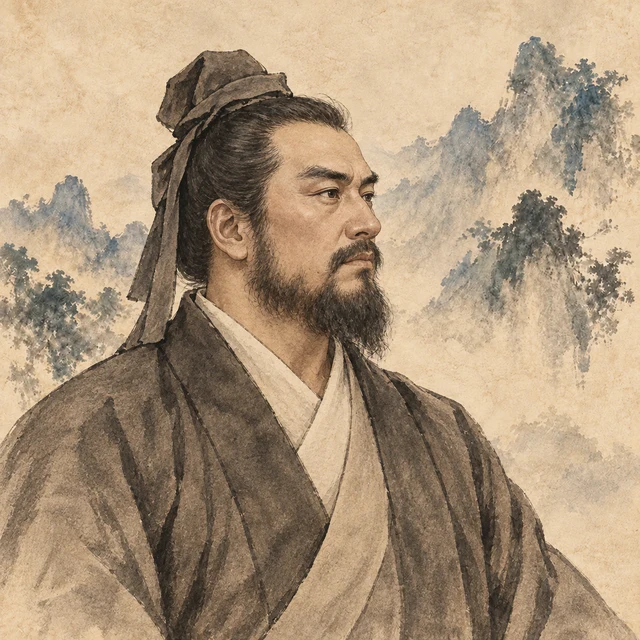
HISTORICAL PERSON
Qian Zhao
牵招
Active on Wei’s northern frontier, Qian Zhao handled Wuhuan, Xianbei, and regional affairs through a mix of military action and negotiation.
This entry is supported by historical references, but does not yet have a conversation profile.
PRIMARY BIOGRAPHY
Biography
Qian Zhao, styled Zijing, was from Guanjin in Anping. In his teens he went to study under his townsman Yue Yin, and when Yue Yin became senior clerk to the general of chariots and cavalry He Miao, Qian Zhao followed him to finish his training. When the capital fell into chaos and He Miao and Yue Yin were killed, Qian Zhao and the disciple Shi Lu braved the blades to encoffin Yue Yin’s body and escort it home; bandits fell on them on the road and the companions scattered, and when the bandits moved to split the coffin for its nails, Qian Zhao begged with tears for mercy — the bandits, moved by this righteousness, let him go, and his name was made. Yuan Shao enlisted him as a supervising attendant officer in joint command of the Wuhuan shock cavalry; when one of Yuan Shao’s own retainers broke the ordinances, Qian Zhao beheaded him first and reported after, and Yuan Shao, admiring the spirit of it, did not blame him. After Yuan Shao died he served Yuan Shang; when the Grand Ancestor besieged Ye, Yuan Shang sent Qian Zhao to Shangdang to bring up army grain, and before he returned Yuan Shang was broken. Yuan Shang’s brother-in-law Gao Gan then held Bing province, and Qian Zhao urged him — Bing province has Mount Heng on its left and the Yellow River on its right, fifty thousand armored men, and the strong Hu at its back — to take Yuan Shang in and watch events, but Gao Gan could not decide and secretly plotted to kill him, so Qian Zhao slipped away by side roads and went east to the Grand Ancestor, who made him an attendant officer.
When the Grand Ancestor prepared to chastise Yuan Tan and the Wuhuan of Liucheng meant to send cavalry to Yuan Tan’s aid, Qian Zhao — who had once commanded the Wuhuan — was sent to Liucheng. He arrived as the Qiewang was holding a great assembly of the chiefs, with the Liaodong envoy Han Zhong seated among them bearing a chanyu’s seal and ribbon from Gongsun Kang; Qian Zhao raised his voice in rebuke and disputed submission and treason until the Qiewang and all below him yielded and dismissed the cavalry. After Yuan Tan was destroyed at Nanpi, Qian Zhao was enrolled as military-planning clerk, joined the campaign against the Wuhuan, and at Liucheng was made colonel protector of the Wuhuan. Back at Ye, when Liaodong sent Yuan Shang’s head and it was hung in the horse market, Qian Zhao was overcome with grief and set out an offering beneath it — the Grand Ancestor, honoring this loyalty, recommended him as flourishing talent. He followed the Hanzhong campaign, stayed behind as central protector of the army, and afterwards as general who pacifies the caitiffs commanded the troops overseeing Qing and Xu, striking the Donglai bandits, beheading their leaders, and quieting the east.
At Emperor Wen’s accession he was made bearer of credentials and colonel protecting the Xianbei, camped at Changping. He taught the people battle formations, memorialized the remission of taxes for five hundred Wuhuan households so they could keep saddled horses, and sent scouts far abroad; whenever the tribes violated the frontier his counterstroke broke them, until officers and people grew daily bolder and the wild marches were safe. He sowed dissension among them, and when the Xianbei chiefs Budugen and Xieguini, at feud with Kebineng, brought thirty thousand households to submit at the frontier, he had them strike back at Kebineng and kill his brother Juluohou. He opened relations with more than a hundred thousand households of the Xianbei west of the river, repaired the old Shangguan fort north of the passes, and planted garrisons to overawe the region, until tribes great and small gave him their allegiance. The provincial seat Guangwu had brackish well water, and the people bore water seven li from the streams; Qian Zhao sighted the lay of the land, cut a canal across the plain along the hills, and led water into the city, to the people’s lasting benefit. In Taihe 2 the colonel protector of the Wuhuan Tian Yu went beyond the frontier and was besieged by Kebineng at old Mayi, and sent for Qian Zhao’s help; Qian Zhao marshaled his troops at once, and though the province barred him under standing orders, he held that a beleaguered general could not be abandoned to clerical procedure, memorialized on his own authority, and marched — speeding ahead a feathered dispatch proclaiming the situation, at whose arrival Tian Yu’s army leapt with fresh courage while the tribesmen scattered in fear, and by the time Qian Zhao reached old Pingcheng they had all fled. He memorialized in advance that Zhuge Liang’s repeated sorties might be coordinated with the crafty Kebineng; the courtiers dismissed it as too remote to matter, but when Zhuge Liang was at Mount Qi he did indeed send envoys to join Kebineng, and the emperor ordered Qian Zhao to act as he saw fit. He died in office and his son Qian Jia succeeded.
Life and role
- Primary role
- Colonel Who Protects the Wuhuan
- Active period
- Documented coverage: Late Han and Cao Wei (c. 190–231)
- Primary group
- Cao-Wei
Affiliations across a lifetime
- Jian’an era
Colonel protector of the Wuhuan
Faced down the Liaodong envoy at the Qiewang’s assembly, and was honored for offering sacrifice beneath Yuan Shang’s displayed head
- Huangchu–Taihe eras
Colonel protecting the Xianbei
Held Changping, divided Kebineng’s allies, cut Guangwu’s canal, and broke standing orders to relieve Tian Yu at Mayi
HISTORICAL RECORD
Historical sources
- Records of the Three Kingdoms · Wei, Book 26 · 满田牵郭传 ↗
Chen Shou’s base text contains the biographies of Man Chong, Tian Yu, Qian Zhao, and Guo Huai. The page also carries Pei Songzhi’s annotations, which should be identified separately.