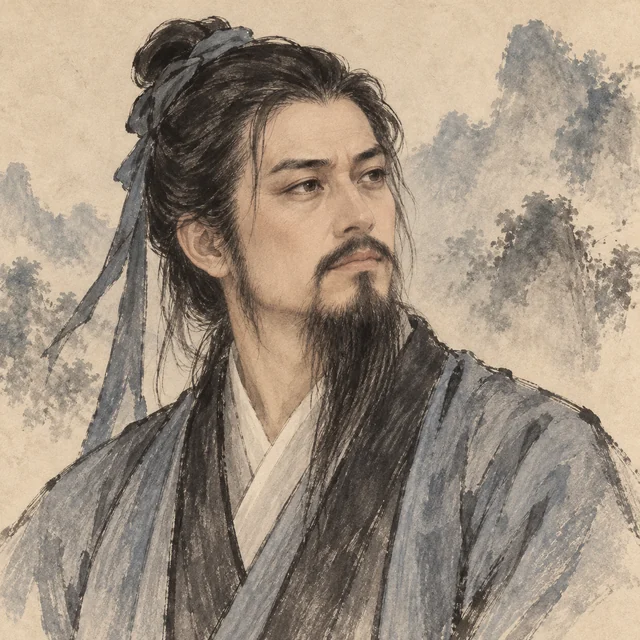
HISTORICAL PERSON
Ruan Ji
阮籍
The annotation calls Ruan Ji “Sijiong” and cites his refusal to discuss current affairs as an example of prudence; Wei Book 21 lists Ruan Ji by name.; The text identifies Ruan Ji as Ruan Yu’s son and records his office as Commandant of the Infantry.
This entry is supported by historical references, but does not yet have a conversation profile.
PRIMARY BIOGRAPHY
Biography
Ruan Ji (210–263), styled Sizong, was a native of Weishi in Chenliu, son of Ruan Yu, one of the Seven Masters of Jian’an. Orphaned at three and raised by his mother, he read widely, loved Laozi and Zhuangzi above all, drank freely, whistled and played the qin, and in his transports forgot all decorum, so that his age called him mad. Climbing Guangwu to view the ground where Chu and Han had fought, he sighed: "There were no heroes in that age — so a mere boy made his name!"
Ruan Ji had begun with ambitions to serve, but in the deadly politics of the Wei–Jin transition, when few famous men died in their beds, he withdrew from affairs and made drunkenness his habit. When Sima Zhao sought Ruan Ji’s daughter for his son Sima Yan, Ruan Ji stayed drunk for sixty days and the proposal was never spoken. Hearing the infantry commissariat had three hundred hu of excellent ale in store, he asked to be made Infantry Commandant — hence "Infantry Ruan." He could show the whites of his eyes or the black pupils: to Ji Xi he rolled the whites; when Ji Kang arrived bearing wine and qin, out came the dark pupils — and the guardians of propriety hated him like an enemy. When his mother died he was at weiqi and insisted on finishing the game; then he drank two dou of wine, gave one great wail, and spat up several sheng of blood. In mourning he wasted to a skeleton and nearly died of grief.
He would often ride out alone, following no road, and where the track ended he would weep bitterly and turn back — the famous "weeping at the road’s end." On Mount Sumen he sought out the recluse Sun Deng and discoursed on ultimate things and the arts of the spirit; Sun Deng gave no answer, so Ruan Ji whistled long and withdrew — and halfway down the ridge heard a sound like luan and phoenixes resounding through the valleys: Sun Deng whistling back. He came home and wrote the Biography of Master Great Man. His eighty-odd Yonghuai poems were prized by the age. He died in 263 at fifty-four.
Life and role
- Primary role
- Court or regional official
- Active period
- Documented coverage: late Wei and Western Jin
- Primary group
- Western Jin
Affiliations across a lifetime
- Wei–Jin transition
Cao Wei · Infantry Commandant
Asked for the infantry post for its three hundred hu of ale; sixty days drunk to dodge Sima Zhao’s marriage suit
- Zhengshi–Jingyuan era
Seven Worthies of the Bamboo Grove
Roamed the groves with Ji Kang and the rest; showed the whites of his eyes to ritualists; wrote the Yonghuai poems
HISTORICAL RECORD
Historical sources
- Records of the Three Kingdoms · Wei, Book 18 · Biographies of the Two Lis, Zang, Wen, Lü, Xu, Dian, Two Pangs, and Yan ↗
Chen Shou’s base text: biographies of Li Dian, Li Tong, Zang Ba (including Sun Guan), Wen Pin, Lü Qian (including Wang Xiang), Xu Chu, Dian Wei, Pang De, Pang Yu (including his mother Zhao E), and Yan Wen (including Zhang Gong). Pei Songzhi’s annotations are separately registered.
- Records of the Three Kingdoms · Wei, Book 21 · 王卫二刘傅传 ↗
Chen Shou’s base text contains the biographies of Wang Can (with attached biographies of Xu Gan, Chen Lin, Ruan Yu, Ying Yang, Liu Zhen, Handan Chun, Fan Qin, Lu Cui, Ding Yi (丁仪), Ding Yi (丁廙), Yang Xiu, Xun Wei, Ying Qu, Ruan Ji, Ji Kang, and Wu Zhi), Wei Ji, Liu Yi, Liu Shao (with attached biographies of Miao Xi, Zhong Changtong, Su Lin, Xiahou Hui, Sun Gai, and Du Zhi), and Fu Gu. The Wei Dan material is in a Pei Songzhi annotation on Liu Shao’s biography, citing the Wenzhang Xulu; identify it as an annotation, not Chen Shou’s base text.
- Records of the Three Kingdoms, with Pei Songzhi annotations · Pei Songzhi annotations to Wei, Book 21 · Wang, Wei, Liu, and Fu biographies ↗
Embedded citations to Wei Lue, Wei Shu, Biographies of the Literary Men, and other works; attributed accounts are kept separate from Chen Shou’s base text.
- Book of Jin · Biographies 49 · Ruan Ji, Ji Kang and others ↗
Biographies of Ruan Ji, Ji Kang, Xiang Xiu, Liu Ling and Ruan Xian, with the main accounts of the Bamboo Grove circle.