HISTORICAL PERSON
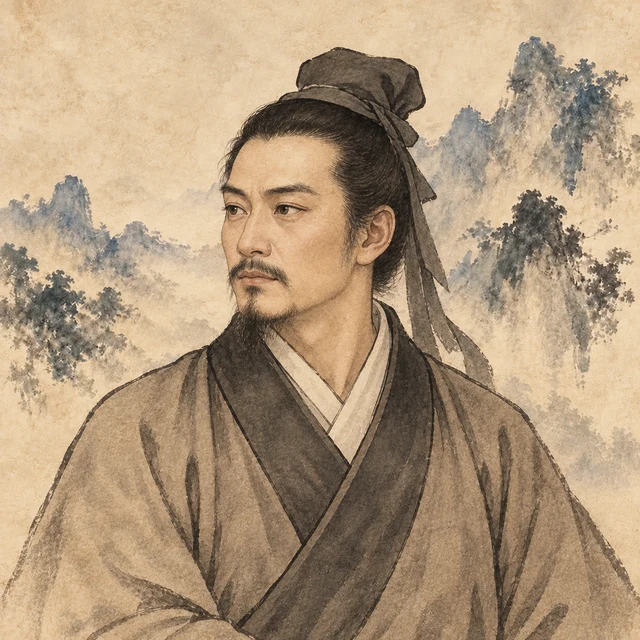
Sima Lang
司马朗
Sima Yi’s elder brother and a Han-Wei official known for humane local administration; he cared for sick soldiers during an expedition against Wu and died of illness.
This entry is supported by historical references, but does not yet have a conversation profile.
PRIMARY BIOGRAPHY
Biography
Sima Lang, styled Boda, came from Wen in Henei, the eldest brother of Sima Yi. At nine, when a guest used his father’s personal name, he said, “To slight another’s parents is to fail in reverence for one’s own”, and the guest apologised. At twelve he was examined in the classics for the office of gentleman-youth; the examiner, seeing how big and strong he was, suspected him of hiding his age and interrogated him. Sima Lang answered, “My family, within and without, has been tall for generations. Though I am young and slight, I have no ambition to climb by flattery; to trim my years for early success is not what my will would do.” The examiner marvelled at him.
When the armies rose east of the passes, the former Ji province inspector Li Shao, whose home at Yewang lay near the defensible hills, meant to move to Wen; Sima Lang argued that Yewang and Wen were as lips and teeth and that to leave was to invite the very disorder feared. Li Shao would not listen — and the hill folk indeed fell into disorder, moved inward, and turned to plunder. At twenty-two Sima Lang was engaged on the minister of works’ staff, made magistrate of Chenggao, left office, and then served as chief of Tangyang. His rule was generous and mild: he never used the whip or staff, yet the people broke no laws. Promoted to inspector of Yan province, his governance and teaching spread wide and the people praised him. Even in the field he wore coarse cloth and ate poor food, leading by frugality. He was devoted to the judgment of character and the classics; when his townsmen Li Di and others were much cried up, Sima Lang openly marked them down, and when they later fell, the age respected his eye.
In 217 Sima Lang campaigned against Wu with Xiahou Dun and Zang Ba. At Juchao a great pestilence struck the army; he went round the tents in person with medicines, caught the sickness, and died, aged forty-seven. His last orders were for plain cloth and a common cap, buried in the dress of the season — and the people of his province remembered him.
Life and role
- Primary role
- Late Han and Wei official
- Active period
- Documented coverage: late Han through Cao Wei
- Primary group
- Cao-Wei
Affiliations across a lifetime
- early years
The twelve-year-old gentleman
Refused to trim his age for early office; warned Li Shao against leaving Yewang
- 196–217
Inspector of Yan province
Ruled without the whip yet no laws were broken; his low estimate of Li Di proved right
- 217
The Juchao pestilence
Carried medicine through the plague-struck camp, caught the sickness and died at forty-seven
HISTORICAL RECORD
Historical sources
- Records of the Three Kingdoms · Wei, Book 15 · 刘司马梁张温贾传 ↗
Chen Shou’s base text: biographies of Liu Fu, Sima Lang, Liang Xi, Zhang Ji, Wen Hui, and Jia Kui, including attached notices about sons and associated figures. Pei Songzhi’s annotations are registered separately.
- Records of the Three Kingdoms, with Pei Songzhi annotations · Pei Songzhi annotations to Wei, Book 15 ↗
Annotations to Wei Book 15, including Sima Biao’s preface, Wei Lue, Sanfu Juelu Zhu, Jin Yang Qiu, and Jin Zhu Gong Zan. Biographical details from these notes are kept distinct from Chen Shou’s base text.