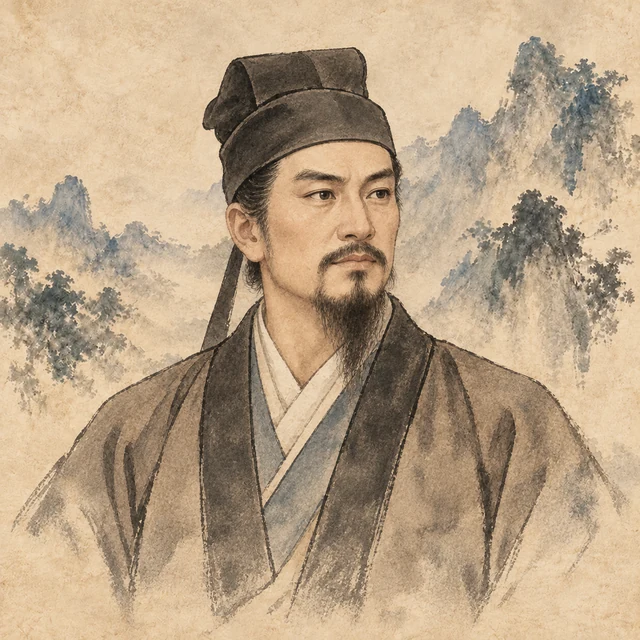
HISTORICAL PERSON
Su Ze
苏则
A Wei official who resettled refugees, negotiated with Qiang and Hu communities, and helped pacify rebellions in the western commanderies.
This entry is supported by historical references, but does not yet have a conversation profile.
PRIMARY BIOGRAPHY
Biography
Su Ze, styled Wenshi, came from Wugong in Fufeng. Famed young for learning and conduct, he was recommended filial-and-incorrupt and flourishing talent and summoned by the ducal offices, declining them all. His first office was administrator of Jiuquan, transferred to Anding and Wudu, winning a formidable name in each. When the Grand Progenitor campaigned against Zhang Lu he passed through Su Ze’s commandery, took a liking to him, and made him the army’s guide. When Zhang Lu was broken, Su Ze gentled the Di of Xiabian and opened the Hexi road, and was transferred to administrator of Jincheng. In the ruin after the troubles, clerks and people were scattered, starving and few; Su Ze tended them with the greatest care — won over the Qiang and Hu beyond the borders, took their cattle and sheep to feed the poor and old, and shared out grain to eat with the people — so that within a month the refugees returned, several thousand households. He then published clear prohibitions: transgressors were executed, the obedient rewarded; he taught the people ploughing with his own hands, and that year the harvest was so rich that allegiance grew daily. When Li Yue rebelled in Longxi, Su Ze led the Qiang and Hu to besiege him, and Li Yue at once submitted. On the Grand Progenitor’s death, when Qu Yan of Xiping rebelled styling himself colonel protecting the Qiang, Su Ze marshalled troops against him and Qu Yan, afraid, begged to surrender. Emperor Wen rewarded the service by making Su Ze colonel protecting the Qiang and Marquis within the Passes.
Later Qu Yan again joined the neighbouring commanderies in revolt: Zhang Jin of Zhangye seized his administrator Du Tong, Huang Hua of Jiuquan refused his administrator Xin Ji, both styling themselves administrators in answer, while three Hu tribes of Wuwei raided and cut the roads — the Wuwei administrator Guanqiu Xing begged Su Ze for help. The magnates of Yong and Liang were all driving Qiang and Hu to follow Zhang Jin; the commandery men judged him irresistible, and the generals Hao Zhao and Wei Ping, stationed at Jincheng, held an edict forbidding them to cross west. Su Ze called the great clerks, the generals and the Qiang and Hu chiefs and counselled: “The rebels are strong but newly joined; many were coerced and their hearts are not one. Strike at the seam and good will part from evil — what parts and returns to me swells me and shrinks them. Though the edict says otherwise, to bend it where expediency serves — that is a commander’s right.” Hao Zhao and the rest agreed; they marched to relieve Wuwei, received the surrender of the three Hu tribes, and struck Zhang Jin at Zhangye. Qu Yan, hearing, came with three thousand horse and foot to “aid” Su Ze, meaning treachery; Su Ze lured him to a meeting and cut him down, showing the head to the army, and his followers scattered. Su Ze and the armies then besieged Zhangye, broke it, beheaded Zhang Jin and his party, and received the rest in surrender. Huang Hua, frightened, released his captives and begged to submit — and the lands west of the river were at peace. Back at Jincheng, Su Ze was advanced to Marquis of a Metropolitan Precinct with three hundred households.
Called in as Palace Attendant, Su Ze was once challenged by Emperor Wen: “When you broke Jiuquan and Zhangye, the Western Regions sent envoys and Dunhuang offered a pearl an inch across — could more be sought and bought?” Su Ze answered, “If Your Majesty’s influence harmonises the central states and your virtue flows to the desert, such things will come unsought; what is sought and bought is not precious.” The emperor was silent. Later, hunting with the emperor, the fences broke and the deer escaped; the emperor, furious, sat on his folding chair with drawn sword, arrested all the beaters’ officers and meant to kill them. Su Ze knocked his head on the ground: “I have heard that the sage kings of old did not harm men for beasts’ sake. Your Majesty is exalting the influence of Yao — yet for a hunting game you would kill many officers. Your foolish servant holds it wrong, and begs it on his life.” The emperor said, “You are a straight servant”, and pardoned them all — but feared Su Ze from then on, demoting him to chancellor of Hedong, then to Dongping; on the road there in 223 he died of illness, posthumously the Unbending Marquis.
Life and role
- Primary role
- Cao Wei regional official
- Active period
- Documented coverage: late Han through Cao Wei
- Primary group
- Cao-Wei
Affiliations across a lifetime
- 215–220
Administrator of Jincheng
Tended the refugees, won the tribes, shared his grain — thousands of households returned and the year reaped rich
- 220–221
Colonel protecting the Qiang
Bent the edict to relieve Wuwei, lured and beheaded Qu Yan, took Zhangye — Hexi pacified
- 221–223
The straight servant
Told the emperor bought pearls are worthless and begged on his life for the hunt officers; demoted, died the Unbending Marquis
HISTORICAL RECORD
Historical sources
- Records of the Three Kingdoms · Wei, Book 16 · 任苏杜郑仓传 ↗
Chen Shou’s base text: biographies of Ren Jun, Su Ze, Du Ji (including Du Shu and notices about Le Xiang), Zheng Hun, and Cang Ci. Pei Songzhi’s annotations are registered separately.