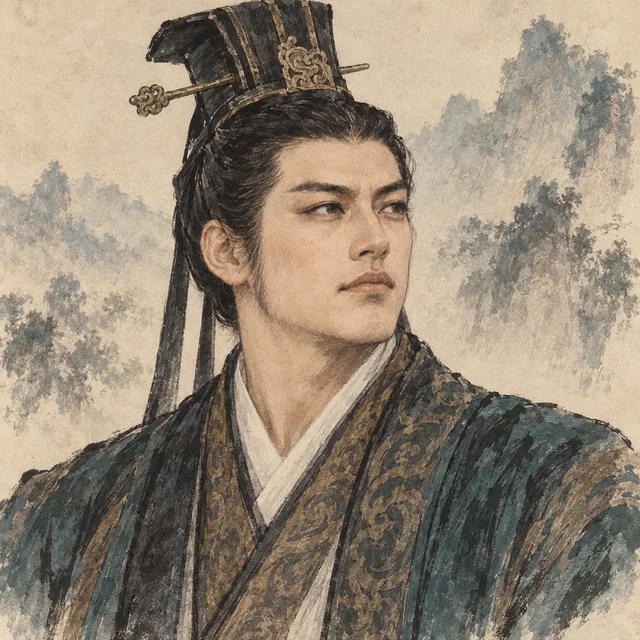
HISTORICAL PERSON
Sun Hao
孙皓
The grandson of Sun Quan and son of Sun He, Sun Hao became emperor after Sun Xiu; amid internal and frontier crises, he surrendered when Jin invaded in 280, ending Wu.
This entry is supported by historical references, but does not yet have a conversation profile.
PRIMARY BIOGRAPHY
Biography
Sun Hao (242–284), courtesy name Yuanzong — also named Pengzu, courtesy name Haozong — was a grandson of Sun Quan, the Grand Emperor of Wu, by the deposed heir apparent Sun He. Sun He had been removed in the Two Palaces succession struggle and was later forced to suicide under the regent Sun Jun. When Sun Xiu took the throne he enfeoffed Sun Hao as Marquis of Wucheng. On Sun Xiu’s death in 264, the chancellor Puyang Xing and the general Zhang Bu passed over Sun Xiu’s sons and enthroned the twenty-three-year-old Sun Hao.
His reign began well: gracious edicts for the soldiers and people, granaries opened to the poor, palace women released to marry the wifeless, the beasts of the imperial parks set free — for a moment the whole court praised an enlightened ruler. Success undid him. He turned harsh, drunken and suspicious, and his law became cruel. When Puyang Xing and Zhang Bu privately regretted their choice, someone informed on them; both were executed that same year.
Sun Hao’s rule became a byword for savagery. At his banquets every minister was forced into drunkenness while ten specially exempted yellow-gate officers stood by all day to record faults; afterwards every misplaced glance and misspoken word was reported, the grave punished on the spot, the lesser marked for later. The histories record flaying of faces and gouging of eyes among his penalties. In 265 he moved the capital upriver to Wuchang on the advice of the Xiling commander Bu Chan; the people of Yang province, forced to haul supplies upstream, sang: "Better to drink the water of Jianye than eat the fish of Wuchang; better to die at home in Jianye than live in Wuchang" — and within a year he moved back. He then built the vast Xianming Palace at costs reckoned in the hundreds of millions.
Honest ministers fared badly. The historian Wei Yao, ordered to write Sun He’s life as an imperial annal, insisted a man never enthroned could only have a biography; after repeated defiance he was imprisoned and executed in 273. The attendant Wang Fan, drunk and disorderly at a banquet, was beheaded below the hall on Sun Hao’s order. The chancellor Lu Kai and the marshal Lu Kang remonstrated again and again; only the power of the Lu clan shielded them. All the while Jin built ships and piled grain upriver, and warning after warning came in from the western front — Sun Hao ignored them all.
In the spring of 280 six Jin armies moved against Wu, and Wang Jun’s towered fleet came down from Yi province. The Wu navy collapsed at Xiling, then at Lexiang and Jiangling; the chancellor Zhang Ti led Wu’s last field army out and was destroyed by Wang Hun at Banqiao. Sun Hao, on the advice of Xue Ying and Hu Chong, sent separate letters of surrender to Wang Jun, Wang Hun and Sima Zhou. In the third month he came to Wang Jun’s headquarters in a plain carriage with white horses, arms bared and bound, his coffin borne behind him, and surrendered. Wu, fifty-nine years after its founding, ceased to exist, bringing the long division that had begun in the late Han to a close.
Sun Hao’s household was moved west to Luoyang, where Emperor Wu of Jin enfeoffed him as the Marquis who Returns to Allegiance, with lands and revenues. He died at Luoyang in 284, aged forty-two.
Life and role
- Primary role
- Last emperor of Eastern Wu
- Active period
- Documented coverage: Late Eastern Wu (242–284)
- Primary group
- Jiangdong–Sun Wu
Affiliations across a lifetime
- Before 264
Wu · Marquis of Wucheng
Son of the deposed heir Sun He, enfeoffed under Sun Xiu.
- 264–266
Emperor of Wu · brief good beginning
Began with popular edicts, then killed his enthroners Puyang Xing and Zhang Bu, moved the capital to Wuchang, and returned to Jianye within a year.
- 266–279
Emperor of Wu · years of cruelty
Forced-drinking banquets with informers, executions of Wei Yao and Wang Fan, the Xianming Palace, and deafness to the western alarms.
- 280–284
Surrender and the fief of Returned Allegiance
Surrendered to Wang Jun at Stone City in 280; lived out his life in Luoyang as Marquis who Returns to Allegiance.
HISTORICAL RECORD
Historical sources
- Records of the Three Kingdoms · Wu, Book 3 · 三嗣主传 ↗
The annals of Sun Liang, Sun Xiu, and Sun Hao.
- Book of Jin · Annals 3 · Emperor Wu ↗
Use the named biography or chronicle entry in this volume; compare it with the Three Kingdoms record where sources differ.