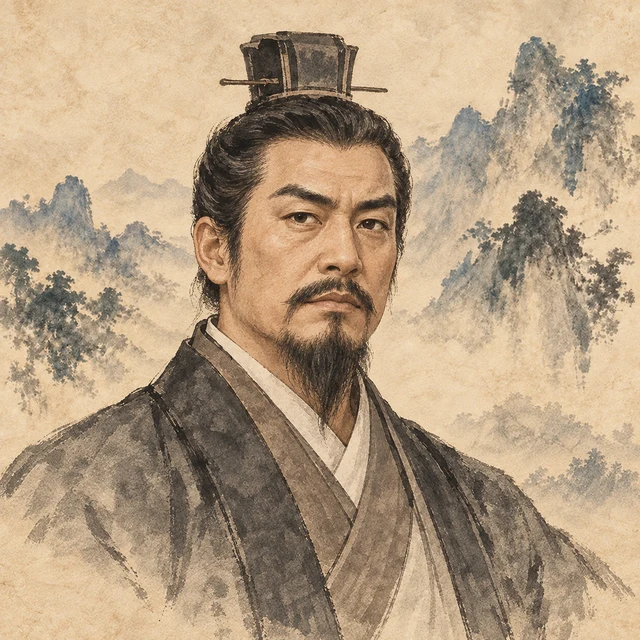
HISTORICAL PERSON
Sun Li
孙礼
A Rongcheng man from Zhuo; he governed Bing against the Xianbei and rose to Minister of Works, noted for stern uprightness.
This entry is supported by historical references, but does not yet have a conversation profile.
PRIMARY BIOGRAPHY
Biography
Sun Li, styled Deda, was from Rongcheng in Zhuo. When the Grand Ancestor pacified You province he summoned him as military-planning clerk of the ministry of works. In the early disorders Sun Li had been parted from his mother, and his townsman Ma Tai found her; Sun Li gave Ma Tai his entire family fortune in gratitude. When Ma Tai later fell under a capital statute, Sun Li secretly guided him to break prison and give himself up, then went straight to Wen Hui, the senior clerk of the bureau for investigating crime, saying, “Your servant cannot abide the duty of flight” — Wen Hui commended them and reported all to the Grand Ancestor, and each had his sentence reduced by one degree. Sun Li was then made assistant administrator of Hejian and rose to commandant of Xingyang. Several hundred bandits in the hills of Lu held the fastnesses and plagued the people, so he was transferred there as chancellor; on taking office he gave out his own salary grain, called up officers and people, set bounties for heads, took in surrendering men, and sent them back as agents — and the hills were pacified in short order. He governed Shanyang, Pingyuan, Pingchang, and Langye in turn; when the grand marshal Cao Xiu campaigned against Wu at Jiashi, Sun Li remonstrated against driving deep, was not heeded, and the army was defeated. He moved to be administrator of Yangping and came in as a secretariat officer.
Emperor Ming was then raising palaces while the seasons were unseasonable and grain scarce; Sun Li stubbornly contested the works until an edict said, “We respectfully accept this forthright counsel — dismiss the laborers at once.” But the supervisor of works Li Hui memorialized to keep them one more month to finish what was begun, whereupon Sun Li went straight to the works and dismissed the laborers in the edict’s name without memorializing again — the emperor admired his intent and did not blame him. When the emperor hunted at Dashi Mountain and a tiger charged the carriage, Sun Li threw down his whip, dismounted, and moved to strike the tiger with his sword; an edict commended his courage. When Cao Shuang came to power as regent, Sun Li was transferred to be inspector of Yang province as general who subdues the waves, enfeoffed marquis within the passes. The Wu general Quan Cong came against him with several tens of thousands, and as the provincial troops were then on furlough, those present were few; Sun Li led his guard in person and fought at the Shao pond from dawn to dusk, more than half his officers and men falling, himself treading naked blades, his horse wounded again and again, the drumstick in his own hand, heedless of his body — and the enemy host withdrew. An edict comforted him with seven hundred bolts of silk; Sun Li raised a sacrifice to the dead and wailed over them from the heart, giving all the silk to the fallen men’s families, keeping not a foot for himself.
Summoned as privy treasurer, he went out as inspector of Jing province, then rose to shepherd of Ji province. Qinghe and Pingyuan had contested their boundary for eight years and two inspectors had failed to settle it; Sun Li judged by the maps, but Cao Shuang believed Qinghe’s plea and had Sun Li impeached for disaffection, condemned to five years. After a year at home, with many speaking for him, he was made commandant of the capital gates. When the Xiongnu king Liu Jing’s tribes grew strong and the Xianbei repeatedly raided the border, he was made inspector of Bing province as general who spreads martiality, bearing credentials as colonel of the gentility of the household protecting the Xiongnu. Calling on the grand tutor Sima Yi, his face showed anger though he said nothing; questioned, Sun Li spoke his mind — that the altars of state stood in peril and the realm was restless — and counseled the grand tutor to endure what could not be endured. He later served as colonel director of the retainers; in all he governed seven commanderies and five provinces, everywhere with awe and good faith. He rose to minister of works as marquis of Dali precinct with a hundred households, and died in Jiaping 2, posthumously named Jing.
Life and role
- Primary role
- Cao Wei official
- Active period
- Documented coverage: late Han through Cao Wei
- Primary group
- Cao-Wei
Affiliations across a lifetime
- Cao Shuang’s regency
Inspector of Yang province at the Shao pond
Beat back Quan Cong’s host with drumstick in hand and a wounded horse, then gave all seven hundred bolts of reward silk to the dead men’s families
- Jiaping 2 (250)
Minister of works, died
Condemned to five years for defying Cao Shuang over the Qinghe–Pingyuan boundary; governed seven commanderies and five provinces with undiminished authority
HISTORICAL RECORD
Historical sources
- Records of the Three Kingdoms · Wei, Book 24 · 韩崔高孙王传 ↗
Chen Shou’s base text contains the biographies of Han Ji, Cui Lin, Gao Rou, Sun Li, and Wang Guan. The concluding evaluation is separate from the biographies.