HISTORICAL PERSON
Tian Yu
田豫
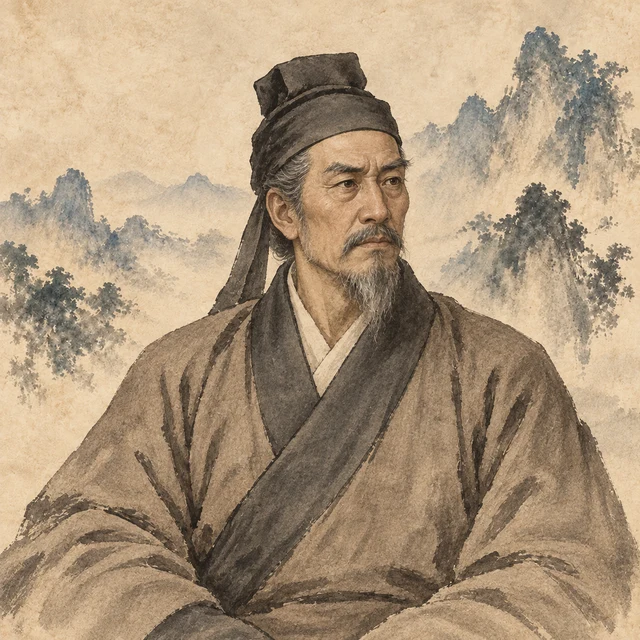
A long-serving northern frontier commander, Tian Yu fought against Wuhuan and Xianbei groups and was noted for understanding local conditions and managing frontier communities.
This entry is supported by historical references, but does not yet have a conversation profile.
PRIMARY BIOGRAPHY
Biography
Tian Yu, styled Guorang, was from Yongnu in Yuyang. When Liu Bei fled to Gongsun Zan, the young Tian Yu entrusted himself to Liu Bei, who thought him remarkable; when Liu Bei became inspector of Yu province, Tian Yu begged leave for his aged mother, and Liu Bei parted from him in tears, saying, “What grief that I cannot achieve great things together with you.” Gongsun Zan made him prefect of Dongzhou, and when the turncoat officer Wang Men came against it with ten thousand of Yuan Shao’s men, Tian Yu mounted the wall and shamed him into withdrawing: “You were treated generously by Gongsun and left — that may have been excusable; but to return as a brigand marks you a rebel. I hold this city on Gongsun’s trust, as one guards a borrowed vessel; if you press the assault, you will have to kill me.” After Gongsun Zan’s fall, Xianyu Fu was raised by the people as acting administrator and made Tian Yu his senior clerk; with heroes rising everywhere and Xianyu Fu unsure whom to follow, Tian Yu told him, “The one who will finally settle the realm must be the Cao house — pledge early, or regret it late.” He was right. The Grand Ancestor summoned Tian Yu as military-planning clerk, then prefect of Yinyin and Langling, then administrator of Yiyang, governing well in each post.
When the Marquis of Yanling Cao Zhang campaigned against Dai, Tian Yu served as his chancellor; at the crossing north of the Yi, barbarian cavalry ambushed the army and threw it into confusion, whereupon Tian Yu wheeled the wagons by the terrain into a circle, crossbows drawn within and decoy troops sealing the gaps — the Hu could not close in, scattered, and were crushed in pursuit, and the pacification of Dai was all his design. As administrator of Nanyang he faced the aftermath of Hou Yin’s revolt, several thousand bandits in the hills; the previous administrator had arrested five hundred of their fellows and memorialized that all should die, but Tian Yu interviewed the prisoners, opened them a road to renewal, struck off their fetters, and freed them — and at once the bandit bands told one another and dissolved in a single morning, leaving the commandery quiet. Early in Emperor Wen’s reign the northern Di grew strong and raided the frontier, so Tian Yu was sent with credentials as colonel protector of the Wuhuan. Judging that a united nomad world was no gain for the central realm, he first sowed division so they became enemies and fought one another. When Suli broke the league to sell a thousand horses to the government and Kebineng attacked him, Tian Yu led picked troops deep into the barbarian court; the Hu cut his line of retreat, so he piled and burned ox and horse dung and slipped away by another road — the Hu saw the unbroken smoke and thought him still there — and when they finally caught up and ringed Macheng ten deep, he sent his major out the south gate with banners and drums to draw their eyes, then burst from the north gate with his elite, striking from both ends; the barbarians broke and were pursued for twenty li, the dead covering the ground. Again, when the Wuhuan king Gujin grew insolent, Tian Yu rode into his tribe on an inspection with a bare hundred horsemen, beheaded Gujin before his own people, proclaimed his crimes, and installed Gujin’s brother in his place — from that day the Hu lost their nerve and his awesomeness shook the desert.
In nine years as colonel he always broke up the strong and scattered the crafty among the tribes, until the partisans of the inspector of You province, Wang Xiong, slandered him as a frontier provocateur, and he was transferred to be administrator of Runan as general who exterminates the barbarians. In late Taihe, when Gongsun Yuan rebelled in Liaodong, the emperor sent Tian Yu with credentials to command Qing province’s armies against him; Wu had sent envoys by sea to join Gongsun Yuan, and when the court, fearing their numbers, ordered the army halted, Tian Yu calculated that the enemy ships would return late in the year into violent winds with nowhere to shelter but Chengshan, so he traced the coast, mapped the terrain, posted troops at the narrows, and himself entered Chengshan and climbed Emperor Wu of Han’s old lookout — and indeed the ships met the gale, struck the mountains, sank, and their crews were all taken. The inspector of Qing province, Cheng Xi, secretly memorialized that Tian Yu, for all his merit, kept slack discipline and had distributed the captured pearls and gold among his men rather than rendering them to the state, and so his service went unrecorded. When Sun Quan later came against Xincheng with a claimed hundred thousand, Tian Yu judged they sought to bait the main army to the city: let them exhaust themselves against the walls and strike only when they flag — the emperor agreed, and the enemy withdrew. Early in Zhengshi he was transferred as bearer of credentials, colonel protecting the Xiongnu, general who spreads awe, and inspector of Bing province; the outer tribes, hearing his name, came in droves to offer tribute, the province was quiet, and the people cherished him. Summoned to court as commandant of the guards, he repeatedly begged to retire, and when pressed he wrote back: “To hold office past seventy is like traveling on after the bell has rung and the water-clock run dry — it makes a criminal of a man.” He was made grand counsellor of the palace with a minister’s stipend, and died at eighty-two.
Life and role
- Primary role
- General Who Guards the North
- Active period
- Documented coverage: Late Han and Cao Wei (c. 190–252)
- Primary group
- Cao-Wei
Affiliations across a lifetime
- late Jian’an
Chancellor to Cao Zhang at the Dai campaign
Wheeled the wagons into a circle against the ambush north of the Yi and broke the Hu — the pacification of Dai was his design
- Huangchu–Taihe eras
Colonel protector of the Wuhuan
Divided the Xianbei, broke out of Macheng, beheaded Gujin, and later trapped the Wu fleet at Chengshan
HISTORICAL RECORD
Historical sources
- Records of the Three Kingdoms · Wei, Book 19 · Biographies of the Prince of Rencheng, Prince Chen Si, and Prince Xiao Huai ↗
Chen Shou’s base text: biographies of Cao Zhang, Cao Zhi, and Cao Xiong. Pei Songzhi’s annotations, including variant accounts and cited works, are registered separately.
- Records of the Three Kingdoms · Wei, Book 26 · 满田牵郭传 ↗
Chen Shou’s base text contains the biographies of Man Chong, Tian Yu, Qian Zhao, and Guo Huai. The page also carries Pei Songzhi’s annotations, which should be identified separately.