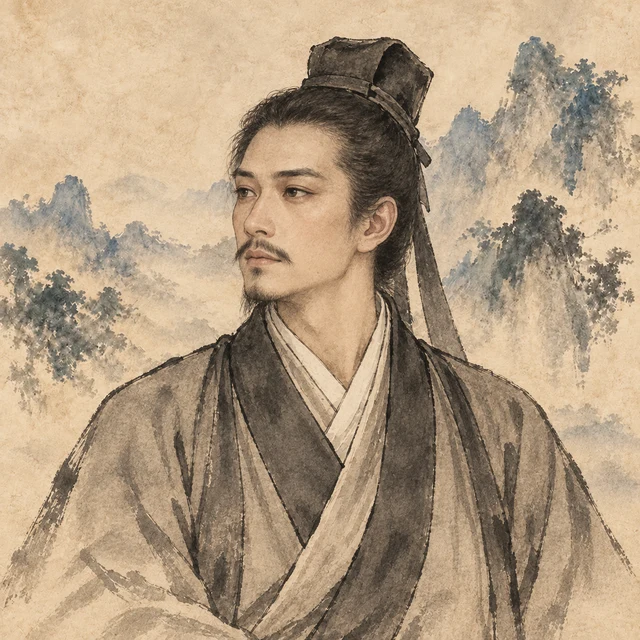
HISTORICAL PERSON
Wang Can
王粲
The biography records Wang Can’s move to Jingzhou, his counsel to Liu Cong to submit to Cao Cao, his service in Cao Cao’s government, work on institutions, and death while campaigning against Wu.
This entry is supported by historical references, but does not yet have a conversation profile.
PRIMARY BIOGRAPHY
Biography
Wang Can, styled Zhongxuan, was from Gaoping in Shanyang. His great-grandfather Wang Gong and grandfather Wang Chang had both been three excellencies of Han. When Emperor Xian moved west, Wang Can moved to Chang’an, where the gentleman of the left household Cai Yong saw him and thought him a marvel. Cai Yong’s learning was then preeminent and he was honored at court, his lane always filled with chariots and his hall with guests — yet hearing Wang Can was at the gate, he rushed out with his sandals on backwards to greet him. When Wang Can entered, so young and slight and small of stature, the whole company was astonished, but Cai Yong said, “This is the grandson of Lord Wang, a talent beyond the common — I am not his equal. All the books and writings in my house shall be his.” At seventeen he was summoned by the minister over the masses and appointed gentleman of the Yellow Gates by edict, but with the western capital in turmoil he declined both and went to Jingzhou to rely on Liu Biao. Liu Biao, for Wang Can’s plain looks, frail body, and free manner, did not think much of him.
When Liu Biao died, Wang Can persuaded his son Liu Cong to yield to the Grand Ancestor, who enlisted him as a chancellery clerk and enfeoffed him marquis within the passes. At a feast the Grand Ancestor set by the banks of the Han, Wang Can raised his cup in tribute: “Yuan Shao rose north of the river with a great host, meaning to swallow the realm, yet loved worthies without being able to use them, and so the extraordinary men left him. Liu Biao sat at ease in Jingchu watching the times turn, fancying himself another Earl of the West; the gentlemen who fled the disorders to Jingzhou were the finest talents of the realm, yet he knew not how to employ them, and so his state stood in peril without support. Your lordship, on the day you settled Ji province, stepped from your carriage to marshal the troops and gather its heroes into your service, sweeping the realm at will; and having pacified the Yangzi and the Han, you drew its worthies and talents into the ranks of office, so that all within the seas turn their hearts to you and long for order at the sight of your banners — civil and martial employed together, every hero spending his strength. This is the deed of the three kings.” He rose to libationer of the army’s councils, and at the founding of the Wei kingdom was made palace attendant.
Wang Can was broadly learned and remembered much, never failing a question. The old rites had fallen into ruin, and the institutions that were newly made he always directed. Once, walking with a companion, he read a roadside stele; asked whether he could recite it from memory, he said he could, and turned his back and recited it without missing a single character. Watching men play go, the board was upset, and he reset it for them; the players, unbelieving, covered the board with a cloth and had him do it again on another board, and comparing the two he had not misplaced a single stone. Such was his memory. He was by nature skilled at calculation and wrote a work on arithmetic that exhausted its principles. In composition he could lift the brush and finish without revision, so that the age thought his pieces must have been composed beforehand — yet even with the deepest concentration none could better them. His poems, fu, discourses, and deliberations numbered near sixty pieces. In Jian’an 21 he followed the campaign against Wu; in the spring of year 22 he fell ill on the road and died, aged forty-one. From the time Emperor Wen was general of the gentlemen of the household, he and the Marquis of Pingyuan Cao Zhi both loved letters, and Wang Can was on friendly terms with Xu Gan of Beihai, Chen Lin of Guangling, Ruan Yu of Chenliu, Ying Yang of Runan, and Liu Zhen of Dongping.
Life and role
- Primary role
- Palace Attendant and writer
- Active period
- Late Han and Cao Wei (190s–240s)
- Primary group
- Cao-Wei
Affiliations across a lifetime
- Jian’an 13 (208)
Persuaded Liu Cong to yield
On Liu Biao’s death he persuaded Liu Cong to yield the province to Cao Cao, and was made chancellery clerk and marquis within the passes
- founding of Wei
Palace attendant, master of institutions
Directed the remaking of court institutions; wrote near sixty poems, fu, and discourses — first among the Seven Masters of Jian’an
HISTORICAL RECORD
Historical sources
- Records of the Three Kingdoms · Wei, Book 21 · 王卫二刘傅传 ↗
Chen Shou’s base text contains the biographies of Wang Can (with attached biographies of Xu Gan, Chen Lin, Ruan Yu, Ying Yang, Liu Zhen, Handan Chun, Fan Qin, Lu Cui, Ding Yi (丁仪), Ding Yi (丁廙), Yang Xiu, Xun Wei, Ying Qu, Ruan Ji, Ji Kang, and Wu Zhi), Wei Ji, Liu Yi, Liu Shao (with attached biographies of Miao Xi, Zhong Changtong, Su Lin, Xiahou Hui, Sun Gai, and Du Zhi), and Fu Gu. The Wei Dan material is in a Pei Songzhi annotation on Liu Shao’s biography, citing the Wenzhang Xulu; identify it as an annotation, not Chen Shou’s base text.
- Records of the Three Kingdoms, with Pei Songzhi annotations · Pei Songzhi annotations to Wei, Book 21 · Wang, Wei, Liu, and Fu biographies ↗
Embedded citations to Wei Lue, Wei Shu, Biographies of the Literary Men, and other works; attributed accounts are kept separate from Chen Shou’s base text.