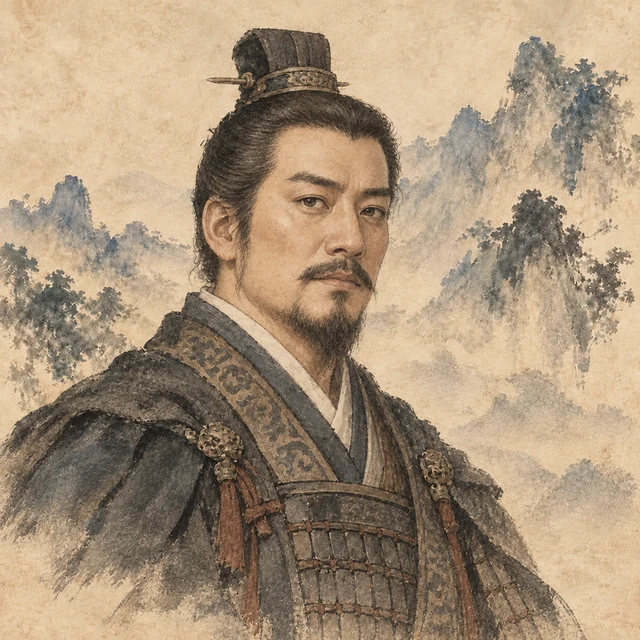
HISTORICAL PERSON
Wang Chang Wei
王昶
A Jinyang man from Taiyuan; he long held Jing against Wu and rose to General of Agile Cavalry, authoring essays on government and war.
This entry is supported by historical references, but does not yet have a conversation profile.
PRIMARY BIOGRAPHY
Biography
Wang Chang, styled Wenshu, was from Jinyang in Taiyuan. In youth he and his fellow townsman Wang Ling were both renowned, and Wang Ling being the elder, Wang Chang treated him as an elder brother. While Emperor Wen was heir apparent, Wang Chang served as his literary scholar and then palace cadet; at the accession he moved to cavalier attendant and became director of agriculture at Luoyang, where the capital district had gone to woodland — he felled and opened the waste, diligently urging the people on, and the newly cleared fields were exceptional. Promoted to inspector of Yan province, he was made general who displays ardor and marquis within the passes under Emperor Ming. Though serving away from court his heart was with the dynasty: judging that Wei had inherited the evils of Qin and Han, its laws harsh and minute, and that without a great revision of state canons on the model of the ancient kings the restoration of good government was impossible, he wrote the Treatise on Government in more than twenty essays adapting ancient institutions to present needs, and a Book of War in more than ten essays on the uses of the orthodox and unorthodox, presented in the Qinglong era.
In naming his nephews and sons he followed modesty and substance, and wrote to admonish them: “I would have you establish yourselves in conduct, follow the teaching of the Ru, and tread the words of the Daoists” — such was his teaching of humility and contentment. In the Zhengshi era he transferred to Xu province as marquis of Wuguan precinct, then rose to general who campaigns in the south with credentials, commanding the armies of Jing and Yu. Holding that a state has constant hosts but no constant victories, and ground has constant defensibility but no constant posture, he noted that the garrison at Wan lay three hundred li from Xiangyang with the boats at Xuanchi — too scattered for mutual relief — and memorialized the move of headquarters to Xinye, trained marines on the two waters, and opened farms until the granaries overflowed.
At the start of Jiaping, after the grand tutor Sima Yi had destroyed Cao Shuang and broadly consulted the great ministers, Wang Chang set out five planks of policy: honor the Way and sincere learning and suppress empty show; employ examinations; keep officials long in their posts; tie emoluments to real duties; and cut extravagance. An edict praised him and charged him with drafting the examination statutes for the bureaucracy. In Jiaping 2 he memorialized that Sun Quan had banished his good ministers and his heir and cadets were at strife — the moment to strike Wu — and so sent the administrator of Xincheng Zhou Tai to raid Wu, Zigui, and Fangling, the inspector of Jing province Wang Ji against Yiling, while he himself went against Jiangling. Drawing bamboo cables across both banks for bridges, he crossed and struck; the enemy fled to the south bank and bored seven tunnels to attack together, whereupon Wang Chang had the massed crossbows loose as one, and the enemy general Shi Ji fled by night into Jiangling city, losing several hundred heads to the pursuit. To draw him onto level ground, Wang Chang sent five corps back along the highway for the enemy to see and rejoice at, galloped the captured armor and heads around the walls to enrage them, and set ambushes; Shi Ji indeed pursued, was beaten in the battle, and fled, losing his officers Zhongli Mao and Xu Min with all their flags, drums, treasures, and gear. Wang Chang was promoted to general-in-chief who campaigns in the south with ceremonial equality and advanced to marquis of Jingling. When Guanqiu Jian and Wen Qin revolted he led troops against them with merit, enfeoffing two sons and rising to general of the agile cavalry; when Zhuge Dan revolted he held Jiashi to threaten Jiangling and pinned Shi Ji and Quan Xi in the west. After Zhuge Dan’s destruction his fief rose by a thousand to forty-seven hundred households and he became minister of works, keeping his credentials and command. He died in Ganlu 4, posthumously named Mu.
Life and role
- Primary role
- Cao Wei official
- Active period
- Documented coverage: late Han through Cao Wei
- Primary group
- Cao-Wei
Affiliations across a lifetime
- Qinglong era
Inspector of Yan province, author
Presented the Treatise on Government and the Book of War; named his sons for modesty and wrote them his famous admonition
- Jiaping 2 (250)
Victory at Jiangling
Crossed on bamboo-cable bridges, loosed the massed crossbows, ambushed Shi Ji, and rose to general-in-chief
HISTORICAL RECORD
Historical sources
- Records of the Three Kingdoms · Wei, Book 27 · 徐胡二王传 ↗
Chen Shou’s base text contains the biographies of Xu Miao, Hu Zhi, Wang Chang, and Wang Ji. The concluding evaluation is separate from the biographies.