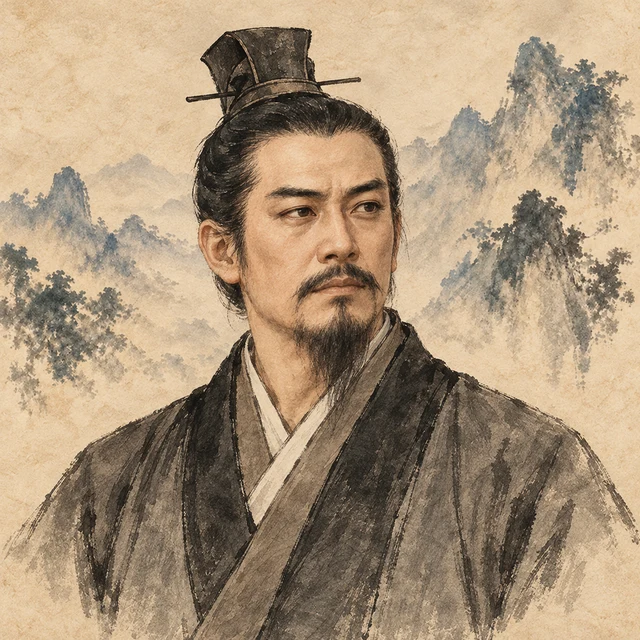
HISTORICAL PERSON
Wang Guan
王观
A Linqiu man from Dong commandery; he rose to Deputy Director of the Masters of Writing in Wei and was praised by Gao Rou for austere integrity.
This entry is supported by historical references, but does not yet have a conversation profile.
PRIMARY BIOGRAPHY
Biography
Wang Guan, styled Weitai, was from Linqiu in Dong commandery. Orphaned young and poor, he steeled his resolve without living for himself alone. The Grand Ancestor summoned him as a literary clerk of the chancellery, then sent him out as prefect of Gaotang, Yangquan, Zan, and Ren, governing with praise in each. At Emperor Wen’s accession he came in as secretariat gentleman and inspector of the commandant of justice, then went out as administrator of Nanyang and Zhuo. Zhuo bordered the Xianbei on the north and suffered repeated raids, so Wang Guan ordered the frontier people to dwell in grouped hamlets of ten households or more and built watch mounds.
At Emperor Ming’s accession an edict had the commanderies and counties graded as heavy, middling, or light in burdens. The clerks wished to report the commandery as middling-to-light, but Wang Guan instructed them, “This commandery borders the outer caitiffs and suffers constant raiding — why should it not be graded heavy?” The clerks said, “If the commandery is graded outer-heavy, your honor will have to furnish a hostage son.” Wang Guan said, “The lord exists for the people. If the commandery is graded outer-heavy, its labor levies will be reduced accordingly — how could I, for an administrator’s private advantage, betray the people of a whole commandery?” So it was reported outer-heavy, and he duly sent his hostage son to Ye — such was his purity and frugality, asking nothing for his own person. He later became privy treasurer. When the general-in-chief Cao Shuang had the artisan officer Zhang Da fell state timber and other things for private use, Wang Guan, learning of it, had it all seized and confiscated; the privy treasury governed the three masteries of the imperial workshops with their stored treasures, and Cao Shuang’s party, extravagant and given to demands, feared Wang Guan’s keeping of the law, and so had him transferred out to be grand coachman.
When the grand tutor Sima Yi destroyed Cao Shuang, he had Wang Guan act as central leader of the army and seize the camp of Cao Shuang’s brother Cao Xi, enfeoffing him marquis within the passes; he returned to the secretariat with the additional title of commandant of the imperial chariots. At the Duke of Gaogui District’s accession he was enfeoffed marquis of Zhongxiang precinct; presently he was made grandee glorious and grand and transferred to be supervisor of the right of the secretariat. At the Duke of Changdao District’s accession he was advanced to marquis of Yang district, raised by a thousand to twenty-five hundred households, and promoted to minister of works; he firmly declined, was not permitted, and the envoy came to his own residence to invest him — a few days after taking office he sent back the seal and ribbon and had himself carried home in a cart. He died at home, leaving instructions that the coffin need only hold the body, with no grave goods, no mound, and no trees planted. His posthumous name was Su.
Life and role
- Primary role
- Cao Wei official
- Active period
- Documented coverage: late Han through Cao Wei
- Primary group
- Cao-Wei
Affiliations across a lifetime
- Emperor Ming’s reign
Administrator of Zhuo
Had his own commandery graded outer-heavy to lighten its levies — though it cost him a son sent as hostage to Ye
- Jiaping 1 (249)
Acting central leader of the army
Seized Cao Xi’s camp in the Gaoping coup — Cao Shuang had earlier pushed him out of the privy treasury for fear of his strictness
HISTORICAL RECORD
Historical sources
- Records of the Three Kingdoms · Wei, Book 24 · 韩崔高孙王传 ↗
Chen Shou’s base text contains the biographies of Han Ji, Cui Lin, Gao Rou, Sun Li, and Wang Guan. The concluding evaluation is separate from the biographies.