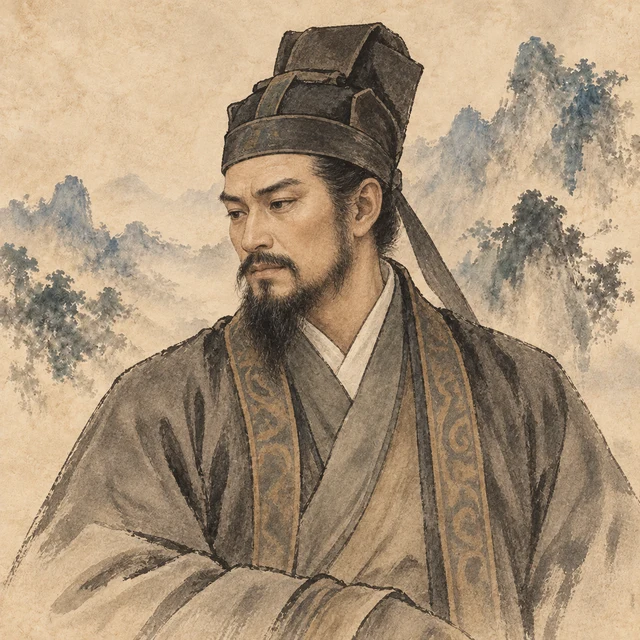
HISTORICAL PERSON
Wang Ji
王基
Known for administrative ability and military planning, Wang Ji served on the Jingzhou and Huainan fronts and advised the Wei court during major campaigns.
This entry is supported by historical references, but does not yet have a conversation profile.
PRIMARY BIOGRAPHY
Biography
Wang Ji, styled Boyu, came from Qucheng in Donglai. Orphaned young, he lived with his uncle Weng, who raised him with devotion, and Wang Ji was known for filial piety. At seventeen the commandery called him to be a clerk; it was not to his liking, and he left to study abroad in Langye. Recommended filial-and-incorrupt in the Huangchu era, he was made a gentleman. With the Qing lands newly settled, the inspector Wang Ling specially memorialised for him as aide; called to be an Excellency of Works clerk, Wang Ling begged him back. When Wang Su wrote his explanations of the classics and his rulings on court ritual, altering Zheng Xuan’s old readings, Wang Ji held by Zheng Xuan’s meaning and constantly opposed him. He rose to administrator of Anping, left office over a public matter, and was engaged by the General-in-chief Cao Shuang as an aide, then sent out as administrator of Anfeng. Bordering the Wu enemy, his government was clear and strict with awe and kindness; his defences so plainly set that the enemy dared not trespass, and he was made General who Punishes Invaders. When Wu once gathered a great host at Jianye, proclaiming an invasion of Yang province, the inspector Zhuge Dan had Wang Ji assess it. Wang Ji said: “Sun Quan came twice to Hefei and once to Jiangxia, and after him Quan Cong came out of Lujiang and Zhu Ran raided Xiangyang — all returned without success. Now Lu Xun and the rest are dead, Sun Quan is old, within there is no worthy heir, in the centre no master of plans. If he comes himself he fears revolt breaking out within; if he sends generals, the old ones are gone and the new not yet trusted. This is nothing but a wish to mend his factions and protect himself.” Sun Quan indeed never came. While Cao Shuang held the handles of power and manners decayed, Wang Ji wrote the Discourse on the Needs of the Time to cut at the world’s ills. Recalled for illness, he was about to be made Intendant of Henan when Cao Shuang fell; as a former officer of Cao Shuang’s he was dismissed by the rule.
That year he was made a Master of Writing, then sent out as inspector of Jing province as General of Ardent Ardour, joining the general Wang Chang against Wu. In a detached strike on Bu Xie at Yiling — Bu Xie shut his gates and held — Wang Ji made a show of assault while in truth dividing his force to take the depot at Xiongfu, gathering over three hundred thousand hu of rice, capturing the general Tan Zheng and accepting several thousand households in surrender; the surrendered people were moved to found Yiling county, and he was enfeoffed Marquis within the Passes. He further memorialised the fortifying of Shangchang and the moving of Jiangxia’s seat there to press on Xiakou, and thereafter the enemy dared not lightly cross the river. He made the statutes clear, ordered army and farms, and set up schools — the south praised him. When the court debated attacking Wu, an edict asked Wang Ji to weigh the right course. He answered that arms moving without success break prestige abroad and empty the treasury within; without the provision of navigable waters, stored grain and water-war readiness, troops massed along the river have no certain way across. Now Jiangling has the Ju and Zhang rivers, and around Anlu the ponds spread fertile — let water and land both be farmed to fill the army’s stores; then lead the force to hold Xiakou in divisions and float the grain down along the Ju and Zhang. When the enemy learns the imperial army has the strength to stay, the defiant lose heart and those drawn to civilisation grow firm; then, with the tribes joined to strike within and picked troops to punish without, all above Xiakou must fall, the Wu–Shu link is cut, and cut, Wu is taken. Otherwise the profit of a campaign cannot be certain. The design was stopped. When King Jing of Sima newly took the government, Wang Ji wrote to warn him — a straight will lets no crowd of evils grow, a quiet heart keeps affairs unhurried — and recommended Xu Yun, Fu Gu, Yuan Kan and Cui Zan as the upright men of the age; King Jing accepted his words. At the accession of the Duke of Gaogui district, Wang Ji was advanced to Marquis of Changle precinct.
When Guanqiu Jian and Wen Qin rebelled, Wang Ji was made acting supervisor of the army with the credentials, commanding the Xuchang host, and joined King Jing at Xuchang. He said: “The Huainan revolt is no wish of its officers and people — Guanqiu Jian and his fellows have duped and cowed them; they huddle together fearing the blade before their eyes. Bring the great host to bear and they will crumble like earth.” An edict ordered Wang Ji to halt; he held that the rebels’ long halting showed their deceit exposed and their men’s hearts failing, that to sit behind high ramparts looked like timidity, and that the army must quickly take Nandun, whose great depot held forty days’ grain — hold the strong city, live on its stores, and forestall the enemy’s will: the very key to quelling rebels. After repeated pleas he was allowed to advance to the Yin river, then said again: “Of arms I have heard of clumsy speed, never of artful slowness long drawn out. To hold firm is not to stand still — it is to advance unassailable. To sit in strong walls, heaping our stores as the enemy’s prize and hauling grain from afar, is no plan at all.” King Jing still withheld consent. Wang Ji said: “The general in the field does not accept every order of his prince. Their gain is our loss, our gain their loss — this is a contested city, and Nandun is it.” He advanced and held Nandun; Guanqiu Jian’s men, coming from Xiang, had marched but ten-odd li to contest it when they heard Wang Ji had got there first, and fell back to hold Xiang. When Deng Ai, the inspector of Yan province, camped at Lejia and Guanqiu Jian sent Wen Qin with troops to strike him, Wang Ji, knowing their force divided, advanced and pressed on Xiang — and Guanqiu Jian’s host collapsed. With Wen Qin and the rest put down, Wang Ji was made General who Guards the South, controller of Yu province’s armies and its inspector, advanced to Marquis of Anle district. He memorialised to split two hundred households from his fief to enfeoff his uncle’s son Ziqiao as Marquis within the Passes, repaying his uncle’s care in raising him — the edict specially allowed it. When Zhuge Dan rebelled, Wang Ji, in his own office, acted as General who Guards the East, controller of the armies of Yang and Yu. An edict ordered him to draw in his troops and hold his ramparts firm; Wang Ji repeatedly asked leave to advance. Ordered again to lead his armies to hold the northern hill, he told his generals: “Our siege-works are daily firmer, men and horses gathering — we need only sharpen our guard against a breakout. To shift troops to hold the heights instead lets them roam free; the wisest could not mend that aftermath.” He memorialised by his own judgment: “Facing the enemy we must be unmovable as a mountain. To shift to the high ground now would shake the men’s hearts and badly hurt our position. With every army in deep ditches and high ramparts, all hearts are settled and cannot be swayed — this is the key of war.” The answer approved him. Wang Ji commanded the twenty-six armies east and south of the city; when the city’s food ran out and they attacked the ramparts day and night, he beat them back every time. When Shouchun fell, King Wen wrote to him: “The debaters were many, the movers numerous, and I too thought them right until I saw the ground. Your deep reckoning of profit and harm held fast alone — above you disobeyed the edict, below you refused the crowd — and in the end you mastered and took the enemy. The ancients recorded nothing finer.” With Huainan newly settled, Wang Ji was made General who Subdues the East, controller of Yang province’s armies, and advanced to Marquis of Dongwu. He firmly declined by memorial, giving the merit to his staff — seven men, clerks and majors, were enfeoffed for it. In 259 he was transferred to General who Subdues the South, controlling Jing province’s armies. In 261 the administrator of Xiangyang reported that the Wu officer Deng You and others wished to come over and be received; Wang Ji, suspecting a trick, galloped a dispatch setting out his doubts — and Deng You indeed never came. That year Wang Ji died; he was posthumously made Excellency of Works with the title Marquis Jing.
Life and role
- Primary role
- General Who Conquers the South
- Active period
- Documented coverage: Cao Wei (c. 220–261)
- Primary group
- Cao-Wei
Affiliations across a lifetime
- 240s
Reading Wu from Anfeng
Read Sun Quan’s age and emptiness and said he would not come — he did not; took the Xiongfu depot’s three hundred thousand hu by a feint
- 255
First to Nandun
Against orders he seized the Nandun depot — “a general in the field need not accept every command” — and the Huainan rebels collapsed
- 257–258
Unmovable as a mountain at Shouchun
Disobeying the edict he refused the northern hill, held twenty-six armies against the city’s breakouts, then gave the credit to his staff
HISTORICAL RECORD
Historical sources
- Records of the Three Kingdoms · Wei, Book 27 · 徐胡二王传 ↗
Chen Shou’s base text contains the biographies of Xu Miao, Hu Zhi, Wang Chang, and Wang Ji. The concluding evaluation is separate from the biographies.