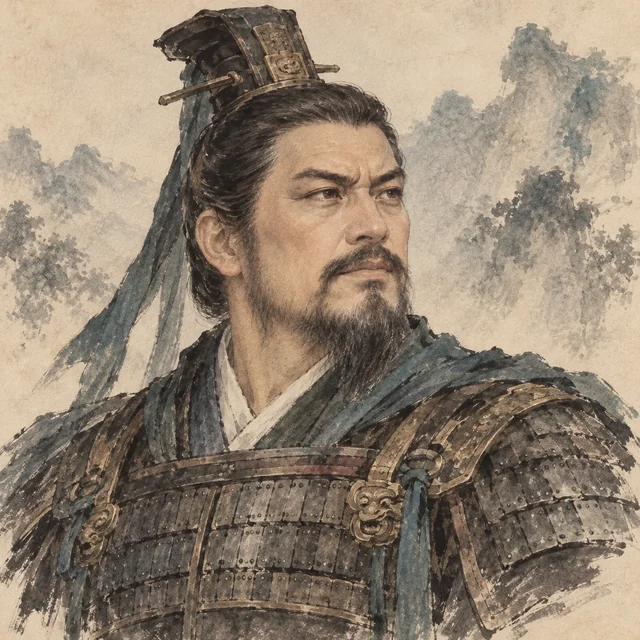
HISTORICAL PERSON
Wang Jun
王濬
A Hu man from Hongnong; as Inspector of Yi he built towered warships for years, then in 280 led the fleet down the Yangzi past Wuchang and Xiakou to receive Sun Hao’s surrender at Stone City, and was enfeoffed Marquis of Xiangyang.
This entry is supported by historical references, but does not yet have a conversation profile.
PRIMARY BIOGRAPHY
Biography
Wang Jun (206–286), courtesy name Shizhi, childhood name Atong, came from Hu county in Hongnong. Widely read and powerfully built, he was dismissed in his youth for indifference to convention; he then reformed himself, and provincial offices followed. Yang Hu, commanding at Jingzhou, recognized his talent; when Yang Hu’s nephew warned that Wang Jun’s ambition and extravagance made him unfit for sole command, Yang Hu answered that a man of such gifts must be given the scope to use them. Wang Jun governed Ba and Guanghan commanderies with a reputation for kindness.
Around 272 Wang Jun was made inspector of Yi province with orders to build a great fleet in Shu for the downstream conquest of Wu. He built towered ships joined in pairs, a hundred and twenty paces square, carrying over two thousand men each, with wooden walls and gates on four sides and decks broad enough to gallop horses; the prows were painted with seabirds and monsters to overawe the river spirits. Sawdust and shavings from his yards drifted down the Yangzi, and the Wu commander of Jianping, Wu Yan, gathered them and warned Sun Hao that Jin must intend invasion and that Jianping must be reinforced — if Jianping held, the Jin fleet would never dare pass. Sun Hao paid no heed.
After seven years in Shu, Wang Jun had built a fleet such as had never existed. In 279 he memorialized: Sun Hao’s cruelty had made his state desperate for deliverance; the ships were rotting after seven years; and he himself was past seventy. Let any one of these three be lost, and Wu could not be taken. The emperor resolved on war.
In the first month of 280 Wang Jun descended the river from Chengdu with seventy thousand men. Wu had stretched iron chains across the narrows and sunk yard-long iron spikes in the channel to rip hulls. Wang Jun built dozens of great rafts, each over a hundred paces square, with armored straw dummies aboard, and sent strong swimmers ahead with them; the spikes caught in the rafts and were carried away. He also made torches a dozen zhang long and tens of spans thick, soaked in hemp oil, and mounted them at the bows; when the fleet met a chain, the torches were lit, and in moments the links melted through. Danyang, Xiling, Jingmen and Yidao fell in succession, and the Wu garrisons of Xiakou and Wuchang scattered before the descending fleet.
The court’s original chain of command placed Wang Jun under Du Yu past Jianping and under Wang Hun at Moling. Du Yu wrote to urge him to seize the moment and take Jianye outright; Wang Jun, delighted, pressed on day and night. Wang Hun, having defeated the Wu chancellor Zhang Ti’s main army north of the river, hesitated to cross and signaled Wang Jun to halt for consultation; Wang Jun answered that the wind would not let his ships stop, and arrived below Stone City first. In the third month Sun Hao performed the rites of surrender — plain carriage and white horses, bared arms bound, jade disk in his teeth, coffin borne behind — and surrendered at Wang Jun’s headquarters. Wang Jun untied him with his own hands, accepted the jade, burned the coffin, and sent him to Luoyang. Wu was destroyed.
As the first into the capital to receive the surrender, Wang Jun claimed the chief merit; Wang Hun, passed over, denounced him for disobeying the chain of command, and the legal officers wanted him brought home in a cage cart — the emperor refused. Opinion held that Wang Jun’s reward fell short of his deeds; he was finally made General who Assists the State and Marquis of Xiangyang county. Conscious of his great service and its slighting, he would recount his campaigns and wrongs at every audience, sometimes leaving in anger without taking his leave. He died in 286 at eighty.
Life and role
- Primary role
- Western Jin Inspector of Yi and fleet commander
- Active period
- Documented coverage: late Wei through Western Jin
- Primary group
- Western Jin
Affiliations across a lifetime
- Before 272
Late Wei / early Jin · commandery administrator
Sponsored by Yang Hu despite warnings about his ambition; governed Ba and Guanghan with a kind administration.
- 272–279
Jin · inspector of Yi, builder of the fleet
Built the great double-hulled war fleet in Shu; his drifting shavings warned Wu’s Wu Yan in vain.
- 280
Dragon-prancing General · first into Stone City
Burned through the river chains, raced past Wang Hun, and received Sun Hao’s surrender at Stone City.
- 280–286
Merit dispute and honors
Denounced by Wang Hun and defended by opinion at large, he was made General who Assists the State and Marquis of Xiangyang.
HISTORICAL RECORD
Historical sources
- Records of the Three Kingdoms · Wu, Book 3 · 三嗣主传 ↗
The annals of Sun Liang, Sun Xiu, and Sun Hao.
- Book of Jin · Book 42 · Biographies of Wang Hun and Wang Jun ↗
Wang Jun’s biography: building the Yi Province fleet and the descent on Jianye.