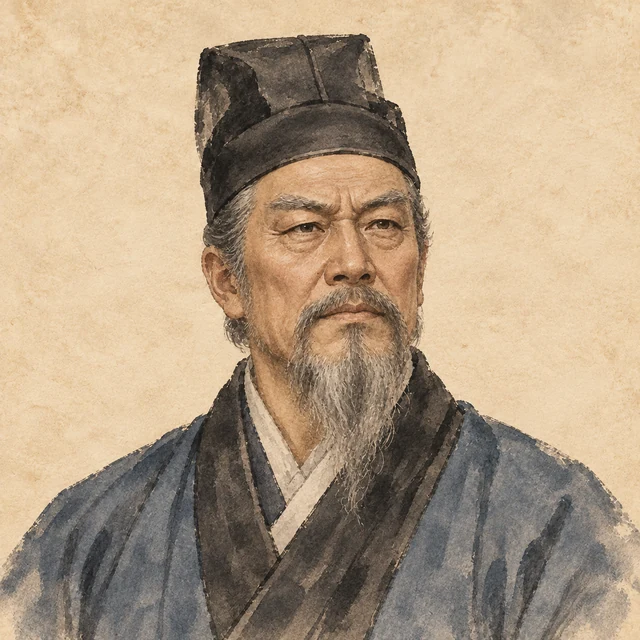
HISTORICAL PERSON
Wang Ling
王凌
A Qi man from Taiyuan and nephew of Wang Yun; as Grand Commandant he plotted to install Prince Biao of Chu against Sima Yi in 251, and killed himself when the plot failed.
This entry is supported by historical references, but does not yet have a conversation profile.
PRIMARY BIOGRAPHY
Biography
Wang Ling, styled Yanyun, came from Qi in Taiyuan, a nephew of the minister over the masses Wang Yun. Recommended filial-and-incorrupt, he served as chief of Fagan and rose to administrator of Zhongshan, governing well wherever he went, until the Grand Progenitor engaged him on the chancellor’s staff. When Emperor Wen took the throne, Wang Ling was made attendant cavalier and went out as inspector of Yan province, campaigning with Zhang Liao and others against Sun Quan at Guangling. On the riverbank, a great wind rose by night and drove the ships of the Wu general Lü Fan onto the northern shore; Wang Ling and the other generals struck, taking heads and ships, and for this service he was enfeoffed Marquis of Yicheng precinct and made General who Establishes Might, then moved to Qing province. The coast was still lawless after the ruin of Han; Wang Ling spread government and teaching, rewarded the good and punished the wicked, and kept such order that the people could not stop praising him. On Cao Xiu’s campaign against Wu they met the enemy at Jiashi, and when Cao Xiu’s army lost, Wang Ling forced the encirclement with all his strength and got Cao Xiu out alive. Transferred to hold Yang and then Yu province as inspector, he won the hearts of soldiers and people alike.
Early in the Zhengshi era he was made General who Conquers the East with the credentials, commanding the armies of Yang province. In 241 the Wu general Quan Cong raided Quebei with tens of thousands; Wang Ling led his armies to meet him, fought for the dike day after day, and drove him off, advanced to Marquis of Nanxiang with 1,350 households and made General of Chariots and Cavalry with the ceremonies of the three excellencies. At that time his nephew Linghu Yu, a man of talent, was inspector of Yan province stationed at Ping’e — uncle and nephew both held armies and shared the weight of Huainan. When Sima Yi destroyed Cao Shuang, Wang Ling was advanced to Grand Commandant with the axe of authority; he and Linghu Yu secretly agreed that the Prince of Qi was unfit for the heavenly seat, while the Prince of Chu, Cao Biao, was grown and able — they meant to set him up with the capital at Xuchang.
In 251 the men of Wu dammed the Tu river, and Wang Ling, meaning to rise on this pretext, put his armies on full alert and memorialised for leave to attack the enemy; the edict forbade it. His plot deepening, he sent the general Yang Hong to tell the Yan province inspector Huang Hua of the plan to depose and enthrone — and Huang Hua and Yang Hong jointly reported it to the grand tutor Sima Yi. The Xuan King brought the central army down by water, first issuing a pardon for Wang Ling’s crime and having the Master of Writing send him a letter of persuasion; then the great army fell on him at Baichi. Knowing he was finished, Wang Ling came out alone in a boat to meet the Xuan King, sent his clerk Wang Yu to apologise, and surrendered his seal, ribbons and battle-axe. When the army reached Qiutou, Wang Ling bound himself facing backward at the water’s edge; the Xuan King, acting on the edict, sent his registrar to loose the bonds and restore his clothes, received and comforted him, returned his insignia, and sent him toward the capital under six hundred horse and foot. At Xiang, passing the shrine of Jia Kui, Wang Ling cried out: “Jia Liangdao! Wang Ling is a loyal servant of great Wei — if you have any spirit, you know it!” Then he drank poison and died. The Xuan King went on to Shouchun and pursued the affair to its roots: the Prince of Chu was granted death, and all implicated were exterminated to the third degree.
Life and role
- Primary role
- Cao Wei official
- Active period
- Documented coverage: late Han through Cao Wei
- Primary group
- Cao-Wei
Affiliations across a lifetime
- 220–240
Inspector of four provinces
Took Lü Fan’s drifting ships at Guangling; broke the encirclement to save Cao Xiu at Jiashi
- 241–251
Grand Commandant · Yang command
Fought off Quan Cong at Quebei; plotted with his nephew Linghu Yu to enthrone the Prince of Chu
- 251
The first Huainan rising
Betrayed by Huang Hua, surprised by Sima Yi’s river descent; he bound himself, cried his loyalty at Jia Kui’s shrine, and drank poison
HISTORICAL RECORD
Historical sources
- Records of the Three Kingdoms · Wei, Book 20 · Biographies of the sons of Cao Cao and Cao Pi ↗
Chen Shou’s base text: biographies of Cao Cao’s and Cao Pi’s sons and their fiefs. Pei Songzhi’s annotations and cited works are registered separately.
- Records of the Three Kingdoms · Wei, Book 28 · 王毌丘诸葛邓锺传 ↗
Chen Shou’s base text contains the biographies of Wang Ling, Guanqiu Jian (with Wen Qin), Zhuge Dan (with Tang Zi), Deng Ai (with Zhou Tai), and Zhong Hui (with Wang Bi). Zhong Hui’s biography also records Jiang Wei’s final actions after Shu fell. Pei Songzhi’s annotations on the page should be identified separately.
- Records of the Three Kingdoms, with Pei Songzhi annotations · Pei Songzhi’s annotations to Wei, Book 19 ↗
Annotations to the biographies of Cao Zhang, Cao Zhi, and Cao Xiong, including passages from Wei Lue, Wei Shi Chunqiu, Shiyu, Ding Yi zhuan, and other cited works; all are kept distinct from Chen Shou’s base text.
- Records of the Three Kingdoms, with Pei Songzhi annotations · Pei Songzhi annotations to Wei, Book 28 · Wang Ling, Guanqiu Jian, Zhuge Dan, Deng Ai and Zhong Hui ↗
Annotations to the biographies of Wang Ling, Guanqiu Jian, Zhuge Dan, Deng Ai and Zhong Hui, including He Shao’s biography of Wang Bi; attributed accounts remain distinct from Chen Shou’s base text.