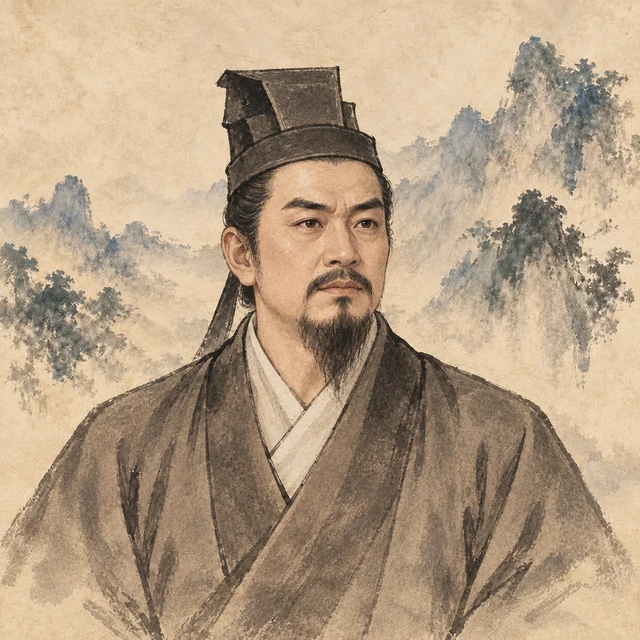
HISTORICAL PERSON
Wang Su
王肃
A Confucian scholar and Wei official who advised restraint in military and building projects and took part in debates over institutions and law.
This entry is supported by historical references, but does not yet have a conversation profile.
PRIMARY BIOGRAPHY
Biography
Wang Su, styled Ziyong, was from Tan in Donghai, son of the minister over the masses Wang Lang. At eighteen he studied the Taixuan under Song Zhong and wrote his own commentary on it. In the Huangchu era he served as cavalier attendant-in-ordinary and gentleman of the Yellow Gates, and in the third year of Taihe was made cavalier attendant-in-ordinary proper, memorializing that corvée should be lightened and husbandry encouraged. He directed the palace library and was libationer of the Chongwen academy, and when Emperor Ming raised palaces on a lavish scale, Wang Su repeatedly remonstrated that the people were exhausted and must be given rest.
In scholarship he followed the traditions of Jia Kui and Ma Rong rather than Zheng Xuan, reconciling their agreements and differences, and produced commentaries on the Documents, the Odes, the Analects, the Three Rites, and the Zuo Tradition, besides editing his father’s commentary on the Changes — all of which were installed in the official curriculum. His rulings on court ritual, the suburban and ancestral sacrifices, and the grades of mourning ran to more than a hundred essays, and his Sheng Zheng Lun collected proofs against Zheng Xuan, founding a distinct school known as the learning of Wang.
In Zhengshi 1 he went out as administrator of Guangping, was recalled on public business, and rose through court gentleman and palace attendant to grand master of ceremonies. When the general-in-chief Cao Shuang monopolized power with He Yan and Deng Yang, Wang Su, discussing the age with Jiang Ji and Huan Fan, said bluntly, “Those men are Hong Gong and Shi Xian reborn,” and Cao Shuang hated him for it. In Jiaping 6 he held the credentials and doubled as grand master of ceremonies to escort the Duke of Gaogui District to the throne from Yuancheng, and that same year he read a white vapor crossing the sky as Chiyou’s banner — soon Guanqiu Jian and Wen Qin did rebel in Huainan. He ended as central leader of the army with the additional title of cavalier attendant, died in Ganlu 1 with a hundred disciples wearing mourning for him, and was posthumously made general of the guards with the posthumous name Jing.
Life and role
- Primary role
- Confucian scholar and Cao Wei official
- Active period
- Documented coverage: late Han through Cao Wei
- Primary group
- Cao-Wei
Affiliations across a lifetime
- Taihe–Zhengshi eras
Director of the palace library
Commentated the classics, wrote the Sheng Zheng Lun against Zheng Xuan, and saw his school installed in the state curriculum
- Jiaping 6 (254)
Escorted the Duke of Gaogui District to the throne
Held the credentials for the accession procession and read the white vapor as an omen of the Huainan revolt that soon followed
HISTORICAL RECORD
Historical sources
- Records of the Three Kingdoms · Wei, Book 13 · 钟繇华歆王朗传 ↗
Chen Shou’s base text: biographies of Zhong Yao (including Zhong Yu), Hua Xin, Wang Lang, and Wang Su. Pei Songzhi’s annotations are registered separately.