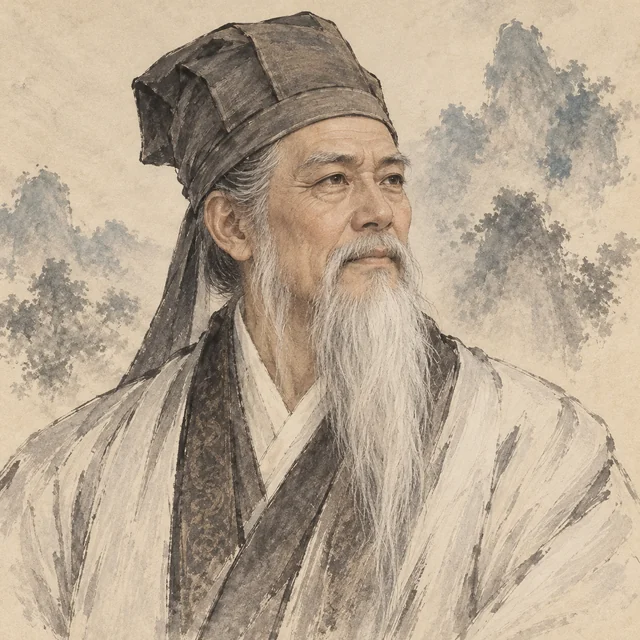
HISTORICAL PERSON
Wang Xiang
王祥
Lü Qian invited Wang Xiang to serve as his aide in Xuzhou and entrusted him with civil affairs.; The annotations identify Wang Xiang as the later Jin statesman and give his courtesy name Xiuzheng; later career details come from cited works, not Chen Shou’s base account.
This entry is supported by historical references, but does not yet have a conversation profile.
PRIMARY BIOGRAPHY
Biography
Wang Xiang (184–268), styled Xiuzhi, was a native of Linyi in Langye, famed for filial devotion. His mother died early; his stepmother Lady Zhu was unkind and slandered him, costing him his father’s love, yet he only grew more dutiful, sweeping the cattle pens without complaint. When his parents were ill he tasted their medicines himself and slept without undressing. His stepmother craved fresh fish in midwinter; Wang Xiang stripped to break the ice — the ice split of itself and two carp leapt out, the origin of the later tale of "lying on ice for carp." When she longed for roast yellow sparrows, a flock flew into his tent, and the village marveled that his filial piety moved Heaven. Guarding the family’s fruiting persimmon for her, he would clasp the tree and weep through every storm.
In the chaos at the end of Han he fled south to Lujiang with his stepmother and half-brother Wang Lan, living in seclusion over thirty years and refusing every summons. After her death he wasted in mourning till he walked with a staff. Lü Qian, the Wei inspector of Xu province, made him senior aide only after Wang Lan urged him and prepared his ox-cart. With bandits overrunning the province, Wang Xiang drilled the soldiers and broke them repeatedly; the people sang: "The peace of Haixi rests on Wang Xiang; the land is not empty — the aide’s work." Lü Qian owned a sword which physiognomists said only a future Three Excellency could wear and gave it to him; dying, Wang Xiang passed it to Wang Lan: "Your line will rise, worthy of this blade" — and Wang Lan’s descendants indeed rose to greatness south of the Yangzi.
When the Wei emperor Cao Mao visited the Imperial University he named Wang Xiang the Elder of the Realm; Wang Xiang sat facing south with staff and armrest, taking the teacher’s seat, while the emperor faced north to beg instruction, and all who heard him were stirred. When Sima Yan became Prince of Jin, Wang Xiang went to pay respects with Xun Yi, who urged him to prostrate himself. Wang Xiang answered: "The Prince is honored, true — but he is Wei’s chancellor, and we are Wei’s Three Excellencies, one grade apart. Since when do an emperor’s excellencies prostrate themselves?" Xun Yi bowed; Wang Xiang merely cupped his hands, and Sima Yan said: "Today I learn the weight of your regard." In Jin he was made Grand Guardian and Duke of Suiling. He died in 268 at eighty-five, leaving instructions for a frugal burial, which his descendants observed.
Life and role
- Primary role
- Court or regional official
- Active period
- Documented coverage: late Wei and Western Jin
- Primary group
- Western Jin
Affiliations across a lifetime
- Late Han
Lujiang recluse · paragon of filial piety
The ice that split for carp and the sparrows in the tent; thirty years a recluse with his stepmother and brother
- Cao Wei
Senior aide of Xu → Elder of the Realm
Broke the bandits for Lü Qian; named Elder of the Realm by Cao Mao and seated facing south as teacher
- 265–268
Jin · Grand Guardian, Duke of Suiling
Refused to kneel to the Prince of Jin; died in 268 with orders for a frugal burial; Lü Qian’s sword passed to Wang Lan, founding the Langye Wang line’s rise
HISTORICAL RECORD
Historical sources
- Records of the Three Kingdoms · Wei, Book 18 · Biographies of the Two Lis, Zang, Wen, Lü, Xu, Dian, Two Pangs, and Yan ↗
Chen Shou’s base text: biographies of Li Dian, Li Tong, Zang Ba (including Sun Guan), Wen Pin, Lü Qian (including Wang Xiang), Xu Chu, Dian Wei, Pang De, Pang Yu (including his mother Zhao E), and Yan Wen (including Zhang Gong). Pei Songzhi’s annotations are separately registered.
- Book of Jin · Biographies 33 · He Zeng and others ↗
Biography of He Zeng, son of He Kui, covering service in late Wei and early Jin.
- Records of the Three Kingdoms, with Pei Songzhi annotations · Pei Songzhi’s annotations to Wei, Book 18 ↗
Annotations to the biographies in Wei Book 18, including cited passages from Wei Shu, Wei Lue, Dian Lue, Sun Sheng, Wang Yin’s Jin Shu, and Pei Songzhi’s source judgments. Kept distinct from Chen Shou’s base text.