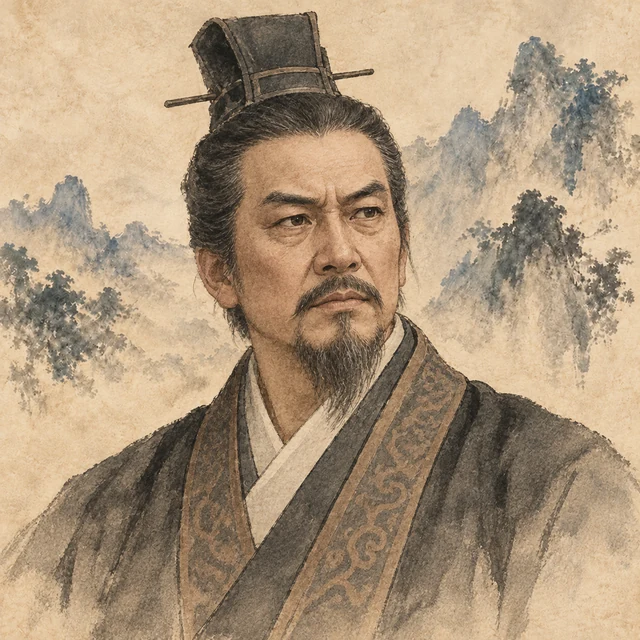
HISTORICAL PERSON
Wang Yun
王允
A Qi man from Taiyuan and late Han Minister over the Masses; in 192 he plotted with Lü Bu to kill Dong Zhuo, then failed to placate the Liangzhou troops and was killed when Li Jue and Guo Si stormed Chang’an.
This entry is supported by historical references, but does not yet have a conversation profile.
PRIMARY BIOGRAPHY
Biography
Wang Yun, styled Zishi, came from Qi in Taiyuan. From youth he set store by great principles, resolved to achieve merit, and practised the classics by day and riding and archery by night. Summoned by all three ducal offices, he came first in the minister of education’s examinations and was made attendant censor. In 184, when the Yellow Turbans rose, he was specially chosen as inspector of Yu province, engaging Xun Shuang and Kong Rong among his aides. Receiving the surrender of hundreds of thousands with Huangfu Song and Zhu Jun, he found among the rebels letters between the clients of the eunuch Zhang Rang and the Turbans; Wang Yun exposed the treason in full and reported it. The emperor raged at Zhang Rang, who kowtowed and excused himself and escaped punishment — and so Zhang Rang nursed his hatred, had Wang Yun thrown into prison the next year, and, when an amnesty restored him as inspector, had him arrested again within ten days on another charge. His hot-blooded aides offered him poison with tears; Wang Yun said sternly, “I am a subject of my lord and have offended against him — I must face the executioner’s block to answer the realm, not drink a drug to seek death”, dashed down the cup, and walked out to the cage cart. The general-in-chief He Jin, the grand commandant Yuan Wei and the minister of education Yang Ci jointly memorialised for him, commuting death; and though a great amnesty came that winter, Wang Yun alone was excluded, until the three excellencies spoke again and freed him the next year. With the eunuchs running violent and lawless, he changed his name and moved between Henei and Chenliu.
On the emperor’s death Wang Yun hurried to the capital for the mourning. The general-in-chief He Jin, meaning to destroy the eunuchs, called him into his counsels as attendant gentleman of the household, and he rose to governor of Henan. Under Emperor Xian he became grand coachman, then acting Prefect of the Masters of Writing; in 190 he replaced Yang Biao as Minister over the Masses while keeping the secretariat. When Dong Zhuo moved the capital into the passes, Wang Yun gathered the essential books and secret texts of the Lantai and Stone Chamber to take along, and in Chang’an catalogued and presented them — that the classics survived at all was largely his work. While Dong Zhuo stayed in Luoyang, all court business great and small was left to Wang Yun, who bent his feelings and yielded in everything; Dong Zhuo trusted him wholly, and so the house of Han was propped up amid mortal danger. Seeing Dong Zhuo’s malignity deepen and usurpation loom, Wang Yun plotted in secret with the colonel-director of retainers Huang Wan and the Master of Writing Zheng Tai to kill him. In the spring of 192, after sixty days of unbroken rain, Wang Yun mounted the rain-prayer terrace with Shisun Rui and Yang Zan, renewed the plot, and secretly won over Dong Zhuo’s officer Lü Bu as the inside man. When Dong Zhuo entered the palace for a celebration, Lü Bu stabbed him to death.
With Dong Zhuo dead, Wang Yun supervised the Masters of Writing and directed the government. His nature was hard-edged and hated evil: having bowed to Dong Zhuo out of fear, once the beast was slain he thought all trouble past; in council he lacked all warmth, held stiffly to the straight, and would not follow expedient courses, so the officers did not cleave to him. He first spoke of pardoning Dong Zhuo’s troops, then doubted and delayed; and when he proposed disbanding the Liangzhou soldiery wholesale, someone urged that Huangfu Song should take command of them at Shan to quiet them — Wang Yun refused. Just then a rumour spread among the people that every Liangzhou man would be put to death; terror ran through the passes, and Li Jue, Guo Si and the rest, desperate, joined in revolt and besieged Chang’an. The city fell. Lü Bu, reining in at the Green Lock Gate, called to Wang Yun to flee with him; Wang Yun answered, “If by the spirits of the altars the state may be kept safe, that is my wish; if not, I will offer up my body and die. The sovereign is a child and leans on me alone — to steal away from danger, I cannot bear.” Li Jue seized and killed him; he was fifty-six. The emperor grieved aloud, the people’s hearts failed, and none dared gather his corpse — only his former clerk Zhao Jian, magistrate of Pingling, abandoned his office to bury him.
Life and role
- Primary role
- Late Han Minister over the Masses
- Active period
- Documented coverage: the late Han warlord era
- Primary group
- Han court & warlords
Affiliations across a lifetime
- 184–185
Inspector of Yu province
Exposed Zhang Rang’s letters to the Turbans; twice arrested in a month, saved by the three excellencies
- 190–192
Minister over the Masses
Bent to Dong Zhuo while saving the state library; plotted with Lü Bu to kill him
- 192
Death at Chang’an
Refused Lü Bu’s call to flee when Li Jue and Guo Si took the city; died at his post
HISTORICAL RECORD
Historical sources
- Records of the Three Kingdoms · Wei, Book 6 · Biographies of Dong Zhuo, the Yuan clan, and Liu Biao ↗
The biographical chapter; each candidate's passage and identity remain to be checked against the text.
- Book of the Later Han · Book 72 · Biography of Dong Zhuo ↗
Use the named biography or chronicle entry in this volume; compare it with the Three Kingdoms record where sources differ.
- Book of the Later Han · Book 66 · Biographies of Chen Fan and Wang Yun ↗
Use the named biography or chronicle entry in this volume; compare it with the Three Kingdoms record where sources differ.