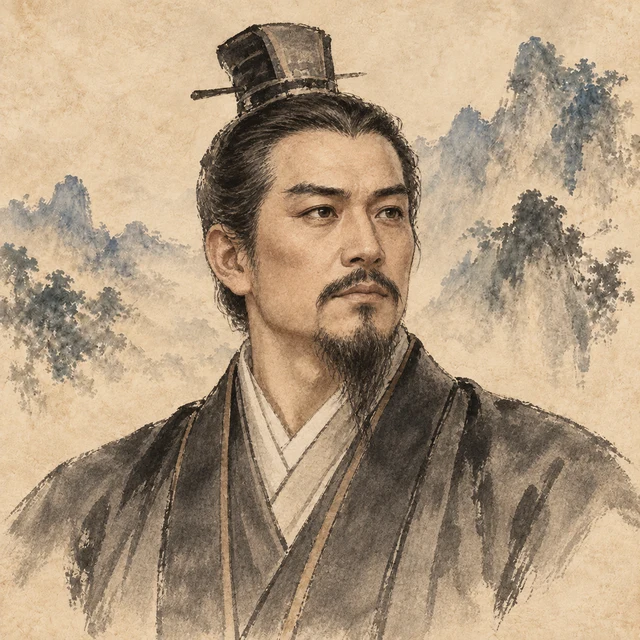
HISTORICAL PERSON
Wei Zhen
卫臻
Son of Wei Zi of Xiangyi in Chenliu; he rose to Minister over the Masses in Wei and repeatedly remonstrated against Emperor Ming’s palace projects.
This entry is supported by historical references, but does not yet have a conversation profile.
PRIMARY BIOGRAPHY
Biography
Wei Zhen, styled Gongzhen, came from Xiangyi in Chenliu. His father Wei Zi, a man of great principle who refused the summons of the Three Excellencies, said when the Grand Progenitor first came to Chenliu: “The man who will pacify the realm — it must be he.” The Grand Progenitor thought him remarkable and often consulted him; Wei Zi followed the campaign against Dong Zhuo and fell at Xingyang, and thereafter, whenever the Grand Progenitor passed through the commandery, he sent an envoy to sacrifice at his grave. When Xiahou Dun was administrator of Chenliu he recommended Wei Zhen as an accounting clerk; at a feast he had his wife come out, and Wei Zhen called it the custom of a decadent age, not the propriety of rites — Xiahou Dun, angry, seized him, then pardoned him. Later, as a Han Gentleman of the Yellow Gate, Wei Zhen was named by the rebel Zhu Yue of Dong commandery as an accomplice; the Grand Progenitor’s order ran: “I raised this cause together with your father and hold your good repute in honour — when I first heard Zhu Yue’s words I did not believe them, and Xun Lingjun’s letter has made your loyalty wholly clear.” When Wei Zhen came on an edict’s errand to arrange a marriage into Wei, the Grand Progenitor memorialised to keep him as an army consultant, recorded his father’s old service, and granted him the rank of Marquis within the Passes.
When Emperor Wen became king, Wei Zhen was made attendant cavalier, and at the imperial accession Marquis of Anguo precinct. While the whole court sang Wei’s virtues and belittled the fallen dynasty, Wei Zhen alone set out the right meaning of the abdication-and-succession and praised the Han’s merits; the emperor looked at him again and again and said, “The treasures of the realm shall be shared with the Duke of Shanyang.” He rose to Master of Writing, then palace attendant and Master of Writing in charge of personnel. Under Emperor Ming he was advanced to Marquis of Kangxiang and made deputy of the right of the Masters of Writing, directing selections. When the Protector of the Centre Army Jiang Ji wrote to him arguing that the Han founder made a runaway prisoner a general and King Wu raised a fisherman to Grand Tutor — that men of straw sandals may mount to dukes and kings without being tested first in letters — Wei Zhen answered: “When the ancients set aside wisdom-talk and trusted measured conduct, was it because they put the tongue first?” His age admired the answer.
When Zhuge Liang raided Tianshui, Wei Zhen memorialised that a picked force should enter the San pass and cut his grain road; he was made General who Subdues Shu with the credentials, commanding the armies, and reached Chang’an as Zhuge Liang withdrew. While the emperor was then lavishing his heart on palace halls, Wei Zhen repeatedly remonstrated sharply, and when the supervisor of the palace presumptuously arrested a clerk of the Orchid Terrace, Wei Zhen prosecuted him, memorialising that the law against officials overstepping their charge guards against great corruption. When Zhuge Liang came out again by Xiegu and the southern command reported Zhu Ran’s army past Jingcheng, Wei Zhen said: “Zhu Ran is Wu’s boldest general — he must be acting on Sun Quan’s orders, making a show to pin down our southern command.” Sun Quan indeed recalled Zhu Ran to Juchao and attacked Hefei. The emperor wished to campaign east in person; Wei Zhen said: “Sun Quan makes an outward show of answering Zhuge Liang but within is watching and waiting. Hefei’s walls are strong and no cause for worry — the carriage need not campaign in person, and the six armies’ cost will be spared.” The emperor reached Xunyang and Sun Quan indeed withdrew. When the inspector of You province Guanqiu Jian memorialised that the idle soldiers of his province could settle Liaodong, Wei Zhen said: “All Guanqiu Jian proposes is the petty art of the warring states, not the business of kingship. Gongsun Yuan has grown up beyond the sea through three generations of rule, soothing the tribes without and drilling archery within; for Jian to think a detached column can march in and roll him up between morning and evening is folly.” Guanqiu Jian’s campaign indeed went badly. Wei Zhen rose to Excellency of Works, then Excellency over the Masses, and in the Zhengshi era was advanced to Marquis of Changyuan. When Cao Shuang held power he sent Xiahou Xuan to convey his wish to draw Wei Zhen in as Prefect of the Masters of Writing, and sought a marriage for his brother — Wei Zhen refused both and firmly begged to retire. He was granted a residence with the rank of Specially Advanced and the emolument of the Three Excellencies; on his death he was posthumously made Grand Commandant with the title Marquis Jing.
Life and role
- Primary role
- Cao Wei official
- Active period
- Documented coverage: late Han through Cao Wei
- Primary group
- Cao-Wei
Affiliations across a lifetime
- 190–213
His father’s old service
His father died for Cao Cao at Xingyang; when a rebel named him, Cao Cao’s order declared the slander disbelieved and kept him in service
- 220–236
The meaning of abdication; remonstrance against the palaces
Alone among the court he praised the fallen Han’s virtue at the accession; later he prosecuted the palace supervisor and repeatedly remonstrated against the building works
- 228–234
Reading Wu and Shu
Cut Zhuge Liang’s grain road; read Zhu Ran’s move as a feint and Sun Quan’s as watching; foretold Guanqiu Jian’s Liaodong folly
HISTORICAL RECORD
Historical sources
- Records of the Three Kingdoms · Wei, Book 22 · 桓二陈徐卫卢传 ↗
Chen Shou’s base text contains the biographies of Huan Jie, Chen Qun (with his son Chen Tai), Chen Jiao, Xu Xuan, Wei Zhen, and Lu Yu. The concluding evaluation is separate from the biographies.