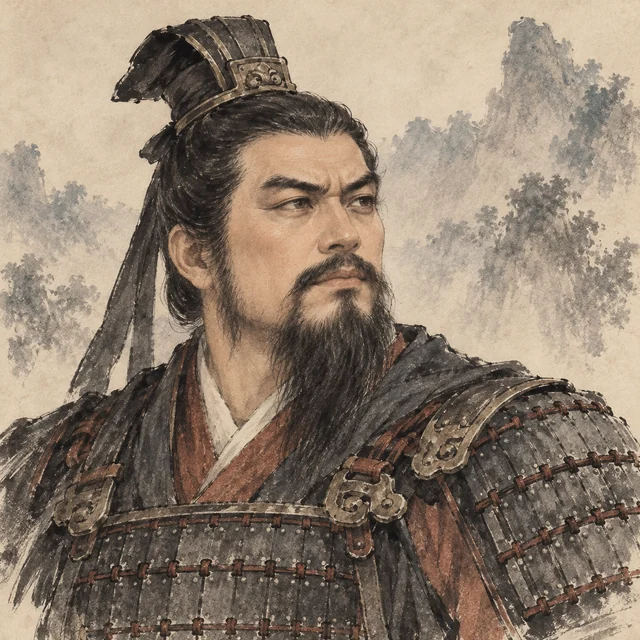
HISTORICAL PERSON
Xiahou Yuan
夏侯渊
Xiahou Yuan supported Cao Cao’s armies with logistics and campaigns across the west, then died fighting Liu Bei’s forces at Mount Dingjun.
This entry is supported by historical references, but does not yet have a conversation profile.
PRIMARY BIOGRAPHY
Biography
Xiahou Yuan (d. 219), courtesy name Miaocai, came from Qiao county in Pei, a clansman of Xiahou Dun. When the young Cao Cao faced a serious criminal charge, Xiahou Yuan took the blame on himself until Cao Cao arranged his release; when Cao Cao raised troops at Chenliu, Xiahou Yuan followed him as a cavalry commandant and never left his service. His wife was a sister of Cao Cao’s own wife, binding the two families still closer.
At Guandu in 200 he served as army supervisor, moving grain from the three provinces of Yan, Yu and Xu to the front. Afterwards, rebellion after rebellion in the east — Chang Xi, Xu He, Lei Xu, Shang Yao — fell to Xiahou Yuan campaigning with Zhang Liao and Yu Jin. He was famous for the speed of his marches; the army said of him: "Xiahou Yuan, colonel of the capital army — five hundred li in three days, a thousand in six."
After the 211 victory at Weinan broke Ma Chao and Han Sui, Cao Cao returned east and left Xiahou Yuan in command of the Guanzhong theater. In 212 he took Hu county from Liang Xing and was enfeoffed Marquis of Bochang precinct. In 214 Ma Chao besieged the inspector of Liang province at Ji city; Xiahou Yuan’s relief arrived too late and he fought Ma Chao without success. That same year he destroyed Song Jian, who had held Fuhan for over thirty years styling himself "King Who Pacified the Han from the River’s Head": a month’s siege took the city, Song Jian was beheaded, the Qiang of Hexi submitted wholesale, and Longyou was finally at peace. Cao Cao’s edict praised him: "treading like a tiger through the west of the passes, irresistible wherever he turned" — and, quoting Confucius, professed himself not the equal of his general.
After Cao Cao took Hanzhong from Zhang Lu in 215 and withdrew north, Xiahou Yuan stayed to hold it with Zhang He and Xu Huang, eventually named General who Conquers the West — the supreme commander of Wei’s western front. From 223 Liu Bei pressed north into Hanzhong, and the two armies faced each other for over a year.
In the first month of 219 Liu Bei crossed the Mian river south of Yangping pass and fortified Mount Dingjun. Xiahou Yuan marched to contest the ground, assigning the eastern cordon to Zhang He and keeping a light force on the southern cordon himself. Liu Bei burned the abatis by night and struck Zhang He hard; Xiahou Yuan detached half his own troops to the rescue, and Liu Bei sent Huang Zhong charging downhill with drums and shouts. The army broke; Xiahou Yuan and the inspector of Yi province, Zhao Yong, were killed in the fighting. Cao Cao had often warned him: "a general must know moments of timidity — courage alone is not enough. Courage is the root, but it must be guided by thought; a man who relies on courage alone is the match of a single swordsman." With Xiahou Yuan dead, Hanzhong could not be held; Cao Cao withdrew that summer and Liu Bei took the province. The dead general received the posthumous title Sympathetic Marquis.
Life and role
- Primary role
- General Who Conquers the West
- Active period
- Late Eastern Han to Cao Wei
- Primary group
- Cao-Wei
Affiliations across a lifetime
- 190–200
Cao Cao’s follower · grain supervisor at Guandu
Followed Cao Cao from the first levy; at Guandu he kept the army fed from three provinces.
- 200–211
Pacifier of the eastern rebellions
Broke Chang Xi, Xu He and the rest in rapid marches — "five hundred li in three days."
- 211–215
Commander of Guanzhong and Longyou
Held Guanzhong after Weinan, destroyed Song Jian at Fuhan, and was praised as "the tiger of the west of the passes."
- 215–219
General who Conquers the West · death at Mount Dingjun
Held Hanzhong against Liu Bei; killed at Mount Dingjun when Huang Zhong charged the weakened cordon.
HISTORICAL RECORD
Historical sources
- Records of the Three Kingdoms · Wei, Book 9 · Biographies of the Xiahou and Cao families ↗
Chen Shou’s base text: Xiahou Dun (with Han Hao and Shi Huan), Xiahou Yuan, Cao Ren (with Cao Chun), Cao Hong, Cao Xiu, Cao Zhen (with Cao Shuang, Deng Yang, and He Yan), and Xiahou Shang (with Xiahou Xuan, Xu Yun, and Wang Jing). The page also carries Pei Songzhi’s annotations, which should be identified separately.
- Records of the Three Kingdoms · Wei, Book 17 · Biographies of Zhang Liao, Le Jin, Yu Jin, Zhang He, and Xu Huang ↗
Chen Shou’s base text: biographies of Zhang Liao, Le Jin, Yu Jin, Zhang He, and Xu Huang, plus the attached account of Zhu Ling. Pei Songzhi’s annotations are registered separately.
- Records of the Three Kingdoms · Wei, Book 18 · Biographies of the Two Lis, Zang, Wen, Lü, Xu, Dian, Two Pangs, and Yan ↗
Chen Shou’s base text: biographies of Li Dian, Li Tong, Zang Ba (including Sun Guan), Wen Pin, Lü Qian (including Wang Xiang), Xu Chu, Dian Wei, Pang De, Pang Yu (including his mother Zhao E), and Yan Wen (including Zhang Gong). Pei Songzhi’s annotations are separately registered.