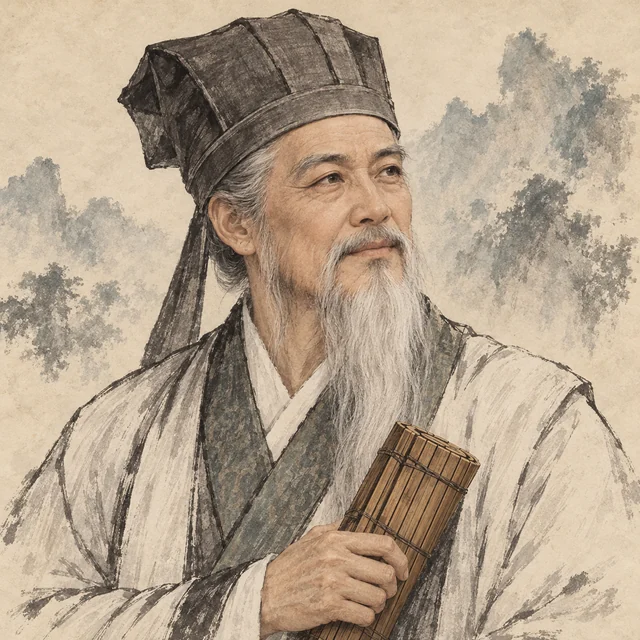
HISTORICAL PERSON
Xiang Lang
向朗
A Yicheng man from Xiangyang and pupil of Sima Hui; he rose to Superintendent of the Imperial Household and in old age collated classics by hand, teaching from his library past eighty.
This entry is supported by historical references, but does not yet have a conversation profile.
PRIMARY BIOGRAPHY
Biography
Xiang Lang, styled Juda, came from Yicheng in Xiangyang. The Jing province governor Liu Biao made him chief of Linju. When Liu Biao died he joined the First Sovereign, who, having settled the lands south of the Yangzi, put Xiang Lang in charge of the military and civil affairs of four counties — Zigui, Yidao, Wu and Yiling. Once Shu was pacified he was made administrator of Ba commandery, then transferred to Zangke and then Fangling.
After the Later Sovereign’s accession he became colonel of the foot soldiers and, succeeding Wang Lian, held the office of senior clerk of the chancellery. When Zhuge Liang marched south, Xiang Lang stayed behind to direct the affairs of the capital; in 227 he followed Zhuge Liang to Hanzhong. He had long been on close terms with Ma Su — when Ma Su fled after Jieting, Xiang Lang knew of it and did not report it; Zhuge Liang resented this and dismissed him from office, and he returned to Chengdu. Some years later he was made Superintendent of the Imperial Household, and after Zhuge Liang’s death was transferred to General of the Left; his former services were reviewed and he was enfeoffed Marquis of Xianming precinct with the rank of Specially Advanced.
In youth Xiang Lang had dabbled in letters but never cultivated pure conduct, and was known for administrative ability. From his dismissal as senior clerk he had nearly thirty unoccupied years — and turned them to the classics, tireless to the end: past eighty he still collated books with his own hand, correcting their errors, and amassed the greatest collection of his day. He opened his gates to guests, drew in younger scholars, discoursed only on ancient principles and never meddled in current affairs; for this he was honoured by all from the chief ministers down to the capped and uncapped youths. He died in 247. Cast out of the chancellery, he made himself the great bibliophile and collator of a generation — a second life’s work after the first had failed.
Life and role
- Primary role
- Shu Han official
- Active period
- Documented coverage: late Han through Shu Han
- Primary group
- Shu-Han
Affiliations across a lifetime
- 208–223
Commandant of four counties, administrator of three commanderies
Charged with four counties’ affairs after the south was settled; then administrator successively of Ba, Zangke and Fangling
- 223–228
Senior clerk of the chancellery
Held the capital during the southern campaign; dismissed for concealing Ma Su’s flight after Jieting
- 228–247
Thirty years among the books
Devoted himself to collation, still correcting texts past eighty; amassed the largest library of his time and shunned politics
HISTORICAL RECORD
Historical sources
- Records of the Three Kingdoms · Shu, Book 11 · 霍王向张杨费传 ↗
Chen Shou’s base text contains the biographies of Huo Jun (with his son Huo Yi), Wang Lian, Xiang Lang (with his nephew Xiang Chong), Zhang Yi (張裔), Yang Hong (with He Zhi), and Fei Shi. Luo Xian’s account appears only in Pei Songzhi’s annotation citing the Xiangyang Ji, not in Chen Shou’s base biography text.