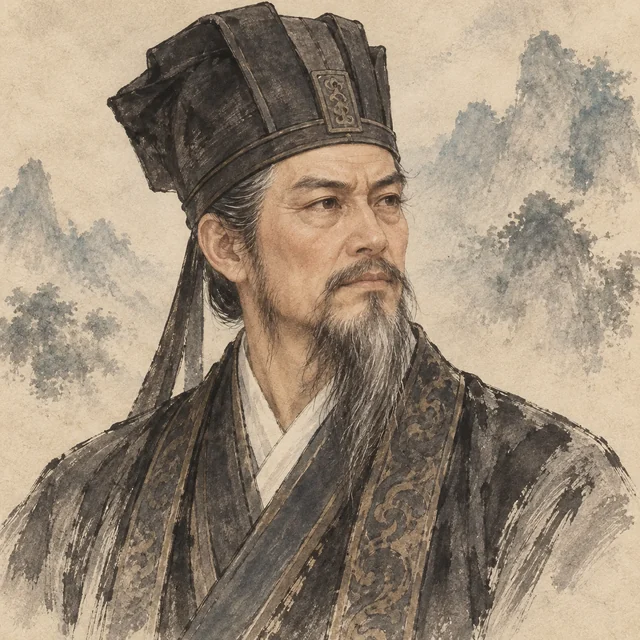
HISTORICAL PERSON
Xin Pi
辛毗
Serving Yuan Shao, Cao Cao, and the Wei court, Xin Pi was known for frank remonstrance and once used imperial authority to restrain Cao Pi’s campaign against Wu.
This entry is supported by historical references, but does not yet have a conversation profile.
PRIMARY BIOGRAPHY
Biography
Xin Pi, styled Zuozhi, came from Yangdi in Yingchuan. With his elder brother Xin Ping he followed Yuan Shao; when the Grand Progenitor, as Excellency of Works, summoned him, he could not answer. When Yuan Shang attacked his brother Yuan Tan at Pingyuan, Yuan Tan sent Xin Pi to the Grand Progenitor to ask for terms, and the Grand Progenitor was greatly pleased. Another day he asked Xin Pi: “Can Tan be trusted? Can Shang surely be beaten?” Xin Pi answered: “Ask not of faith or fraud, Your Grace — weigh only the shape of things. That Tan now begs your aid tells all. Defeated in arms abroad, his counsellors slain within, the brothers slandering and feuding, the state split in two, with drought, locusts and famine together — fool and wise alike know it is crumbling: this is Heaven’s hour for destroying Shang. March on Ye now: if Shang does not turn back to relieve it he cannot hold; if he turns back, Tan treads on his heels. With Your Grace’s might against an exhausted enemy, it is no more than a swift wind stripping autumn leaves. Of the realm’s foes none is greater than north of the river; settle the north and the six armies are strong and the realm shakes.” The Grand Progenitor said, “Good”, granted Yuan Tan terms, and the next year took Ye — and memorialised Xin Pi as court gentleman.
Later, when the Grand Progenitor sent the controller Cao Hong to settle Xiabian, Xin Pi and Cao Xiu went as his counsellors, with the order: “Of old the High Ancestor loved wealth and women, and Zhang Liang and Chen Ping corrected his faults — Zuozhi and Wenlie will not have a light care of it.” On the army’s return Xin Pi became senior clerk of the chancellery. At Emperor Wen’s accession he was made palace attendant and enfeoffed Marquis within the Passes. The emperor wished to move a hundred thousand military households of Ji province to people Henan; with locusts year on year and the people starving, the officers all judged it impossible, but the emperor’s will ran strong. Xin Pi sought audience with his fellow ministers; the emperor, knowing they came to remonstrate, received them with a dark face, and none dared speak. Xin Pi said: “Your Majesty wishes to move the military households — what is the reasoning?” — “Do you say I am wrong to move them?” — “Your servant truly thinks it wrong.” — “I will not discuss it with you.” — “Your Majesty, not thinking me worthless, placed me at your side among your counsellors — how can you not discuss it with me? What I say is no private matter but a care for the altars — how can you be angry at me?” The emperor, without answering, rose and went within; Xin Pi followed and caught hold of his robe; the emperor tugged free and would not return, and only after a long while came out and said: “Zuozhi — why do you press me so hard?” Xin Pi said: “The move now both loses the people’s hearts and gives them nothing to eat.” The emperor moved only half. Once, out shooting pheasants with the emperor, who said “what joy is pheasant-shooting!”, Xin Pi answered: “For Your Majesty, great joy; for your servants below, great hardship.” The emperor was silent — and afterwards went out the rarer for it.
Under Emperor Ming he was advanced to Marquis of Ying district. The secretariat supervisors Liu Fang and Sun Zi then stood high in the sovereign’s trust and cut off and decided the policy of the day; no great minister failed to court them — Xin Pi alone held no truck with them. His son Xin Chang remonstrated; Xin Pi said with a straight face: “My standing has its own roots and branches. At worst, being at odds with Liu and Sun means I never make one of the Three Excellencies — what harm is there in that? Since when does a true man destroy his high principles to become a duke?” While the emperor built palaces and the people toiled, Xin Pi memorialised that with Wu and Shu unvanquished and the grain harvests failing, frugality was the one care of the altars. In 234, when the General-in-chief, King Xuan of Sima, faced Zhuge Liang south of the Wei and repeatedly asked leave to fight, Emperor Ming, fearing he could not be restrained, made Xin Pi army’s counselor of the General-in-chief with the credentials; the six armies stood in awe, all under Xin Pi’s control, and none dared disobey. When Zhuge Liang died, Xin Pi returned as Commandant of the Guards. He died with the posthumous title Marquis Su.
Life and role
- Primary role
- Minister of the Guards
- Active period
- Documented coverage: Late Han and Cao Wei (c. 190–235)
- Primary group
- Cao-Wei
Affiliations across a lifetime
- 202–204
The counsel that took the north
Sent by Yuan Tan to treat, he read the Yuan collapse and turned Cao Cao on the north — Ye fell the next year
- 220–226
Holding the emperor’s robe
He seized the emperor’s robe against the great household transfer until it was halved; his “joy for you, hardship for us” thinned the hunts
- 234
With the credentials on the Wei river
He scorned Liu Fang and Sun Zi — “at worst I never make Excellency”; with the credentials before Zhuge Liang, not one of the six armies dared disobey
HISTORICAL RECORD
Historical sources
- Records of the Three Kingdoms · Wei, Book 25 · 辛毗杨阜高堂隆传 ↗
Chen Shou’s base text contains the biographies of Xin Pi, Yang Fu, and Gaotang Long (with Zhan Qian). The page also carries Pei Songzhi’s annotations, which should be identified separately.