HISTORICAL PERSON
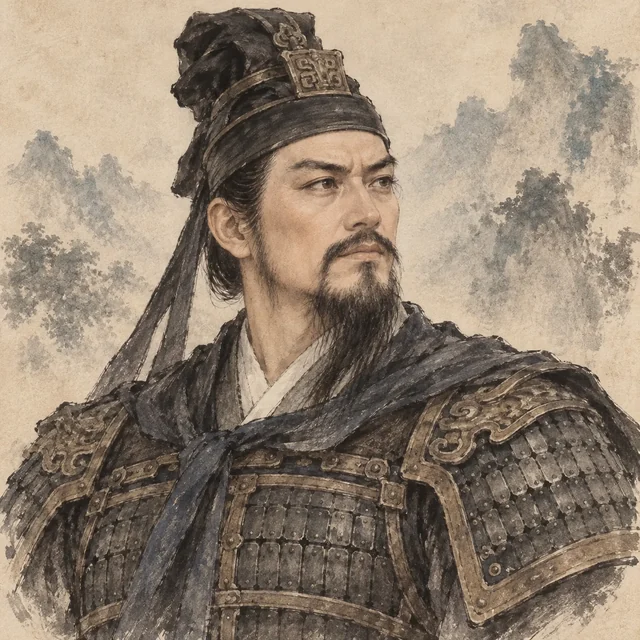
Xu Chu
许褚
Xu Chu led a local defense force before joining Cao Cao, served in close protection, and fought in campaigns including Guandu and Tong Pass.
This entry is supported by historical references, but does not yet have a conversation profile.
PRIMARY BIOGRAPHY
Biography
Xu Chu (dates uncertain), courtesy name Zhongkang, of Qiao, was massive of frame and unmatched in strength. When the dynasty collapsed he fortified a wall with several thousand youths and kinsmen. Ten thousand Gebei bandits attacked; his arrows spent, Xu Chu had the men pile head-sized stones at the corners and hurled them himself — whatever they struck was smashed. When grain ran out he feigned a truce to trade oxen for food; when the bandits led the oxen off, the beasts bolted home, and Xu Chu strode out, seized one by the tail, and dragged it backward a hundred paces. The bandits fled without the oxen, and the whole region between the Huai and the Liang came to dread his name.
When Cao Cao campaigned through the Huai, Xu Chu brought his followers over. “This is my Fan Kuai,” Cao Cao said, and made him commandant of the bodyguard that day. At Guandu, attendants led by Xu Ta plotted assassination but feared him; waiting for his rest day, they entered the tent with hidden blades. Xu Chu, uneasy below, had returned at once; Xu Ta’s face betrayed him, and Xu Chu killed them all. From then Cao Cao kept him inseparable at his side.
At the Tong Pass in 211, Cao Cao crossed the Ji River north with the army and stayed on the south bank with only Xu Chu and a hundred tiger-guards to cover the crossing. Ma Chao fell on them with ten thousand, arrows raining down. Xu Chu urged Cao Cao aboard, cut down soldiers clawing at the gunwales, shielded Cao Cao with a saddle in his left hand, and when the boatman died by a stray shaft, poled the boat out himself with his right. That day, without Xu Chu, Cao Cao had nearly been lost. Days later Cao Cao met Ma Chao horse-to-horse with Xu Chu alone attending; Ma Chao, meaning to charge, asked, “Where is this Tiger Marquis of yours?” Cao Cao pointed; Xu Chu glared, and Ma Chao dared not move. The army nicknamed him “Tiger-Fool.” Under Emperor Wen he commanded the palace guard as General of Martial Guards — the title began with him. When Cao Cao died, Xu Chu wailed until he vomited blood. He died under Emperor Ming, posthumously Zhuang-hou, “the Stalwart.”
Life and role
- Primary role
- Palace guard commander
- Active period
- Late Eastern Han to Cao Wei
- Primary group
- Cao-Wei
Affiliations across a lifetime
- ?–197
Local stronghold
Held off ten thousand bandits; dragged an ox backward by the tail
- 197–after 227
Bodyguard, then General of Martial Guards
Killed the plotters in the tent; shielded Cao Cao at the Ji River; stared Ma Chao down
HISTORICAL RECORD
Historical sources
- Records of the Three Kingdoms · Wei, Book 18 · Biographies of the Two Lis, Zang, Wen, Lü, Xu, Dian, Two Pangs, and Yan ↗
Chen Shou’s base text: biographies of Li Dian, Li Tong, Zang Ba (including Sun Guan), Wen Pin, Lü Qian (including Wang Xiang), Xu Chu, Dian Wei, Pang De, Pang Yu (including his mother Zhao E), and Yan Wen (including Zhang Gong). Pei Songzhi’s annotations are separately registered.