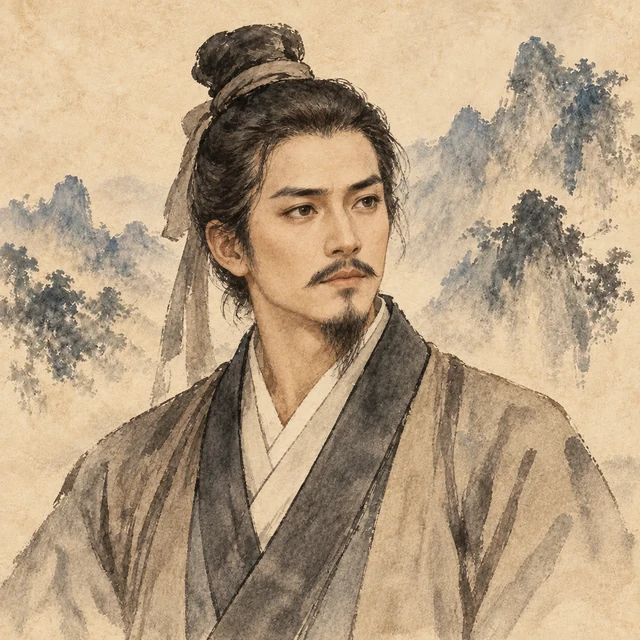
HISTORICAL PERSON
Xu Gan
徐干
The text records Xu Gan as an official in the Office of the Excellency of Works and as a literary aide to the Heir Apparent, and includes Cao Pi’s assessment of his writings.; The cited biography describes Xu Gan’s scholarship and says appointments were affected by illness.
This entry is supported by historical references, but does not yet have a conversation profile.
PRIMARY BIOGRAPHY
Biography
Xu Gan, styled Weichang, was from Ju in Beihai. By nature tranquil and few in desires, he did not covet glory or gain, but gave his whole mind to his writings. In the Jian’an years the Grand Ancestor specially honored him with appointment, making him a clerk under the libationer of the ministry of works’ military councils, and he transferred to be a literary scholar to the general of the gentlemen of the household.
He held office light as a feather and loved the old books; though he held a place among the officers, it was not his delight. When pestilence spread and men of parts fell, Xu Gan too was struck by the sickness of the season.
Emperor Wen judged him in the Discourse on Literature: “Of these seven masters, in learning nothing was left out, and in expression nothing borrowed,” and wrote in his letter to Wu Zhi, “Weichang alone cherished letters and embraced substance, tranquil and few in desires, with the resolve of a Mount Ji recluse — truly a gentleman in whom substance and refinement meet. His Zhonglun in more than twenty essays, elegant in phrase and meaning, is fit to be handed down to later ages — in this man is what does not decay.” He died in Jian’an 22.
Life and role
- Primary role
- Scholar and writer
- Active period
- Documented coverage: late Han through Cao Wei
- Primary group
- Cao-Wei
Affiliations across a lifetime
- Jian’an era
Literary scholar to the heir of Wei
Tranquil and few in desires; his Zhonglun, praised by Cao Pi as fit to outlast him, in more than twenty essays
HISTORICAL RECORD
Historical sources
- Records of the Three Kingdoms · Wei, Book 21 · 王卫二刘傅传 ↗
Chen Shou’s base text contains the biographies of Wang Can (with attached biographies of Xu Gan, Chen Lin, Ruan Yu, Ying Yang, Liu Zhen, Handan Chun, Fan Qin, Lu Cui, Ding Yi (丁仪), Ding Yi (丁廙), Yang Xiu, Xun Wei, Ying Qu, Ruan Ji, Ji Kang, and Wu Zhi), Wei Ji, Liu Yi, Liu Shao (with attached biographies of Miao Xi, Zhong Changtong, Su Lin, Xiahou Hui, Sun Gai, and Du Zhi), and Fu Gu. The Wei Dan material is in a Pei Songzhi annotation on Liu Shao’s biography, citing the Wenzhang Xulu; identify it as an annotation, not Chen Shou’s base text.
- Records of the Three Kingdoms, with Pei Songzhi annotations · Pei Songzhi annotations to Wei, Book 21 · Wang, Wei, Liu, and Fu biographies ↗
Embedded citations to Wei Lue, Wei Shu, Biographies of the Literary Men, and other works; attributed accounts are kept separate from Chen Shou’s base text.