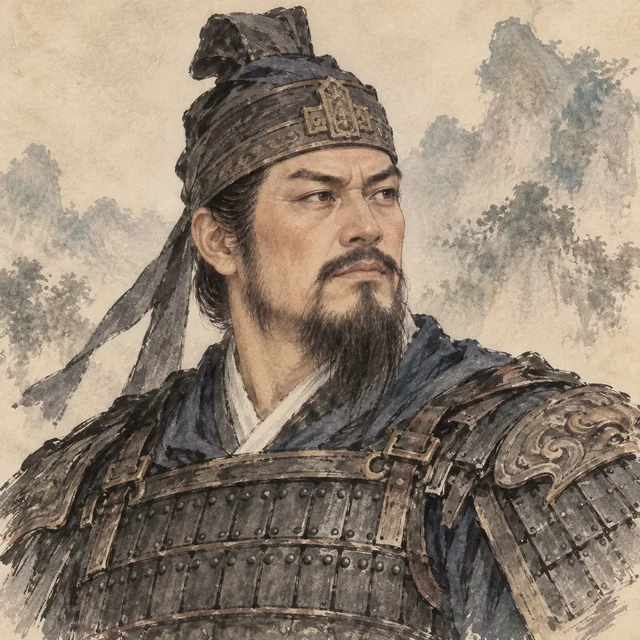
HISTORICAL PERSON
Xu Huang
徐晃
Xu Huang served under Yang Feng before joining Cao Cao and became a senior commander; the biography records his campaigns against Yuan Shao, Ma Chao, Zhang Lu, Liu Bei, and Guan Yu.
This entry is supported by historical references, but does not yet have a conversation profile.
PRIMARY BIOGRAPHY
Biography
Xu Huang (d. 227), courtesy name Gongming, came from Yang county in Hedong. A county clerk who rose through the cavalry under the general Yang Feng, he urged Yang Feng in 196 to escort Emperor Xian east to Luoyang and was enfeoffed for it; when the court fell to feuding he urged Yang Feng to join Cao Cao. Yang Feng wavered and refused; Cao Cao attacked him at Liang, and Xu Huang went over to Cao Cao.
Under Cao Cao he campaigned everywhere: against Liu Bei in Xu province, against Lü Bu, at Baima against Yan Liang, at Yanjin against Wen Chou — each time with merit. During the Guandu standoff, Cao Cao sent Xu Huang and Shi Huan to intercept Yuan Shao’s grain convoy at Gushi, and they burned the stores, helping decide the campaign. He followed the army to Ye, Pingyuan and Liucheng.
In 208 Cao Cao marched on Jingzhou; Xu Huang garrisoned Fancheng, put down the hill tribes of Zhonglu, Linju and Yicheng, and after the Red Cliffs defeat fought Guan Yu at Hanjin and Zhou Yu at Jiangling. At Weinan in 211, with Ma Chao blocking the Tong pass, Cao Cao asked Xu Huang for a plan: Xu Huang led four thousand picked troops across at the Puban ford first and fortified the west bank. Before his palisade was even finished, Liang Xing attacked by night with five thousand men; Xu Huang threw him back, the main army crossed, and the Guanzhong campaign turned.
In autumn 219 Guan Yu besieged Cao Ren in Fancheng, and the flooded Han river had drowned Yu Jin’s seven armies. Cao Cao sent Xu Huang to the rescue with mostly new recruits; unable to fight head-on, Xu Huang feinted at cutting Guan Yu’s rear with a long trench, took Yancheng when the Shu troops burned their camp and withdrew, and pushed his linked camps to within three zhang of Guan Yu’s lines. Twelve reinforcement camps arrived. Guan Yu’s main body was at Weitou with a second camp at Sizhong; Xu Huang threatened Weitou and struck Sizhong in secret. Guan Yu came out with five thousand men, was beaten, and Xu Huang chased the fleeing enemy straight through their own perimeter, breaking the siege; many of Guan Yu’s men drowned in the Mian. Cao Cao’s citation: the enemy’s tenfold abatis, stormed in one rush — "in thirty years of war I have never seen a general drive headlong into an enemy’s siege lines; the relief of Fan and Xiangyang surpasses the deeds of Sun Wu and Rangju." When Xu Huang returned to Mobi, Cao Cao rode seven li to meet him and raised a cup: "the saving of Fan and Xiangyang is your work." Reviewing the assembled armies, Cao Cao saw every camp’s soldiers leave ranks to gawk — except Xu Huang’s, whose men stood fast — and sighed: "General Xu has the air of Zhou Yafu."
Under Cao Pi, Xu Huang became General of the Right and Marquis of Yangping. He helped Xiahou Shang take Shangyong from the Shu commander Liu Feng, and under Emperor Ming repelled the Wu general Zhuge Jin at Xiangyang. He died in 227, receiving the posthumous title Robust Marquis, and left orders for a plain burial — a commander to the end, noted for discipline, foresight, and fortifying before he fought.
Life and role
- Primary role
- General of the Right
- Active period
- Late Eastern Han to Cao Wei
- Primary group
- Cao-Wei
Affiliations across a lifetime
- Before 196
Yang Feng’s cavalry officer
Urged Yang Feng to escort Emperor Xian east, then to join Cao Cao.
- 196–208
Cao Cao’s campaigning general
Fought at Baima, Yanjin, and burned the grain convoy at Gushi during Guandu.
- 208–219
Jingzhou and Guanzhong fronts
Fought Guan Yu at Hanjin after Red Cliffs; his night-ford at Puban opened the Weinan campaign.
- 219
Savior of Fancheng
Broke Guan Yu’s siege lines in a headlong assault; Cao Cao compared him to Sun Wu, Rangju, and Zhou Yafu.
- 220–227
Wei General of the Right
Took Shangyong from Liu Feng and held Xiangyang against Zhuge Jin; died in 227.
HISTORICAL RECORD
Historical sources
- Records of the Three Kingdoms · Wei, Book 17 · Biographies of Zhang Liao, Le Jin, Yu Jin, Zhang He, and Xu Huang ↗
Chen Shou’s base text: biographies of Zhang Liao, Le Jin, Yu Jin, Zhang He, and Xu Huang, plus the attached account of Zhu Ling. Pei Songzhi’s annotations are registered separately.
- Records of the Three Kingdoms, with Pei Songzhi annotations · Pei Songzhi annotations to Wei, Book 17 ↗
Annotations to Wei Book 17, including extracts from Fu Zi, Sun Sheng, Wei Shu, Han Jin Chunqiu, Wei Lue, and Jiuzhou Chunqiu. These accounts and Pei’s judgments are kept distinct from Chen Shou’s base text.