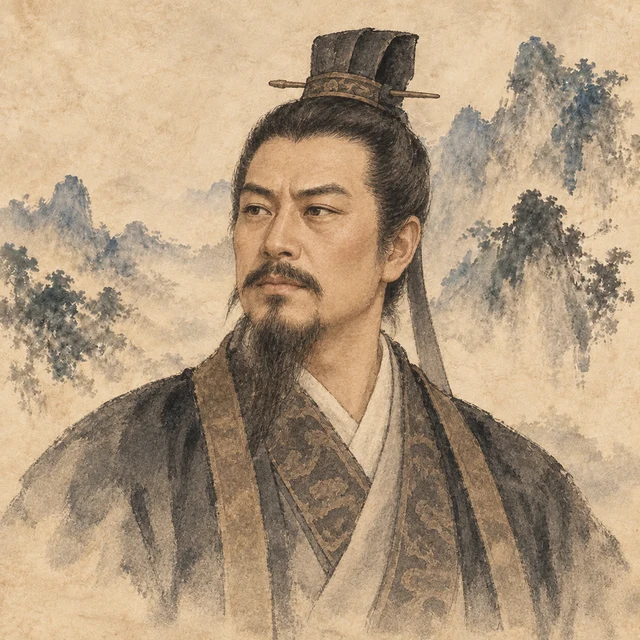
HISTORICAL PERSON
Xu Miao
徐邈
A Ji man from the Yan principality; as Inspector of Liang he pacified the Hexi region and rose to Minister of Works, known for incorruptibility.
This entry is supported by historical references, but does not yet have a conversation profile.
PRIMARY BIOGRAPHY
Biography
Xu Miao, styled Jingshan, was from Ji in Yan. When the Grand Ancestor pacified the land north of the Yellow River he summoned him as a military-planning clerk of the chancellery, tried him as prefect of Fenggao, and brought him into the eastern bureau as a consulting clerk; at the founding of the Wei kingdom he was a secretariat gentleman. Wine was then banned by statute, but Xu Miao drank in private to a stupor, and when the inspector Zhao Da asked him about office business he answered, “Struck by the sage.” Zhao Da reported it and the Grand Ancestor was furious, but the general who crosses the Liao, Xianyu Fu, interceded: “Tipsy guests call the clear wine sage and the cloudy worthy; Xu Miao is by nature prudent and merely spoke drunk” — and so he escaped punishment. He later held Longxi as administrator and transferred to Nan’an.
Under Emperor Wen he served successively as chancellor of Qiao, administrator of Pingyang and Anping, and gentleman of the household for agriculture in Yingchuan, renowned in each post and enfeoffed a marquis within the passes. When the carriage visited Xuchang the emperor asked him, “Been struck by the sage lately?” Xu Miao replied, “Of old Zifan died at Guyang and Yushu was punished for drink; my craving matches those two worthies, I cannot chastise myself, and I am struck from time to time. Yet Sui Liu was remembered for her very ugliness, and your servant is remembered for his drunkenness.” The emperor laughed heartily, looked about him, and said, “His name is not empty,” and made him military counselor to the general who soothes the army. Emperor Ming, judging Liang province remote and bordering the Shu foe, made him its inspector with credentials and the colonelcy protecting the Qiang. He arrived just as Zhuge Liang came out at Mount Qi and the three commanderies west of the Long revolted, and at once sent his staff officers with the administrator of Jincheng to smash the rebels at Nan’an.
West of the river rain was scarce and grain always short; Xu Miao memorialized the repair of the Wuwei and Jiuquan salt ponds to trade for barbarian grain, opened paddy fields on a broad scale and enrolled the poor to tenant them, until every household was full and the granaries overflowed. With the surplus beyond the province’s military needs he bought gold, silk, dogs, and horses for the central realm; gradually he gathered in the people’s private arms and stored them in the arsenal; then he led with benevolence and righteousness — founded schools, made instruction plain, banned lavish burials, cut off licentious cults, advanced the good, and dismissed the wicked — until the moral transformation spread wide and the people gave him their hearts; that the Western Regions opened their trade and the far Rong sent tribute was all his achievement. Chastising the rebel Qiang Kewu won him a fief as marquis of a chief precinct with three hundred households and the title general who establishes might. In dealing with the Qiang and Hu he ignored small faults, but for capital crimes he first informed the tribal chief, then executed the man as a public example, so that they submitted in trust and awe. His rewards he distributed entirely among his officers, keeping nothing for his own house, so that his wife and children went short of food and clothing — which the Son of Heaven praised, supplying his household from the throne. In Zhengshi 1 he returned as grand minister of agriculture, then rose to colonel director of the retainers, whom all officials held in awe. Leaving on public business, he was later made grandee glorious and grand, and when offered the ministry of works he sighed, “The three excellencies are offices for deliberating the Way; lacking the right man they stand empty — how could I disgrace one, old and sick?” and firmly declined. He died in Jiaping 1 at seventy-eight, posthumously named Mu.
Life and role
- Primary role
- Cao Wei official
- Active period
- Documented coverage: late Han through Cao Wei
- Primary group
- Cao-Wei
Affiliations across a lifetime
- Huangchu era
The “struck by the sage” exchange
Escaped the wine ban through Xianyu Fu’s wit, and his repartee at Xuchang made the emperor laugh and promote him
- Taihe era
Inspector of Liang province
Broke the revolted commanderies, restored the salt ponds and paddies, and reopened the Western Regions’ tribute and trade
HISTORICAL RECORD
Historical sources
- Records of the Three Kingdoms · Wei, Book 27 · 徐胡二王传 ↗
Chen Shou’s base text contains the biographies of Xu Miao, Hu Zhi, Wang Chang, and Wang Ji. The concluding evaluation is separate from the biographies.