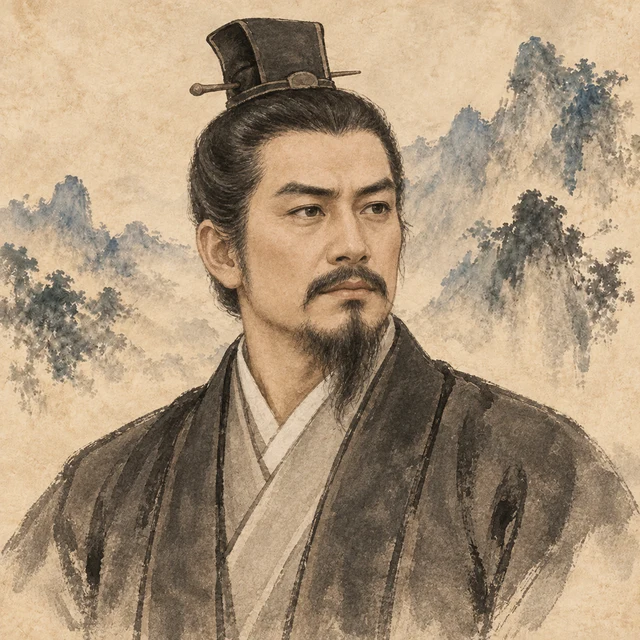
HISTORICAL PERSON
Xu Xuan
徐宣
A native of Haixi in Guangling who fled south and later returned north to Cao Cao; he served Wei up to Supervisor of the Left and was esteemed under Emperor Ming for his plain honesty.
This entry is supported by historical references, but does not yet have a conversation profile.
PRIMARY BIOGRAPHY
Biography
Xu Xuan, styled Baojian, came from Haixi in Guangling. Having fled the turmoil to Jiangdong, he declined Sun Ce’s call and returned home, where he and Chen Jiao served together as the commandery’s senior officers — equal in fame though never friends — both valued by Administrator Chen Deng and at one with him in loyalty to the Grand Progenitor. When the people of Haixi and Huaipu rose, the commandant Wei Mi and prefect Liang Xi fled by night to Xu Xuan’s house, and he sent them secretly to safety. When the commander Hu Zhi, sent against the rebels, would not advance for want of troops, Xu Xuan saw him privately, reproved him and showed him the shape of things — Hu Zhi advanced and broke them. The Grand Progenitor engaged him as an Excellency’s clerk, prefect of Dongmin and Fagan, administrator of Qi commandery, then supervisor of the gate, following to Shouchun. When Ma Chao rebelled and the host marched west, the Grand Progenitor told his officers: “I march far while this quarter is unsettled — my rear is my worry. I need a man of pure impartiality and great virtue to hold it” — and made Xu Xuan Protector of the Army of the left, commanding the remaining host. Returning, he was made east bureau clerk of the chancellery, then administrator of Wei commandery.
When the Grand Progenitor died at Luoyang and the ministers entered the hall to mourn, someone proposed replacing all the city garrisons with men of Qiao and Pei. Xu Xuan said in a stern voice: “Now that far and near are one and every heart is loyal, why Qiao and Pei men — and so chill the hearts of those who keep the watch?” Emperor Wen, hearing of it, said: “This is what is meant by a minister of the altars.” At the accession Xu Xuan was made deputy imperial censor, enfeoffed Marquis within the Passes, moved to commandant of the city gates, then colonel-director of retainers within the month, then attendant cavalier. Following the emperor to Guangling as the six armies took ship, a storm burst and the imperial boat was thrown about; Xu Xuan, sick and to the rear, pressed through the waves ahead of every officer — the emperor thought it heroic and made him a Master of Writing.
Under Emperor Ming he was enfeoffed Marquis of Jinyang precinct. The general of the centre army Huan Fan recommended him as one whose conduct was loyal and generous, whose nature upright and bright, refined and standing apart from the crowd, immovably firm, with the quality of the altars; the emperor made him deputy of the left of the Masters of Writing, later palace attendant and Grandee of Glorious Favour. When the carriage went to Xuchang, Xu Xuan directed the affairs left behind; on the emperor’s return the keepers presented the documents, and the edict said: “My reading them — how would that differ from the deputy’s?” — and he never looked. When the master of the imperial workshop was cruelly examined to death, Xu Xuan memorialised against the excess of awe and punishment, and again against the palace works that exhausted the people’s strength; the emperor praised and accepted both by his own hand. At sixty-eight Xu Xuan, citing the rite of hanging up one’s carriage at seventy, firmly pleaded illness to retire; the emperor would never permit it. He died in 236, leaving orders for a commoner’s dress and plain kerchief and burial in the clothes of the season. The edict praised him: “solid in substance, straight within and square without, serving through three reigns with impartial brightness — he had the quality to receive an orphan and a realm: a pillar-and-cornerstone minister.” His posthumous title was Marquis Zhen.
Life and role
- Primary role
- Cao Wei official
- Active period
- Documented coverage: late Han through Cao Wei
- Primary group
- Cao-Wei
Affiliations across a lifetime
- 211
Protector of the Army, holding the rear
Chosen as the man of “pure impartiality and great virtue” to hold all remaining forces while Cao Cao marched west against Ma Chao
- 220
“A minister of the altars”
His stern rebuke killed the proposal to restaff the garrisons with Qiao–Pei men; Emperor Wen called him a minister of the altars
- 226–236
Deputy of the left, holding the capital
So trusted that the emperor refused to review the papers of his administration in the capital; his memorials against harsh punishment and palace works were praised by the imperial hand
HISTORICAL RECORD
Historical sources
- Records of the Three Kingdoms · Wei, Book 22 · 桓二陈徐卫卢传 ↗
Chen Shou’s base text contains the biographies of Huan Jie, Chen Qun (with his son Chen Tai), Chen Jiao, Xu Xuan, Wei Zhen, and Lu Yu. The concluding evaluation is separate from the biographies.