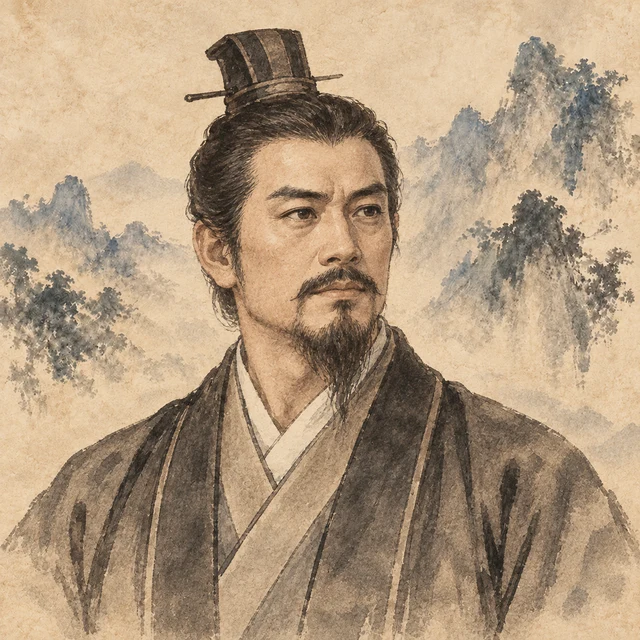
HISTORICAL PERSON
Yang Fu
杨阜
A Ji man from Tianshui who joined Jiang Xu in rising against Ma Chao; he served in Liang Province posts and as Privy Treasurer of Wei, famed for fearless remonstrance.
This entry is supported by historical references, but does not yet have a conversation profile.
PRIMARY BIOGRAPHY
Biography
Yang Fu, styled Yishan, came from Ji in Tianshui. As an aide of the province he was sent by the governor Wei Duan to Xu and made senior clerk of Anding. On his return the generals west of the passes asked him which way Yuan and Cao would go; Yang Fu said: “Duke Yuan is generous but irresolute, fond of plans and slow to decide; irresolute he lacks awe, slow he misses the moment — strong as he is now, he cannot finish the great work. Duke Cao has heroic gifts and far designs, decides the hinge without doubt, his law is one and his soldiers keen, and he uses men beyond the common measure, each to the full of his strength — he can carry the great affair through.” Finding the clerkship not to his taste he left office; when Wei Duan was called in as Grand Coachman and his son Wei Kang succeeded as inspector, Yang Fu was engaged as his aide, recommended filial-and-incorrupt and summoned by the chancellery, and kept by the province as an army consultant.
When Ma Chao, beaten south of the Wei, fled to shelter among the tribes, the Grand Progenitor pursued him to Anding but had to hurry east on Su Bo’s revolt in Hejian. Yang Fu, then on a mission, warned him: “Ma Chao has the valour of a Han Xin or an Ying Bu and has deeply won the Qiang and Hu; the western province fears him. If the great host withdraws without strict provision, the commanderies up the Long will be the state’s no longer.” The Grand Progenitor approved, but the army’s haste left the provision incomplete. Ma Chao led the tribal chieftains against the commanderies up the Long, and all answered him — only Ji city held out for province and commandery. Ma Chao gathered all the hosts west of the Long, and Zhang Lu sent his general Yang Ang to help — over ten thousand against the city. Yang Fu led the state’s officers and gentry and his own clansmen who could bear arms, over a thousand, and set his cousin Yang Yue in a crescent-moon camp on the walls; they fought Ma Chao from the first month to the eighth with no relief in sight. The province sent the aide Yan Wen out by night along the water to beg aid; Ma Chao killed him. The inspector and the administrator lost heart and first spoke of surrender. Yang Fu wept and remonstrated: “We have led our fathers, brothers and sons and younger kin to hearten one another in duty — death, but no second thought. Tian Dan’s defence was no more than this. To cast away a work near completion and take the name of the faithless — I hold to the death.” And he wailed aloud. The inspector and administrator in the end sent to ask terms and opened the gates; Ma Chao entered, held Yang Yue in Ji, and had Yang Ang kill the inspector and the administrator.
Yang Fu nursed within the will to strike back, awaiting his moment. Presently he asked leave to bury his wife. His cousin Jiang Xu garrisoned Licheng; visiting Jiang Xu and his mother, Yang Fu spoke of what had passed in Ji and wept bitterly: “I could not keep the city whole nor die with my lord — what face have I to draw breath under heaven! Ma Chao betrayed his father and rebelled against his sovereign and butchered the province’s generals — the shame is not mine alone but the whole province’s. You hold troops and rule by your own word yet have no heart to punish the traitor: this is why the record writes Zhao Dun’s regicide. Ma Chao is strong but without right, full of openings and easy to undo.” Jiang Xu’s mother, stirred, bade her son follow Yang Fu’s plan; with Jiang Yin, Zhao Ang, Yin Feng, Yao Qiong, Kong Xin, Li Jun, Wang Ling, Liang Kuan, Zhao Qu and Pang Gong the plot was bound. In the ninth month of 212 they rose at Lucheng; Ma Chao came out in person, whereupon Zhao Qu and Liang Kuan freed Yang Yue, shut the gates of Ji and slaughtered Ma Chao’s wife and children. Ma Chao stormed Licheng and took Jiang Xu’s mother; she cursed him: “You unfilial traitor who betrayed your father and slew your lord — will heaven and earth suffer you long?” He killed her in rage. Yang Fu fought Ma Chao, took five wounds, and lost seven of his clansmen and cousins — and Ma Chao fled south to Zhang Lu. When the lands west of the Long were settled and the Grand Progenitor rewarded the service against Ma Chao, eleven were enfeoffed and Yang Fu was granted the rank of Marquis within the Passes. He declined: “While my lord lived I had no service of shielding him; when he died I rendered no constancy of dying with him. By right I should be dismissed, by law executed; and Ma Chao is not dead — I may not idly bear rank and stipend.” The Grand Progenitor answered: “You and the host of worthies built the great work together, and the western lands tell of it with praise. When Zigong declined a reward Confucius called it the obstruction of goodness. Lay open your heart and obey the state’s command.” On the Hanzhong campaign Yang Fu was made inspector of Yi province; recalled, he was appointed administrator of Jincheng and, before setting out, transferred to Wudu. He moved over ten thousand households of settlers and Di tribesmen into the borders of Jingzhao, Fufeng and Tianshui and shifted the commandery seat to Xiaohuaili — the people followed carrying their infants on their backs. He governed by the great outlines only, and those below could not bear to deceive him. When Emperor Wen asked the attendants what manner of man the administrator of Wudu was, all said Yang Fu had the quality of the Three Excellencies. Under Emperor Ming he was commandant of the city gates, then Court Architect, then Privy Treasurer. Seeing the emperor once in an embroidered cap and a pale silk half-sleeve, he asked, “What ritual garb is this, in the rites?” The emperor was silent and did not answer — and never again came before Yang Fu but in proper dress. His memorials against the palaces, the hunts and the costs of the harem were many and piercing to the utmost. He died in service.
Life and role
- Primary role
- Cao Wei official
- Active period
- Documented coverage: late Han through Cao Wei
- Primary group
- Cao-Wei
Affiliations across a lifetime
- 211
Foreseeing Ma Chao
Warned before the army withdrew that the Long commanderies would be lost without strict provision — and so it proved
- 212
The defence of Ji and the rising at Lucheng
Held Ji eight months and wept against surrender; then rose with Jiang Xu — five wounds, seven kinsmen dead — and drove Ma Chao south
- 212–230s
Moving Wudu’s people; the question of the cap
Ten thousand households followed him carrying their infants; one question on the emperor’s undress ended it forever
HISTORICAL RECORD
Historical sources
- Records of the Three Kingdoms · Wei, Book 25 · 辛毗杨阜高堂隆传 ↗
Chen Shou’s base text contains the biographies of Xin Pi, Yang Fu, and Gaotang Long (with Zhan Qian). The page also carries Pei Songzhi’s annotations, which should be identified separately.