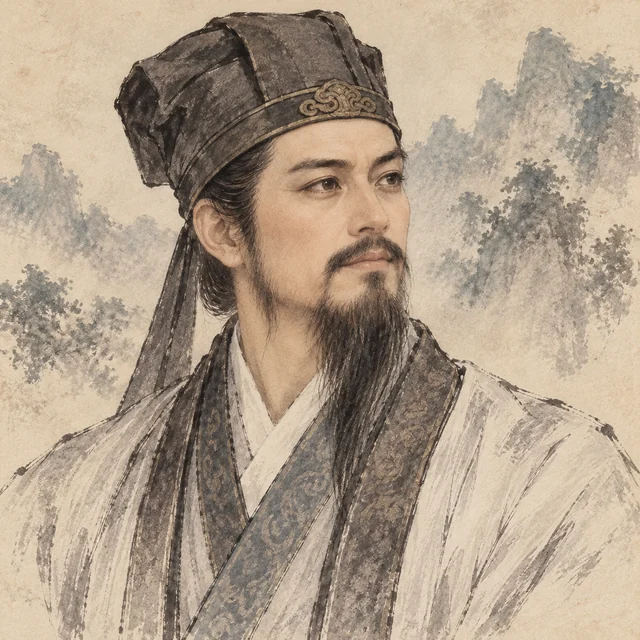
HISTORICAL PERSON
Yang Hu
羊祜
Jin’s commander in Jingzhou, based at Xiangyang: he stockpiled grain, treated Wu across the frontier with scrupulous courtesy opposite Lu Kang, pressed the case for conquering Wu, and named Du Yu his successor.
This entry is supported by historical references, but does not yet have a conversation profile.
PRIMARY BIOGRAPHY
Biography
Yang Hu (221–278), courtesy name Shuzi, came from Nancheng in Taishan, descended from the Han official Yang Xu; his mother was a daughter of the scholar Cai Yong, and his sister married Sima Shi — posthumously the Jingxian Empress of Jin. Learned from youth, tall and striking, a superb conversationalist, he served the late Wei court in the secretariat and the chancellor’s office, sharing confidential business with Xun Xu.
When Sima Yan founded Jin in 265, Yang Hu was honored for his part in the succession with the title General of the Center and a fief as Viscount of Juping, commanding the palace guard. Modest by nature, he repeatedly declined added rank and fiefs, and court and country revered him for it.
In 269, with the conquest of Wu in mind, Emperor Wu made Yang Hu area commander of Jingzhou, based at Xiangyang. There he won the hearts of the Han river country: he dealt in open good faith with the people of Wu, letting any defector who wished to return go home, and he opened more than eight hundred qing of colony farmland — when he arrived the army had less than a hundred days’ grain; when he left it, ten years’ stores.
Facing the Wu general Lu Kang across the frontier, the two kept an exact and courteous peace: Yang Hu drank without suspicion the wine Lu Kang sent, and Lu Kang took at once the medicine Yang Hu sent when he fell ill. When Sun Hao reproached Lu Kang for it, Lu Kang replied that even a village cannot do without good faith, let alone a great state. Yang Hu’s army, passing through Wu territory, repaid in silk every sheaf of grain it cut; his hunts stopped at the border, and game wounded by Wu hunters that fell on Jin soil was returned.
In 276 Yang Hu memorialized for the conquest of Wu: Sun Hao’s cruelty had alienated his own state, and the moment would not wait. When the court hesitated, he sighed that "nine times out of ten the world falls short of our wishes — here is a case where a decision refused will be regretted by those who come after." Ill, he came to court to argue the plan in person, and on his sickbed recommended Du Yu as his successor.
Yang Hu died in 278 at fifty-eight. The emperor mourned in plain dress on a day of great cold, and his tears froze on his beard. In Jingzhou the people left their markets and wailed in the lanes, and even the Wu border soldiers wept. The people of Xiangyang raised a stele and temple on Mount Xian, where Yang Hu had loved to roam; everyone who looked on the stele wept, and Du Yu named it "the stele of falling tears." Two years after his death Wu fell, and when the ministers raised their cups in congratulation, the emperor wept and said: "This was the work of the Grand Tutor Yang."
Life and role
- Primary role
- Western Jin General who Conquers the South
- Active period
- Documented coverage: the Wei–Jin transition and early Western Jin
- Primary group
- Western Jin
Affiliations across a lifetime
- Before 265
Late Wei · Sima confidence
Brother-in-law of Sima Shi; handled confidential business in the chancellor’s office with Xun Xu.
- 265–269
Jin · General of the Center
Enfeoffed as Viscount of Juping for his part in the founding; commanded the palace guard.
- 269–278
Jin · commander at Xiangyang against Wu
Won the Han river country by good faith, farmed ten years of grain, kept an honored peace with Lu Kang, and pressed the case for conquering Wu.
- 278
Death and the stele of falling tears
Recommended Du Yu from his deathbed; Wu fell two years later and the emperor credited "the work of the Grand Tutor Yang."
HISTORICAL RECORD
Historical sources
- Records of the Three Kingdoms · Wu, Book 13 · Biography of Lu Xun, with Lu Kang ↗
Chen Shou’s base text contains the biographies of Lu Xun and Lu Kang. Lu Kang’s account narrates Bu Chan’s defection and Yang Hu’s campaign toward Jiangling. The page also carries Pei Songzhi’s annotations, which should be identified separately.
- Book of Jin · Annals 3 · Emperor Wu ↗
Use the named biography or chronicle entry in this volume; compare it with the Three Kingdoms record where sources differ.
- Book of Jin · Book 34 · Biographies of Yang Hu and Du Yu ↗
Du Yu’s biography: planning the conquest of Wu and the Jingzhou command.