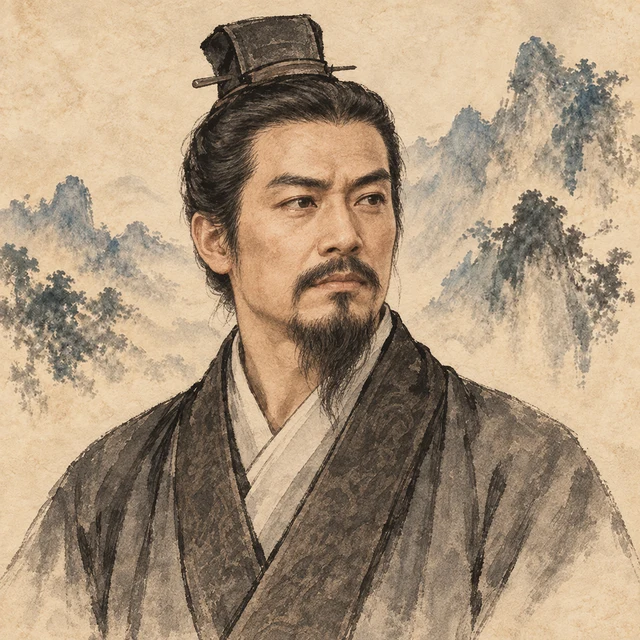
HISTORICAL PERSON
Yang Jun
杨俊
A Huojia man from Henei; as Administrator of Nanyang he promoted schooling and humane rule, but later fell afoul of Cao Pi and killed himself.
This entry is supported by historical references, but does not yet have a conversation profile.
PRIMARY BIOGRAPHY
Biography
Yang Jun, styled Jicai, was from Huojia in Henei. He studied under Bian Rang of Chenliu, who thought him extraordinary. Judging that with war rising Henei, sitting at a crossroads, must become a battlefield, he led the aged and weak of more than a hundred households to the hills of Jing and Mi, relieving the poor and sharing what he had along the way; six families among his kin and acquaintance had been seized and made slaves, and Yang Jun spent his whole fortune redeeming them. Meeting the sixteen-year-old future Emperor Xuan, he said, “This is no ordinary man”; and of Sima Lang’s elder clansman Sima Zhi, then unknown, he said, “Though Zhi’s early fame falls short of Lang’s, in substance he may prove the better.” Moving on to Bing province, he found his townsman Wang Xiang — orphaned, enslaved, and beaten for reading while he tended sheep at seventeen or eighteen — admired his quality, redeemed him into his own household, saw him married and housed, and only then parted from him.
The Grand Ancestor appointed him prefect of Quliang, then brought him into the chancellery, recommended him as flourishing talent, and made him prefect of Anling and then administrator of Nanyang, where he proclaimed civil instruction, founded schools, and was praised by officers and people. He transferred to be military counselor of the southern campaign, and at the founding of the Wei kingdom became commandant of the capital. When the Grand Ancestor was campaigning in Hanzhong and Wei Feng revolted at Ye, Yang Jun impeached himself and went to the field headquarters. From youth to age he made the judgment of men his own charge: Shen Gu of his commandery and Wei Xun of Chenliu both came up from the ranks, and through his patronage and praise both became worthy officers — Shen Gu ending as an administrator, Wei Xun as a clerk and prefect — and his clear discernment and righteous conduct were all of this kind.
Earlier the Marquis of Linzi, Cao Zhi, had been friendly with Yang Jun. While the Grand Ancestor’s succession was unsettled, the throne secretly consulted the officers, and though Yang Jun weighed the talents of both the future Emperor Wen and the Marquis of Linzi without committing himself, he praised the marquis the more warmly — which Emperor Wen long resented. In Huangchu 3 the imperial carriage came to Wan, and because the markets were not festively arrayed, Yang Jun was arrested. The secretariat supervisor Sima Yi and the palace attendants Wang Xiang and Xun Wei pleaded for him, knocking their heads until the blood ran, but the emperor would not grant it. Yang Jun said, “I know my offense,” and killed himself. All who heard mourned him as wronged.
Life and role
- Primary role
- Cao Wei official
- Active period
- Documented coverage: late Han through Cao Wei
- Primary group
- Cao-Wei
Affiliations across a lifetime
- Jian’an era
Administrator of Nanyang, commandant of the capital
Founded schools in Nanyang; famed for judging men — he spotted Sima Yi in his teens and redeemed Wang Xiang from slavery
- Huangchu 3 (222)
The Wan market affair
Arrested because Wan’s markets were not festooned for the emperor; despite Sima Yi and Wang Xiang pleading till their foreheads bled, he was driven to suicide
HISTORICAL RECORD
Historical sources
- Records of the Three Kingdoms · Wei, Book 23 · 和常杨杜赵裴传 ↗
Chen Shou’s base text contains the biographies of He Qia, Chang Lin, Yang Jun, Du Xi, Zhao Yan, and Pei Qian. The page also carries Pei Songzhi’s annotations, which should be identified separately.