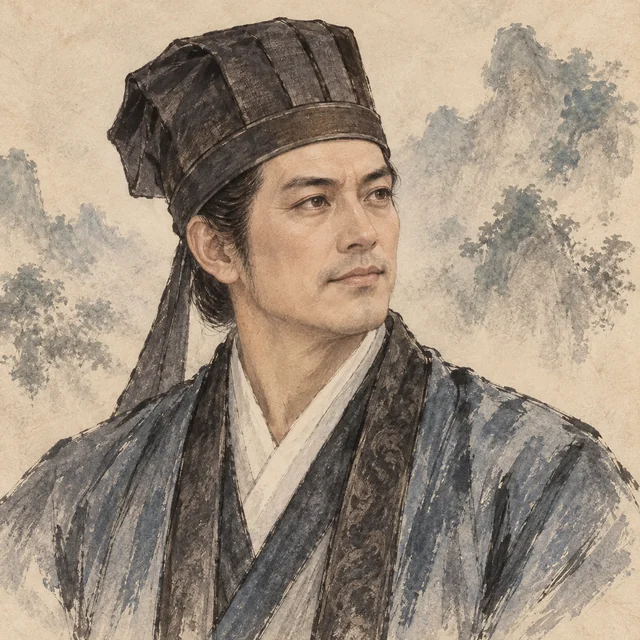
HISTORICAL PERSON
Yi Ji
伊籍
After serving Liu Biao, Yi Ji joined Liu Bei and contributed to Shu Han’s legal and administrative work, including the compilation of the Shu code with Zhuge Liang and others.
This entry is supported by historical references, but does not yet have a conversation profile.
PRIMARY BIOGRAPHY
Biography
Yi Ji, styled Jibo, was a man of Shanyang. In youth he attached himself to his fellow townsman Liu Biao, the General who Guards the South. While the First Sovereign was in Jing province, Yi Ji visited him constantly and entrusted himself to him; when Liu Biao died, Yi Ji followed the First Sovereign south across the Yangzi and on into Yi province.
Once Yi province was settled, Yi Ji was made aide to the General of the Left, received with honours just below Jian Yong and Sun Qian. Sent east as envoy to Wu, Sun Quan had heard of his quick tongue and tried to trip him with a greeting: as Yi Ji entered and bowed, Sun Quan said, “Is it not toilsome to serve a lord without the Way?” Yi Ji answered at once, “One bow down, one bow up — hardly toil at all.” His wit was always that quick, and Sun Quan marvelled at him.
He was later promoted to General of Manifest Letters and joined Zhuge Liang, Fa Zheng, Liu Ba and Li Yan in drafting the Shu Code — the laws and ordinances of Shu were framed by these five men together, making Yi Ji one of the founders of the state’s institutions.
Life and role
- Primary role
- General Who Promotes Letters
- Active period
- Documented coverage: Late Han and Shu Han (c. 190s–220s)
- Primary group
- Shu-Han
Affiliations across a lifetime
- 201–214
With Liu Biao → with Liu Bei
Attached to Liu Biao in youth; after Biao’s death followed Liu Bei south into Shu
- after 214
General of Manifest Letters
Out-fenced Sun Quan on embassy; co-author of the Shu Code with Zhuge Liang
HISTORICAL RECORD
Historical sources
- Records of the Three Kingdoms · Shu, Book 8 · 许麋孙简伊秦传 ↗
Chen Shou’s base text contains the biographies of Xu Jing, Mi Zhu, Sun Qian, Jian Yong, Yi Ji, and Qin Mi. The concluding evaluation is separate from the biographies.