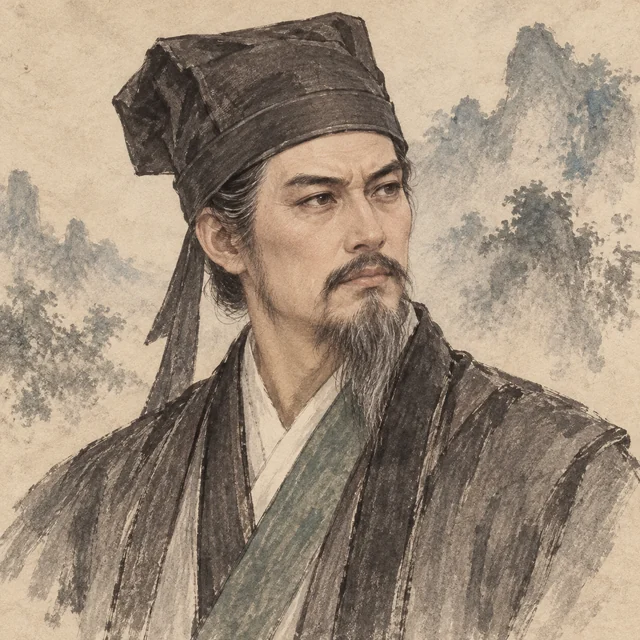
HISTORICAL PERSON
Yu Fan
虞翻
A classicist and adviser who served Wang Lang, Sun Ce, and Sun Quan, Yu Fan was known for frank counsel and was eventually exiled to Jiaozhou after repeated conflicts at court.
This entry is supported by historical references, but does not yet have a conversation profile.
PRIMARY BIOGRAPHY
Biography
Yu Fan (164–233), courtesy name Zhongxiang, of Kuaiji, served Administrator Wang Lang as officer of merit; when Sun Ce conquered Kuaiji he followed the fleeing Wang Lang to the coast until sent home to his aged mother. Sun Ce received him back with a friend’s courtesies, and Yu Fan later persuaded the stubborn Hua Xin to surrender Yuzhang.
He warned Sun Ce against riding out lightly on the hunt: “The white dragon disguised as a fish was shot by the fisherman Yuju” — Sun Ce agreed, kept hunting alone, and was murdered by Xu Gong’s retainers.
Under Sun Quan he remonstrated without tact or pause. When Sun Quan, tipsy, caught him feigning drunkenness, he nearly died to the king’s own sword, saved by Liu Ji’s embrace; and when Sun Quan and Zhang Zhao discoursed on immortals, Yu Fan pointed at Zhang Zhao: “Those are dead men talking of immortals — where in the world is an immortal?” His accumulated offenses earned exile to Jiaozhou, where he taught hundreds of students and wrote commentaries on Laozi, the Analects, and the Guoyu that circulated for centuries. He died in exile at seventy.
Life and role
- Primary role
- Mounted Commandant
- Active period
- Documented coverage: Late Han and Eastern Wu (164–233)
- Primary group
- Jiangdong–Sun Wu
Affiliations across a lifetime
- 196–200
Wang Lang, then Sun Ce
Loyal to Wang Lang in flight; persuaded Hua Xin’s surrender; warned Sun Ce in vain
- 200–233
Sun Quan’s court, then exile
Exiled to Jiaozhou for blunt speech; taught and wrote there until death at seventy
HISTORICAL RECORD
Historical sources
- Records of the Three Kingdoms · Wu, Book 12 · 虞陆张骆陆吾朱传 ↗
Chen Shou’s base text contains the biographies of Yu Fan (with his sons, including Yu Si, attached), Lu Ji, Zhang Wen, Luo Tong, Lu Mao, Wu Can, and Zhu Ju. The concluding evaluation is separate from the biographies.