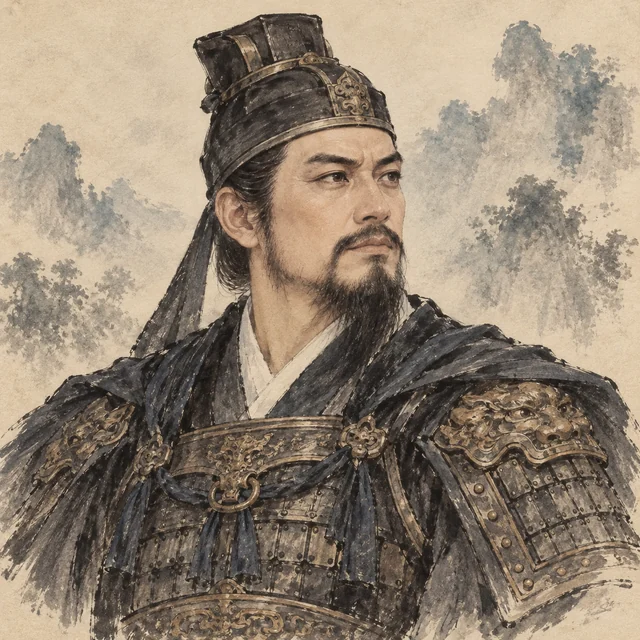
HISTORICAL PERSON
Yu Jin
于禁
Yu Jin served as a senior Cao Cao commander in campaigns from the wars against Lü Bu and Yuan Shao through the battles at Fan and Xiangyang; he surrendered to Guan Yu after the Han River flood and later returned to Wei.
This entry is supported by historical references, but does not yet have a conversation profile.
PRIMARY BIOGRAPHY
Biography
Yu Jin (d. 221), courtesy name Wenze, came from Juping in Taishan. He joined Bao Xin’s levy against the Yellow Turbans, and after Bao Xin’s death followed Cao Cao with the remnants, serving as a squad leader under the general Wang Lang. Wang Lang saw more in him and recommended him to Cao Cao as fit one day to be a general-in-chief; Cao Cao interviewed him and made him a major. Promotions followed in the campaigns against the Yellow Turban remnants and Lü Bu.
At Wancheng in 197 Zhang Xiu, newly surrendered, turned and attacked; Cao Cao’s army broke in confusion. Yu Jin alone marched his several hundred men off in order, fighting as they went, holding formation despite losses; only when the pursuit slackened did he beat the drums and withdraw at ease. Meeting a dozen of his own side’s soldiers robbed and wounded by the Qingzhou corps, he punished the marauders, who ran ahead to accuse him to Cao Cao. Arriving, Yu Jin built his camp defenses before reporting, telling his worried officers: the enemy is behind us — without walls we cannot fight, and our lord is too wise to be swayed by slander. Cao Cao was delighted: at the Yushui disaster I myself was hard-pressed, yet the general kept his ranks in chaos, punished the violent, and fortified first — "a firmness that cannot be shaken; the great captains of old could do no more." He enfeoffed him Marquis of Yishou precinct.
At Guandu, Yu Jin and Yue Jin led five thousand men against Yuan Shao’s outlying camps, burning thirty-odd stockades and taking thousands of heads and prisoners. Trusted for his severity, he was once sent to take over Zhu Ling’s command, and neither Zhu Ling nor his troops dared stir. When his old friend Chang Xi rebelled in Donghai and, hard-pressed, surrendered directly to Yu Jin, the other generals said the captive should be sent to Cao Cao. Yu Jin answered: you know the standing order — those who surrender only after being surrounded are not spared; Chang Xi is an old friend, but I will not fail the law for him. He wept with Chang Xi and executed him. Cao Cao sighed that fate itself had sent Chang Xi to Yu Jin, and esteemed him the more. Yu Jin rose to General of the Left with the ceremonial battle-axe.
In autumn 219 Guan Yu besieged Cao Ren at Fancheng, and Cao Cao sent Yu Jin with seven armies to the rescue. The Han river flooded several zhang over the plain; the seven armies drowned. Clinging to high ground with no way out as Guan Yu’s great ships closed in, Yu Jin surrendered his whole force — while Pang De, cursing to the last, died rather than yield. Cao Cao grieved long: "I knew Yu Jin for thirty years — who would have thought that facing peril he would fall short of Pang De?"
When Guan Yu fell, Yu Jin passed into Wu hands. In 221 Sun Quan, professing vassalage to Cao Pi, sent him home. Cao Pi received him — white-haired, haggard, weeping at the foot of the throne — and comforted him with the old precedents of defeated generals restored to favor, naming him General who Calms Distant Lands and planning an embassy to Wu. First Yu Jin was to go north and pay respects at Cao Cao’s tomb at Ye. Cao Pi had the tomb-house walls painted in advance with scenes of Guan Yu victorious, Pang De defiant in death, and Yu Jin prostrate in surrender. Yu Jin saw them, sickened with shame and rage, and died. His posthumous title was the Severe Marquis.
Life and role
- Primary role
- General of the Left
- Active period
- Late Eastern Han to Cao Wei
- Primary group
- Cao-Wei
Affiliations across a lifetime
- Before 192
Bao Xin’s levy
Joined the levy against the Yellow Turbans; passed to Cao Cao after Bao Xin’s death.
- 192–208
The unshakable general
At Wancheng he alone kept order; Cao Cao praised "a firmness the great captains of old could not exceed."
- 208–219
General of the Left with the battle-axe
Executed his surrendering old friend Chang Xi by the standing order; rose to the top commands.
- 219–221
Fancheng surrender · shame and death
Drowned out at Fancheng, he surrendered where Pang De died; returned from Wu, he died of shame before the painted tomb-house.
HISTORICAL RECORD
Historical sources
- Records of the Three Kingdoms · Wei, Book 17 · Biographies of Zhang Liao, Le Jin, Yu Jin, Zhang He, and Xu Huang ↗
Chen Shou’s base text: biographies of Zhang Liao, Le Jin, Yu Jin, Zhang He, and Xu Huang, plus the attached account of Zhu Ling. Pei Songzhi’s annotations are registered separately.
- Records of the Three Kingdoms · Wei, Book 18 · Biographies of the Two Lis, Zang, Wen, Lü, Xu, Dian, Two Pangs, and Yan ↗
Chen Shou’s base text: biographies of Li Dian, Li Tong, Zang Ba (including Sun Guan), Wen Pin, Lü Qian (including Wang Xiang), Xu Chu, Dian Wei, Pang De, Pang Yu (including his mother Zhao E), and Yan Wen (including Zhang Gong). Pei Songzhi’s annotations are separately registered.
- Records of the Three Kingdoms, with Pei Songzhi annotations · Pei Songzhi annotations to Wei, Book 17 ↗
Annotations to Wei Book 17, including extracts from Fu Zi, Sun Sheng, Wei Shu, Han Jin Chunqiu, Wei Lue, and Jiuzhou Chunqiu. These accounts and Pei’s judgments are kept distinct from Chen Shou’s base text.