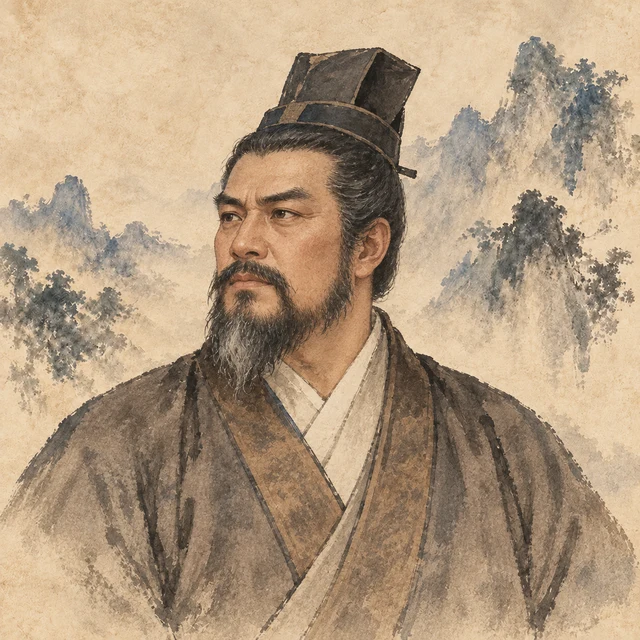
HISTORICAL PERSON
Zhang Ji (De Rong)
张既
An administrator and commander who secured Ma Teng’s aid against Guo Yuan and Gao Gan, resettled refugees in Guanzhong, and helped suppress later unrest in Liangzhou.
This entry is supported by historical references, but does not yet have a conversation profile.
PRIMARY BIOGRAPHY
Biography
Zhang Ji, styled Derong, came from Gaoling in Pingyi. A commandery clerk at sixteen, he later held senior offices; recommended filial-and-incorrupt he declined, and when the Grand Progenitor as minister of works summoned him he had not yet gone; recommended as flourishing talent, he was made magistrate of Xinfeng, where his administration ranked first in the three capital districts. When Yuan Shang defied the Grand Progenitor at Liyang and sent the Hedong administrator Guo Yuan, the Bing province inspector Gao Gan and the Chanyu of the Xiongnu to take Pingyang, with envoys west to concert with the generals of Guanzhong, the colonel-director of retainers Zhong Yao sent Zhang Ji to persuade General Ma Teng and his allies; Zhang Ji laid out the stakes, they agreed, and Ma Teng sent his son Ma Chao with over ten thousand to join Zhong Yao — Guo Yuan was crushed and beheaded. When Gao Gan rebelled again in Bing province and Zhang Sheng of Henei, Wei Gu of Hedong and Zhang Yan of Hongnong rose in answer, the Grand Progenitor made Zhang Ji a gentleman-consultant on Zhong Yao’s staff; the western generals were called in, the rebels broken, Zhang Yan and Wei Gu beheaded, and Zhang Ji was enfeoffed Marquis of Wushi precinct. Sent again to bid Ma Teng and his peers give up their troops and come east, when they wavered after consenting, Zhang Ji ordered the counties to prepare stores and the two-thousand-bushel officers to meet them at the borders — and they had no choice but to move. When the state of Wei was founded Zhang Ji became a Master of Writing, then went out as inspector of Yong province; the Grand Progenitor told him, “To return to your native province — that is wearing embroidered clothes in daylight.” On the Zhang Lu campaign, when Zhang Lu surrendered, Zhang Ji persuaded the Grand Progenitor to transplant tens of thousands of Hanzhong households to fill Chang’an and the three districts. When the Grand Progenitor drew out of Hanzhong, fearing Liu Bei would take the Wudu Di and press the passes, Zhang Ji urged their removal, and was sent to Wudu himself to move fifty thousand Di camps out into the Fufeng–Tianshui marches.
At that time Yan Jun of Wuwei, He Luan of Zhangye, Huang Hua of Jiuquan and Qu Yan of Xiping all raised their commanderies in revolt and fought among themselves; Yan Jun sent his mother and son as hostages begging help. Zhang Ji said, “Yan Jun and his kind borrow the state’s might abroad and nurse arrogant treason at home; once their footing is set they will rebel. While we are busy settling Shu, better to keep both alive and let them fight — like Bian Zhuangzi stabbing the tigers, sitting to collect the kill.” The Grand Progenitor approved; a year later He Luan killed Yan Jun, and Wang Mi of Wuwei killed He Luan. When Emperor Wen became King of Wei and first constituted Liang province, Zhang Jin of Zhangye seized his administrator and rose, with Huang Hua and Qu Yan expelling theirs in answer; when the Lushui Hu of Liang province under Yijian Jiqie and Zhi Yuanduo rebelled and the lands west of the river fell into turmoil, the emperor worried: “None but Zhang Ji can quiet Liang province”, and made him its inspector, likening him in the edict to Jia Fu sent against Yan. Reaching Jincheng, Zhang Ji meant to cross the Yellow River; his generals objected that the men were few and the roads steep, but he said, “Steep the roads may be, but this is no Jingxing defile; the tribes are a mob of crows with no Li Zuoju to plan for them. Wuwei is in mortal danger — we must move fast.” He crossed, hid three thousand picked men in ambush by night, and sent the staff officer Cheng Gongying with a thousand cavalry to provoke battle with orders to feign retreat; the Hu rushed in, the ambush cut their rear, and striking head and tail he shattered them, taking heads and prisoners by the ten thousand. The delighted emperor decreed: “You crossed the river and braved the narrows, struck the rested with the weary and the many with the few — your service passes Nan Zhong’s and your toil exceeds Jifu’s. This feat did not merely break the Hu; it has quieted the right bank forever, so that I need never again look west”, and transferred him to the marquisate of Xixiang.
When Su Heng of Jiuquan rebelled with the Qiang magnate Lindai and over ten thousand Dingling and Hu cavalry attacking the border counties, Zhang Ji and Xiahou Ru broke them and received their surrender; he then memorialised to build fortifications, beacon posts and granaries against the Hu, and the western Qiang, alarmed, came in with over twenty thousand camps to surrender. Later, when Qu Guang of Xiping killed his administrator and rebelled and the generals clamoured to strike, Zhang Ji said, “Only Qu Guang and his clique are traitors — the commandery men are not all of them. If we march in at once, clerks, people, Qiang and Hu will say the state cannot tell right from wrong and will close ranks; that is giving wings to a tiger.” Instead he proclaimed to the Qiang that the misled would be pardoned and whoever brought the rebel chief’s head would be rewarded — whereupon Qu Guang’s own followers cut off his head, and the rest dwelt in peace as before. Zhang Ji governed the two provinces for over a decade, famed for beneficent rule; he died in 223, posthumously the Grave Marquis.
Life and role
- Primary role
- Cao Wei official and commander
- Active period
- Documented coverage: late Han through Cao Wei
- Primary group
- Cao-Wei
Affiliations across a lifetime
- 202–211
Zhong Yao’s staff
Won Ma Teng over so Ma Chao crushed Guo Yuan; pressed the Guanzhong lords to give up their troops
- 211–220
Inspector of Yong province
Filled the capital districts from Hanzhong and moved the Wudu Di; let the Hexi rebels kill each other like Bian Zhuangzi’s tigers
- 220–223
Inspector of Liang province
Crushed the Lushui Hu by ambush across the river; had the Qiang bring in Qu Guang’s head; died the Grave Marquis
HISTORICAL RECORD
Historical sources
- Records of the Three Kingdoms · Wei, Book 15 · 刘司马梁张温贾传 ↗
Chen Shou’s base text: biographies of Liu Fu, Sima Lang, Liang Xi, Zhang Ji, Wen Hui, and Jia Kui, including attached notices about sons and associated figures. Pei Songzhi’s annotations are registered separately.