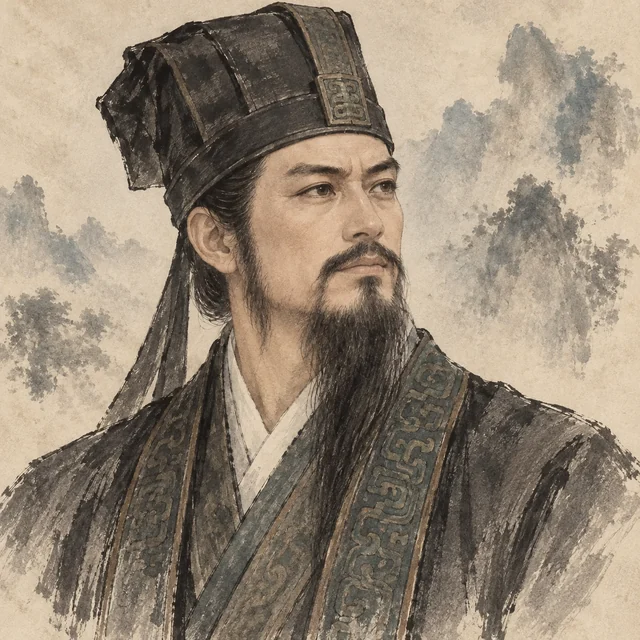
HISTORICAL PERSON
Zhang Yi S41
张裔
A Chengdu man made Administrator of Ba by Liu Bei; the rebel Yong Kai bound him and sent him to Wu, Deng Zhi secured his return, and he rose to Chief Clerk of the Chancellor’s office.
This entry is supported by historical references, but does not yet have a conversation profile.
PRIMARY BIOGRAPHY
Biography
Zhang Yi, styled Junsi, came from Chengdu in Shu commandery. He studied the Gongyang Spring and Autumn and ranged widely over the Records of the Historian and the History of Han. Xu Jing of Runan, on entering Shu, said Zhang Yi’s quick grasp of affairs put him in the class of the Central Lands’ Zhong Yao. Under Liu Zhang he was recommended filial-and-incorrupt, served as chief of Yufu, then as an aide of the province with the office of major of the guard. When Zhang Fei entered from Jing province by way of Dianjiang, Liu Zhang gave Zhang Yi troops to oppose him; beaten at Moxia below Deyang, he returned to Chengdu. Sent as Liu Zhang’s envoy to the First Sovereign, he obtained the promise that his lord would be treated with courtesy and his people spared; Zhang Yi returned, and the city gates opened. The First Sovereign made him administrator of Ba commandery, then called him back as General of the Gentlemen in charge of metalwork, supervising the making of implements for farming and war.
Earlier, Yi province commandery had killed its administrator Zheng Ang, and the great elder Yong Kai, whose credit ran strong in the southern lands, had opened dealings with Sun Quan. Zhang Yi was sent as the new administrator. Yong Kai held back in defiance and put out a spirit-medium teaching: “Prefect Zhang is like a gourd bottle — glossy without, coarse within. He is not worth killing; bind him and send him to Wu.” So Zhang Yi was delivered to Sun Quan. When the First Sovereign died, Zhuge Liang sent Deng Zhi to Wu with instructions to ask for Zhang Yi; in his years there Zhang Yi had drifted and hidden so thoroughly that Sun Quan did not know he had him, and so agreed. On the point of departure Zhang Yi was granted an audience. Sun Quan asked: “In Shu a widowed Zhuo ran off with Sima Xiangru — how is it your land has such customs?” Zhang Yi answered: “I hold that Zhuo’s widow was still worthier than Zhu Maichen’s wife.” Sun Quan added: “You will surely hold office in the western court — how will you repay me?” He answered: “I return under accusation and will submit my fate to the officers. If by luck I keep my head, my first fifty-eight years were my parents’ gift; whatever comes after is the state’s gift.” Sun Quan laughed, delighted, and esteemed his talent. Once Zhang Yi had gone, Sun Quan deeply regretted letting him go and sent pursuers — Zhang Yi travelled double stages and they could not catch him.
Back in Shu, Chancellor Zhuge Liang made him an adjutant acting in the affairs of his office and concurrently headquarters aide of Yi province. When Zhuge Liang went out to garrison Hanzhong, Zhang Yi, as colonel of the archers-who-shoot-at-a-sound, held the office of senior clerk of the headquarters left behind at Chengdu, and was wont to say: “The Duke’s rewards do not pass over the distant, nor his punishments bend for the near; rank cannot be taken without merit, nor the rod escaped for noble standing — that is why wise and foolish alike forget themselves in his service.” The next year, when he went north to consult Zhuge Liang, several hundred came to see him off and carriages filled the road; he wrote home: “On this journey I received guests day and night without rest. It is the Chancellor’s senior clerk they honour — the man Zhang Junsi is only tagging along, and he is tired to death.” His witty, rapid talk was all of this kind. In youth he had been a close friend of Yang Gong of Jianwei; Yang Gong died early leaving orphans not yet several years old, and Zhang Yi took them in, shared his own house and table between mother and sons, served Gong’s mother as his own, and when the sons grew up bought them wives, fields and houses and set them up in life. His care for old friends and support of declining kin were of the utmost. He was made General who Supports Han, still holding the senior clerkship, and died in 230.
Life and role
- Primary role
- Shu Han official
- Active period
- Documented coverage: late Han through Shu Han
- Primary group
- Shu-Han
Affiliations across a lifetime
- 214–223
Master of metalwork, then sent bound to Wu
Served the First Sovereign, then as administrator of Yi commandery was bound by Yong Kai and shipped to Sun Quan, drifting in hiding for years
- 223
Ransomed by Deng Zhi’s embassy
Parried Sun Quan’s taunts with wit, then doubled his stages so the pursuing riders missed him
- 223–230
Senior clerk of the office left behind
Ran the headquarters left behind during the northern campaigns and praised Zhuge Liang’s impartiality; raised his dead friend’s orphans as his own
HISTORICAL RECORD
Historical sources
- Records of the Three Kingdoms · Shu, Book 11 · 霍王向张杨费传 ↗
Chen Shou’s base text contains the biographies of Huo Jun (with his son Huo Yi), Wang Lian, Xiang Lang (with his nephew Xiang Chong), Zhang Yi (張裔), Yang Hong (with He Zhi), and Fei Shi. Luo Xian’s account appears only in Pei Songzhi’s annotation citing the Xiangyang Ji, not in Chen Shou’s base biography text.