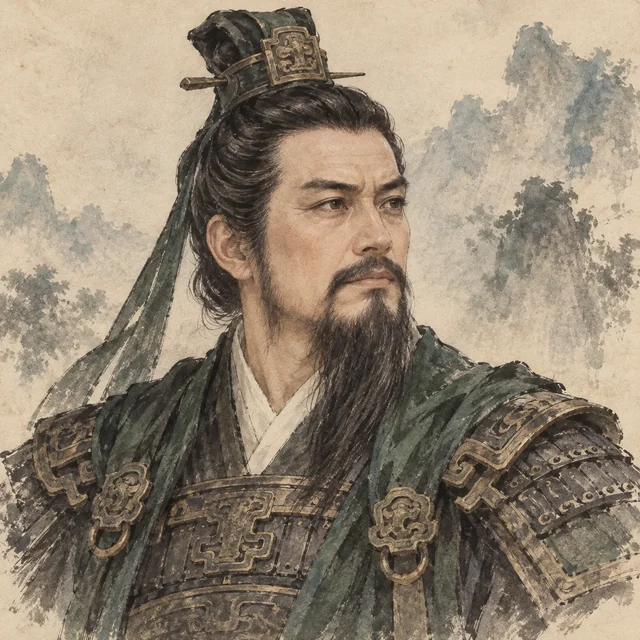
HISTORICAL PERSON
Zhang Yi S45
张翼
A Wuyang man from Jianwei; as Left General of Chariots and Cavalry and Laixiang Commander he governed Nanzhong, and in court debates opposed Jiang Wei’s repeated northern campaigns as overtaxing a small state.
This entry is supported by historical references, but does not yet have a conversation profile.
PRIMARY BIOGRAPHY
Biography
Zhang Yi (d. 264), courtesy name Bogong, descended from the Han Excellency Zhang Hao and the upright inspector Zhang Gang. He rose through Shu’s civil service to become Zhuge Liang’s front-army controller at Wugong.
As Laixiang area commander in the south his law was too strict for local taste, and the chieftain Liu Zhou revolted. Recalled mid-campaign, Zhang Yi refused to ride off: “My successor has not arrived; I am still in the field — grain must be moved and stockpiled for the killing blow. I will not abandon the state’s business over a demotion.” Ma Zhong arrived to find everything prepared and crushed the revolt; Zhuge Liang praised him.
In 255 he alone opposed Jiang Wei’s new expedition in open court — the state too small, the people too weary. Overruled, he marched; after the great victory at the Tao river he warned, “Stop here — advance further and this triumph is ruined.” Jiang Wei snapped, “You would draw legs on a snake!” and pressed on to a failed siege. It became the pattern of the late wars. In 264 Zhang Yi followed Jiang Wei into Zhong Hui’s camp and died in the mutiny at Chengdu.
Life and role
- Primary role
- Shu Han official
- Active period
- Documented coverage: late Han through Shu Han
- Primary group
- Shu-Han
Affiliations across a lifetime
- ?–234
Shu — civil and staff posts
Front-army controller under Zhuge Liang; stockpiled for his successor in the south
- 234–264
Shu — Left General of Chariots
Jiang Wei’s in-house critic; killed in Zhong Hui’s mutiny at Chengdu
HISTORICAL RECORD
Historical sources
- Records of the Three Kingdoms · Shu, Book 15 · 邓张宗杨传 ↗
Chen Shou’s base text contains the biographies of Deng Zhi, Zhang Yi (張翼), Zong Yu (with Liao Hua attached), and Yang Xi. Yang Xi’s section includes his Ji Han Fuchen Zan. The concluding evaluation is separate from the biographies.