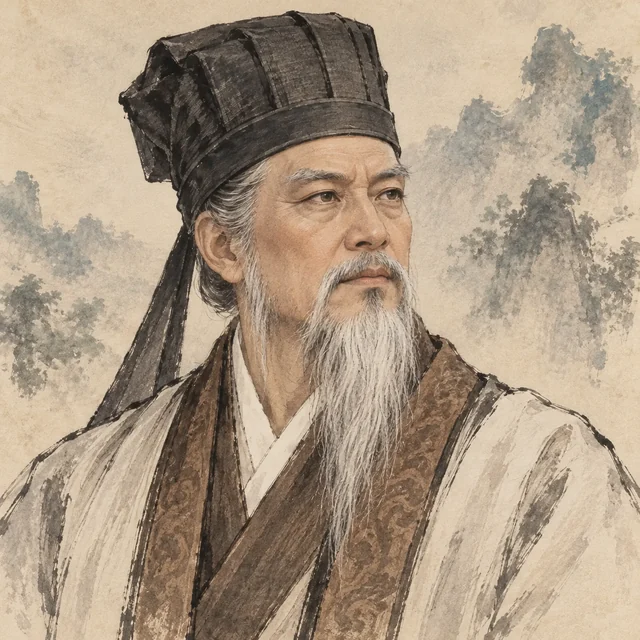
HISTORICAL PERSON
Zhang Zhao
张昭
Sun Ce appointed Zhang Zhao as chief clerk and entrusted him with civil and military affairs. Under Sun Quan, Zhang Zhao remained a senior minister and repeatedly offered direct remonstrance.
This entry is supported by historical references, but does not yet have a conversation profile.
PRIMARY BIOGRAPHY
Biography
Zhang Zhao (156–236), courtesy name Zibu, of Pengcheng, studied the Zuo Commentary under Baihou Zi’an and made his name alongside Zhao Yu and Wang Lang. Fleeing south across the Yangzi, he joined Sun Ce’s enterprise as chief clerk and General Who Comforts the Army; Sun Ce walked him up the hall to bow to his mother, treating him as an equal, and entrusted all affairs, civil and martial, to him. Dying, Sun Ce charged him with his brother. When Sun Quan lay prostrate with grief, Zhang Zhao said: “An heir’s duty is to carry forward the founder’s work — the realm boils with bandits; how can you lie down in private sorrow?” He lifted Sun Quan onto his horse, paraded the troops, and so the army knew whom to follow.
In 208 Cao Cao took Jing province and sent an intimidating letter; the court shook, and Zhang Zhao with Qin Song counseled submission (Jiangbiao Zhuan, quoted by Pei Songzhi) — but Zhou Yu and Lu Su carried the day, and Cao Cao was broken at Red Cliffs. Sun Quan loved hunting tigers from horseback; once a tiger reared onto his saddle. Zhang Zhao changed countenance: “A ruler’s business is to command heroes and drive the worthy — not to race across fields testing his nerve against beasts. If mischance struck, how would the realm laugh?” Sun Quan apologized, yet could not stop; he built a caged hunting chariot and went on laughing at Zhang Zhao’s protests.
When Sun Quan took the imperial title in 229, Zhang Zhao returned his offices for age and illness and was made General Who Assists Wu, ranked just below the Three Excellencies, Marquis of Lou. Later Gongsun Yuan of Liaodong offered fealty, and Sun Quan in delight prepared to send Zhang Mi and Xu Yan with ten thousand men to crown him King of Yan. Zhang Zhao objected bitterly: “Yuan fears punishment and seeks distant help — it is not sincere. If he turns back to Wei, our envoys will not return, and the world will laugh.” Sun Quan, beside himself, gripped his sword: “Wu’s gentlemen bow to me in the palace and to you outside it — my respect has been complete — yet you keep breaking me down before the crowd.” Zhang Zhao wept: “I know my words go unused, but I still hear the late queen mother’s dying charge to this old servant.” Sun Quan threw down the sword and they wept together — yet the envoys sailed. Zhang Zhao shut himself in, pleading illness; Sun Quan sealed his gate with earth, and Zhang Zhao sealed it from inside. Gongsun Yuan did kill the envoys. Sun Quan’s apologies failed; he burned the gate to frighten the old man, who only barred it tighter, until his sons lifted him out and the emperor carried him to the palace in his own carriage, blaming himself deeply. Dignified and severe, Zhang Zhao so awed the realm that Sun Quan said, “With Lord Zhang I dare not speak carelessly.” He died in 236 at eighty-one, leaving orders for a plain coffin and burial in everyday clothes; posthumously Wen-hou, “the Cultured.”
Life and role
- Primary role
- Chief Clerk and senior minister
- Active period
- Late Eastern Han to Eastern Wu
- Primary group
- Jiangdong–Sun Wu
Affiliations across a lifetime
- 200–208
Chief clerk to Sun Ce, then regent’s right hand
Sun Ce’s dying charge; lifted Sun Quan into the saddle
- 208–236
General Who Assists Wu, Marquis of Lou
Remonstrated unto the sealed and burned gate; never bent
HISTORICAL RECORD
Historical sources
- Records of the Three Kingdoms · Wu, Book 7 · 张顾诸葛步传 ↗
Chen Shou’s base text: Zhang Zhao’s nephew Fen, who designed a siege engine at age twenty, later served as a Wu general, and was appointed commander of Pingzhou; other biographies and annotations are outside this locator.