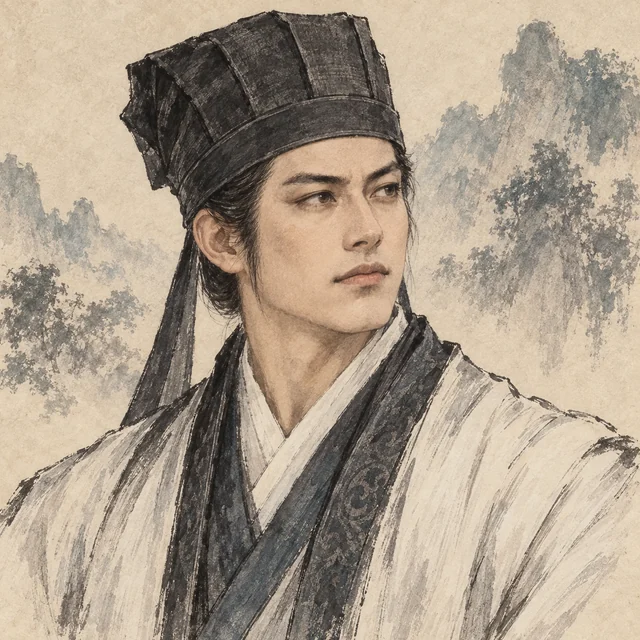
HISTORICAL PERSON
Zhong Hui
钟会
A learned strategist trusted by the Wei court, Zhong Hui commanded an army in the 263 invasion of Shu and rebelled in Chengdu after the conquest, where he was killed.
This entry is supported by historical references, but does not yet have a conversation profile.
PRIMARY BIOGRAPHY
Biography
Zhong Hui (225–264), courtesy name Shiji, came from Changshe in Yingchuan, the youngest son of the Grand Tutor Zhong Yao. Precocious and learned, he was famous in his youth as a master of the arcane "study of names and principles," ranked with the philosopher Wang Bi while still capped. After the accession of the young emperor Cao Mao he gained court access, and under the regent Sima Shi he already handled confidential business in the Sima secretariat.
When Guanqiu Jian and Wen Qin rose in Huainan in 255, Zhong Hui campaigned with Sima Shi in charge of secret dispatches; after Sima Shi died at Xuchang, Zhong Hui planned strategy at Sima Zhao’s side, and contemporaries compared him to Zhang Liang. He accompanied the 257–258 expedition against Zhuge Dan at Shouchun, directed much of its planning, and was promoted to Metropolitan Commandant. Though formally an external office, he was consulted on every question of policy and appointment; his biography holds that the execution of the poet-philosopher Ji Kang and others also came of Zhong Hui’s counsel.
In the Jingyuan era Sima Zhao judged that Jiang Wei’s annual campaigns had exhausted Shu and resolved on conquest. Most of the court objected; Zhong Hui alone championed the plan and helped design the march. In 263 he was named General who Guards the West and area commander of Guanzhong, leading the main force of over a hundred thousand through the Xie and Luo valleys into Hanzhong, while Deng Ai and Zhuge Xu pinned Jiang Wei down with thirty thousand each. Zhong Hui stormed the Yang’an pass, swept the Hanzhong forts, and drove south — only to be stopped cold at Jiange by Jiang Wei. With the pass unbreakable and grain lines overextended, he was already discussing withdrawal.
At that moment Deng Ai crossed the Yinping track and took Liu Shan’s surrender; Jiang Wei was ordered to lay down arms to Zhong Hui. With Shu destroyed, the court named Zhong Hui Minister over the Masses and raised his fief to a full county marquisate with ten thousand added households. Judging his own merit unsurpassed and unwilling to serve under anyone again, he had already denounced Deng Ai for treason and seen him carted off; now the picked troops of Yi province were his alone. Plotting with Jiang Wei, he forged a testamentary edict of the late Empress Dowager Guo calling for war against Sima Zhao: Jiang Wei would lead fifty thousand Shu troops out of the Xie valley as vanguard, Zhong Hui would follow with the main army, take Chang’an, and descend the Wei river on Luoyang.
Before the plan could move, the army supervisor Hu Lie and others spread word among the northern troops that Zhong Hui meant to massacre them. On the eighteenth day of the first month of 264 the soldiers mutinied and stormed the palace enclosure; Zhong Hui and Jiang Wei fought with their personal guards and died in the melee. He was forty. Zhong Hui’s brother’s son, Zhong Yong, died with him. Zhong Hui had also raised his nephews Zhong Yi, Zhong Qun, and Zhong Chan; they were jailed. Sima Zhao asked the court to consider the service of Zhong Yao and Zhong Yu. Ultimately, only Zhong Yi and Zhong Yong’s son were executed; Zhong Qun and Zhong Chan were pardoned.
Life and role
- Primary role
- General Who Guards the West
- Active period
- Documented coverage: Cao Wei (c. 220–264)
- Primary group
- Cao-Wei
Affiliations across a lifetime
- Before 255
Wei · Sima regency secretariat
A young metaphysician of the Wang Bi circle who became a confidential secretary to Sima Shi.
- 255–262
Wei · chief strategist, then Metropolitan Commandant
Planned the suppression of Guanqiu Jian and Zhuge Dan; promoted to Metropolitan Commandant and consulted on all state appointments.
- 263–264
Commander of the conquest of Shu
Led the main force through the Xie and Luo valleys, overran Hanzhong, and was checked at Jiange until Deng Ai’s flank march decided the war.
- 264
Minister over the Masses · rebellion and death
Enfeoffed as Minister over the Masses after the conquest, he forged a dowager edict and rebelled with Jiang Wei; the army mutinied and killed him at forty.
HISTORICAL RECORD
Historical sources
- Records of the Three Kingdoms · Wei, Book 28 · 王毌丘诸葛邓锺传 ↗
Chen Shou’s base text contains the biographies of Wang Ling, Guanqiu Jian (with Wen Qin), Zhuge Dan (with Tang Zi), Deng Ai (with Zhou Tai), and Zhong Hui (with Wang Bi). Zhong Hui’s biography also records Jiang Wei’s final actions after Shu fell. Pei Songzhi’s annotations on the page should be identified separately.
- Book of Jin · Book 2 · Annals of Emperor Jing and Emperor Wen ↗
Annals of Sima Shi (Jing) and Sima Zhao (Wen), posthumously honored by Jin.