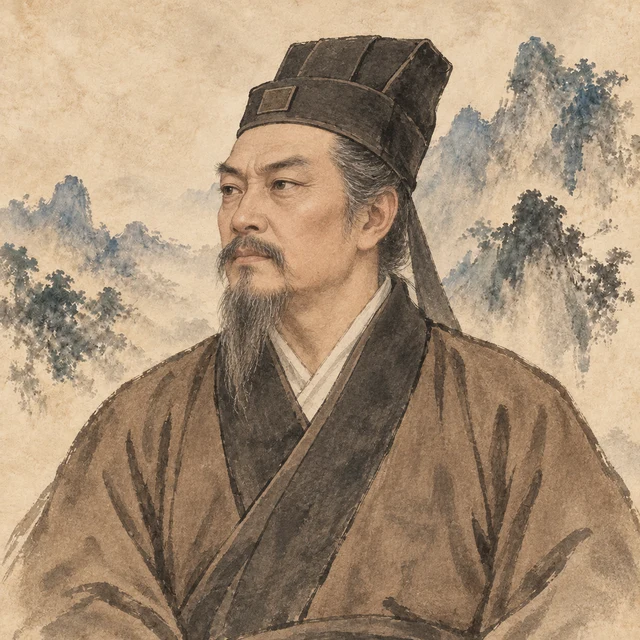
HISTORICAL PERSON
Zhong Yao
钟繇
Zhong Yao helped secure Emperor Xian’s departure from Chang’an, stabilized Guanzhong, supplied horses to Cao Cao during the Guandu campaign, and later held senior judicial and court offices in Wei.
This entry is supported by historical references, but does not yet have a conversation profile.
PRIMARY BIOGRAPHY
Biography
Zhong Yao (151–230), courtesy name Yuanchang, of Yingchuan. When Li Jue and Guo Si held Chang’an and meant to reject Cao Cao’s first embassy, Zhong Yao persuaded them: “Only the Governor of Yan has the dynasty at heart — to spurn his loyalty is to disappoint the realm.” Cao Cao’s channel to the court opened, and the emperor’s later escape east owed much to Zhong Yao.
With Ma Teng, Han Sui, and the warlords of Guanzhong at each other’s throats, Cao Cao sent Zhong Yao as Colonel Director of Retainers with plenary powers over the west. He persuaded Ma Teng and Han Sui to send their sons as hostages, and during Guandu delivered two thousand horses to the front. Cao Cao wrote: “Guanzhong settled and no worry at my back — this is your achievement, a true Xiao He.”
Under Wei he rose from Grand Judge to Chancellor, then Commandant of Justice and Grand Commandant; Emperor Ming made him Grand Tutor and — for his ailing knees — let him ride to the throne room seated in a sedan, a first for the dynasty. He died in 230. His regular-script calligraphy set the classical standard; posterity pairs him with Wang Xizhi as “Zhong and Wang.”
Life and role
- Primary role
- Grand Commandant and calligrapher
- Active period
- Late Han and Cao Wei (190s–240s)
- Primary group
- Cao-Wei
Affiliations across a lifetime
- 190–200
Han court and Guanzhong
Opened Cao Cao’s channel to the captive court; held Guanzhong with plenary powers
- 200–230
Wei — the Three Excellencies
Rose through all Three Excellencies; patriarch of regular-script calligraphy
HISTORICAL RECORD
Historical sources
- Records of the Three Kingdoms · Wei, Book 13 · 钟繇华歆王朗传 ↗
Chen Shou’s base text: biographies of Zhong Yao (including Zhong Yu), Hua Xin, Wang Lang, and Wang Su. Pei Songzhi’s annotations are registered separately.