HISTORICAL PERSON
Zhou Tai
周泰
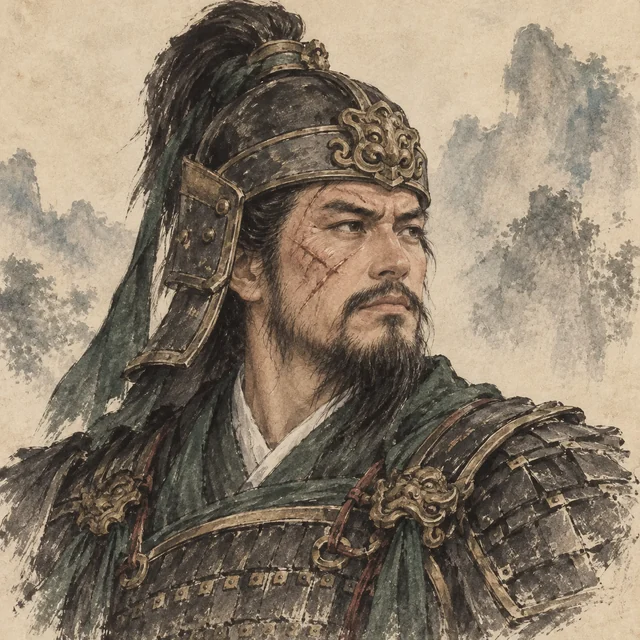
Zhou Tai served Sun Ce and Sun Quan in repeated campaigns. During a battle, he protected Sun Quan and sustained many wounds.
This entry is supported by historical references, but does not yet have a conversation profile.
PRIMARY BIOGRAPHY
Biography
Zhou Tai (d. after 229), courtesy name Youping, of Xiacai, served at Sun Ce’s side with Jiang Qin. Sun Quan liked him and asked for him. When thousands of mountain bandits fell on Xuancheng and reached Sun Quan’s saddle before the guard could form, Zhou Tai threw his body over his lord and fought with such fury that the wavering troops rallied — he took twelve wounds and lay near death. “Without Zhou Tai that day, I would have perished,” Sun Quan said.
He fought at Wancheng and Xiakou, against Huang Zu, at Chibi, and in the Nan commandery campaign, then held Ruxu as General who Pacifies Caitiffs when Cao Cao withdrew.
The other officers — Zhu Ran, Xu Sheng among them — scorned serving under him. Sun Quan rode down to Ruxu, feasted them, and at the wine-cup bade Zhou Tai strip: he traced each scar with his own finger and asked where it came from, and Zhou Tai named battle after battle. Next day Sun Quan gave him his own parasol. The scoffers submitted. Made Administrator of Hanzhong (in anticipation) and Marquis of Lingyang, he died in the Huangwu years.
Life and role
- Primary role
- General Who Displays Might
- Active period
- Late Eastern Han to Eastern Wu
- Primary group
- Jiangdong–Sun Wu
Affiliations across a lifetime
- 196–208
Sun Quan’s guard
Took twelve wounds shielding Sun Quan at Xuancheng; veteran of Chibi
- 215–after 229
Commander of Ruxu
His scars, displayed by Sun Quan, silenced the skeptics; died in the Huangwu era
HISTORICAL RECORD
Historical sources
- Records of the Three Kingdoms · Wu, Book 10 · 程黄韩蒋周陈董甘凌徐潘丁传 ↗
Chen Shou’s base text contains the biographies of Cheng Pu, Huang Gai, Han Dang, Jiang Qin, Zhou Tai, Chen Wu (with Chen Biao), Dong Xi, Gan Ning, Ling Tong, Xu Sheng, Pan Zhang, and Ding Feng. The concluding evaluation is separate from the biographies.