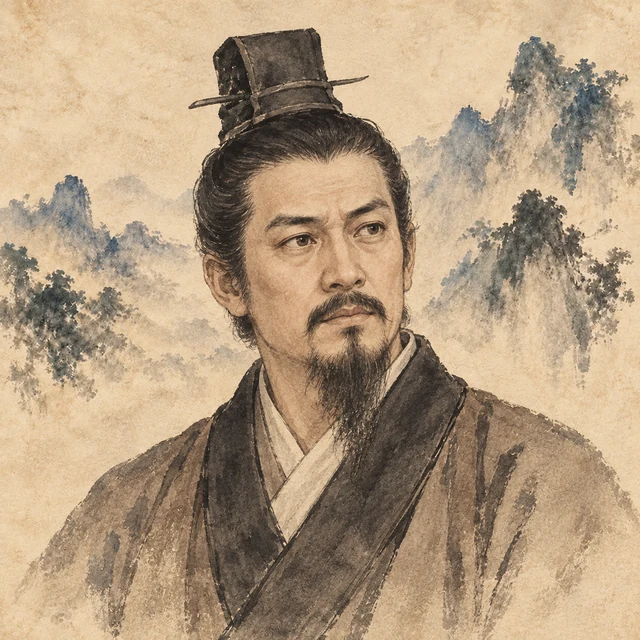
HISTORICAL PERSON
Zhu Jianping
朱建平
A Pei man famed for physiognomy; Cao Cao made him a gentleman of the household, and his readings for Cao Pi, Xiahou Wei and others proved uncannily accurate.
This entry is supported by historical references, but does not yet have a conversation profile.
PRIMARY BIOGRAPHY
Biography
Zhu Jianping was from Pei. A master of physiognomy, his readings among the lanes and alleys had proven true more than once. The Grand Ancestor, as Duke of Wei, heard of him and summoned him as a gentleman. When Emperor Wen was general of the gentlemen of the household, he gathered more than thirty guests at his seat, asked about his own span, and had Zhu Jianping read all the guests in turn. Zhu Jianping said, “The general will live to eighty, but at forty there will be a small crisis — be careful to guard against it.” To Xiahou Wei he said, “At forty-nine you will be a provincial governor, and there a crisis awaits; if you pass it, you may reach seventy and the highest offices.” To Ying Qu he said, “At sixty-two you will be a palace attendant, and there a crisis awaits; one year before it, you alone will see a white dog that no one beside you can see.” To Cao Biao he said, “You will hold a princely fief; at fifty-seven you will meet a crisis of arms — guard well against it.”
Earlier, Xun You of Yingchuan and Zhong Yao had been close friends. Xun You died first, his sons young, and Zhong Yao managed his household and wished to marry off his concubine, writing to a friend: “Gongda and I once had Zhu Jianping read us, and he said, ‘Though Lord Xun is the younger, his after-affairs will be entrusted to Lord Zhong.’ I joked at the time, ‘Then I shall be marrying off your A-wu!’ Who would have thought the man would perish so early and the jest prove true? Now I am about to marry off A-wu, that she may be well placed.” Recalling Zhu Jianping’s subtlety, even Tang Ju and Xu Fu could add nothing to it.
In Huangchu 7, at the age of forty, Emperor Wen lay gravely ill and said to his attendants, “What Jianping called eighty counts day and night as two — my end is fixed,” and presently he did die. Xiahou Wei, as inspector of Yan province, fell ill at forty-nine in early twelfth month; remembering Zhu Jianping’s words he judged his death certain, prepared his testament and his funeral in advance — then toward month’s end the illness eased and recovery seemed near, and on the thirtieth at dusk he gathered his senior officers for wine, saying, “My affliction is nearly healed; at cockcrow tomorrow I shall be fifty, and Jianping’s warning will truly be past.” But after the guests left, as darkness closed, the illness stirred, and at midnight he died. Ying Qu at sixty-one was a palace attendant when within the forbidden precinct he suddenly saw a white dog; asking those about him, none had seen it, whereupon he gathered his friends often and hastened through the fields in pleasure outings, feasting to console himself, and one year past the term, at sixty-three, he died. Cao Biao, enfeoffed Prince of Chu, at fifty-seven was condemned to death for conspiring with Wang Ling. Of all his readings, none failed to come true; they cannot be fully recorded, so these few stand for the rest — only in his readings of the minister of works Wang Chang, the general Cheng Xi, and the central leader of the army Wang Su did he stumble.
Life and role
- Primary role
- Physiognomist of Cao Wei
- Active period
- Documented coverage: late Han through Cao Wei
- Primary group
- Cao-Wei
Affiliations across a lifetime
- late Jian’an–Huangchu
Physiognomist at the Wei court
Read Emperor Wen’s crisis at forty, Xiahou Wei’s at forty-nine, Ying Qu’s white dog, and Cao Biao’s crisis of arms — all came true
HISTORICAL RECORD
Historical sources
- Records of the Three Kingdoms · Wei, Book 29 · 方技传 ↗
Chen Shou’s base text contains the biographies of Hua Tuo, Du Kui, Zhu Jianping, Zhou Xuan, and Guan Lu. Ma Jun appears in a Pei Songzhi annotation under Du Kui, which quotes a preface by Fu Xuan; he is not a separate biography in Chen Shou’s base text. The concluding evaluation is separate from the biographies.