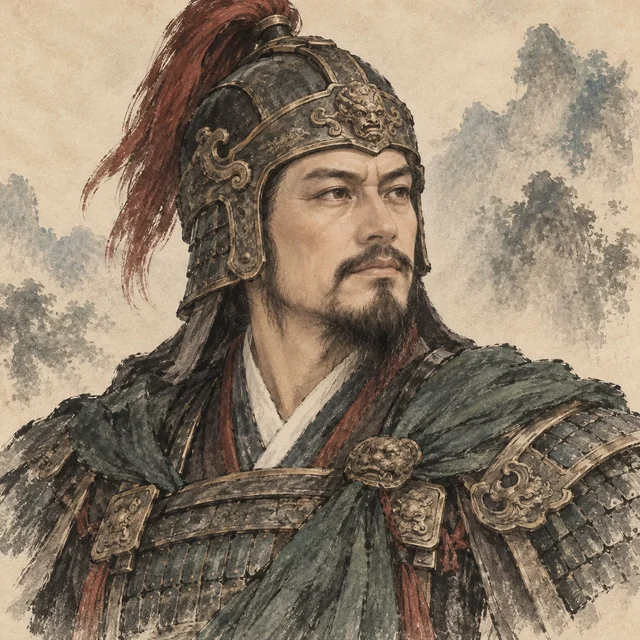
HISTORICAL PERSON
Zhu Ran
朱然
Adopted as Zhu Zhi’s heir and later a trusted commander under Sun Quan, Zhu Ran took part in Guan Yu’s capture and fought at Yiling and Jiangling.
This entry is supported by historical references, but does not yet have a conversation profile.
PRIMARY BIOGRAPHY
Biography
Zhu Ran (182–249), courtesy name Yifeng, was born Shi and adopted at thirteen by his uncle Zhu Zhi with Sun Ce’s blessing. Sun Quan made him a county prefect at nineteen, then Administrator of the new Linchuan commandery with two thousand men, with which he settled a bandit outbreak within weeks.
In 219 he and Pan Zhang cut off and captured Guan Yu at Linju. When Lü Meng lay dying, Sun Quan asked who could replace him; Meng answered: “Zhu Ran has more than enough nerve and steadfastness.” At Yiling in 222 Zhu Ran broke Liu Bei’s vanguard and cut his retreat.
His monument is the defense of Jiangling in 223: besieged for six months by Cao Zhen, Xiahou Shang, and Zhang He with Emperor Wen himself at Wan, his garrison reduced by sickness to five thousand fit men under earthen ramps, tunnels, and towers of arrows — Zhu Ran showed no fear, counterattacked and took two enemy camps, and uncovered and executed the prefect who plotted to open the gates. The siege was lifted; his name struck awe into the enemy state. He died in 249 at sixty-eight, and Sun Quan mourned in plain dress.
Life and role
- Primary role
- Senior Commander and Deputy Military Adviser
- Active period
- Documented coverage: Late Han and Eastern Wu (182–249)
- Primary group
- Jiangdong–Sun Wu
Affiliations across a lifetime
- 200–219
Wu — commandery posts
County prefect at nineteen; helped capture Guan Yu at Linju
- 219–249
Commander of Jiangling
Lü Meng’s named successor; hero of Yiling and the six-month defense of Jiangling
HISTORICAL RECORD
Historical sources
- Records of the Three Kingdoms · Wu, Book 11 · 朱治朱然吕范朱桓传 ↗
Chen Shou’s base text contains the biographies of Zhu Zhi (with his nephew Zhu Ran and Shi Ji attached under Zhu Ran), Lü Fan (with Lü Ju), and Zhu Huan (with Zhu Yi). The concluding evaluation is separate from the biographies.