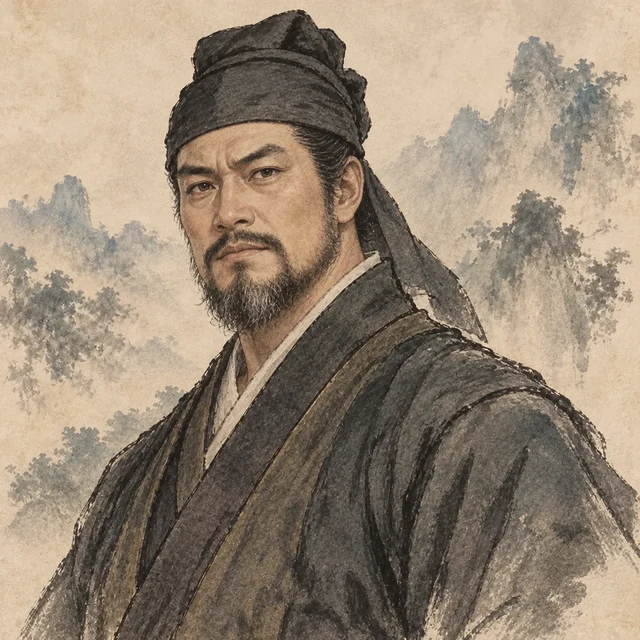
HISTORICAL PERSON
Zhuge Dan
诸葛诞
A senior Wei official and Huainan commander, Zhuge Dan rebelled against the Sima regency at Shouchun in 258 with support from Wu; he was killed when the city fell.
This entry is supported by historical references, but does not yet have a conversation profile.
PRIMARY BIOGRAPHY
Biography
Zhuge Dan, styled Gongxiu, came from Yangdu in Langye, a descendant of Zhuge Feng. From secretariat gentleman he served as magistrate of Xingyang, then entered as a gentleman of the appointment bureau. When men solicited him for posts he would publish the request while granting it, and afterward let public judgment of success or failure fix the praise or blame — so that no officer dared recommend carelessly. Rising to palace aide to the censorate and Master of Writing, he grew close to Xiahou Xuan and Deng Yang, gathering fame at court until the capital buzzed. The censors charged that Zhuge Dan, Deng Yang and their kind cultivated flash and traded in empty praise, a growth not to be encouraged; Emperor Ming, hating it, dismissed him. On the emperor’s death, early in the Zhengshi era, with Xiahou Xuan back in office, Zhuge Dan was restored, then sent out as inspector of Yang province with the rank of General of Illustrious Might.
When Wang Ling plotted in secret and the grand tutor Sima Yi stole east with his army, Zhuge Dan was made General who Guards the East with the credentials, commanding Yang province, and enfeoffed Marquis of Shanyang precinct. When Zhuge Ke raised the Dongguan works, Zhuge Dan was sent against him and fared badly; he was moved to General who Guards the South. Later, when Guanqiu Jian and Wen Qin rebelled and sent envoys to call out the soldiers and people of Yu province, Zhuge Dan cut down their envoy and posted the news of their treason through the realm. When the general-in-chief Sima Shi marched west, Zhuge Dan led the Yu province armies from the Anfeng crossing against Guanqiu Jian; Wen Qin was broken, Guanqiu Jian destroyed. Back at Shouchun, Zhuge Dan became General-in-Chief who Guards the East with the ceremonies of the three excellencies, commanding Yang province. Bound by affection to Xiahou Xuan and Deng Yang, and having watched Wang Ling and Guanqiu Jian exterminated one after another, he could not rest easy: he emptied his treasury in gifts to win hearts and richly kept several thousand of his intimates and the lightfoot gallants of Yang province as men sworn to die.
In the fifth month of 257 the court summoned him to be Minister of Works; receiving the edict, his fear deepened, and he rebelled. He assembled the generals, marched out himself and killed the Yang province inspector Yue Lin, gathered over a hundred thousand officers and soldier-colonists of Huainan and Huaibei and forty or fifty thousand newly submitted fighting men of Yang province, laid in grain for a year, closed the city, and sent his senior clerk Wu Gang with his young son Zhuge Jing to Wu to beg help. Wu rejoiced and sent the generals Quan Yi, Quan Duan, Tang Zi and Wang Zuo with thirty thousand men, coming secretly with Wen Qin to answer him. In the sixth month the general-in-chief Sima Zhao brought two hundred sixty thousand men of the central and outer armies to the Huai, and had Wang Ji and the general who calms the east Chen Qian encircle the city on four sides with double lines and steep ditches. In the first month of 258 Zhuge Dan, Wen Qin and Tang Zi built great assault engines and attacked the southern ring day and night for five or six days, trying to break out; the men on the ramparts from their height burned and smashed the engines with stone-throwers and fire-arrows, and bolts and stones fell like rain until dead and wounded covered the ground, and the assault fell back inside. As food ran out, tens of thousands came out to surrender. Wen Qin wanted to expel all the northerners to save grain and hold on with the Wu men; Zhuge Dan refused, they quarrelled in bitterness, and Zhuge Dan cut Wen Qin down with his own hand. Wen Qin’s sons Yang and Hu climbed the wall and surrendered to the general-in-chief, who pardoned them and sent them riding round the walls with a few hundred horsemen, crying, “Even Wen Qin’s sons are not killed — what have the rest of you to fear?”; the city rejoiced and wavered. In the second month the general-in-chief came to the ring in person, the assault went up on four sides with one great shout, and Zhuge Dan, desperate, rode alone with his guard out of a small gate, where the troops of the general-in-chief’s major Hu Fen met him and cut him down. His head was sent round and his clan exterminated to the third degree. The several hundred men of his guard, refusing to surrender, were executed one by one, each saying, “To die for Lord Zhuge — no regret.” Such was the love he won.
Life and role
- Primary role
- Senior General Who Conquers the East
- Active period
- Documented coverage: Cao Wei (c. 220–258)
- Primary group
- Cao-Wei
Affiliations across a lifetime
- Taihe–Zhengshi
The flash-and-fame case
Dismissed by Emperor Ming for cultivated fame with Xiahou Xuan’s circle; restored under Zhengshi
- 251–255
General-in-Chief who Guards the East
Cut down the rebels’ envoys and fought the second rising; back at Shouchun he kept thousands of sworn men
- 257–258
The third Huainan rising
Rose when summoned as Minister of Works, killed Yue Lin, drew Wu’s aid; slew Wen Qin in the siege, was cut down — his hundreds of guards died unbowed
HISTORICAL RECORD
Historical sources
- Records of the Three Kingdoms · Wei, Book 17 · Biographies of Zhang Liao, Le Jin, Yu Jin, Zhang He, and Xu Huang ↗
Chen Shou’s base text: biographies of Zhang Liao, Le Jin, Yu Jin, Zhang He, and Xu Huang, plus the attached account of Zhu Ling. Pei Songzhi’s annotations are registered separately.
- Records of the Three Kingdoms · Wei, Book 28 · 王毌丘诸葛邓锺传 ↗
Chen Shou’s base text contains the biographies of Wang Ling, Guanqiu Jian (with Wen Qin), Zhuge Dan (with Tang Zi), Deng Ai (with Zhou Tai), and Zhong Hui (with Wang Bi). Zhong Hui’s biography also records Jiang Wei’s final actions after Shu fell. Pei Songzhi’s annotations on the page should be identified separately.