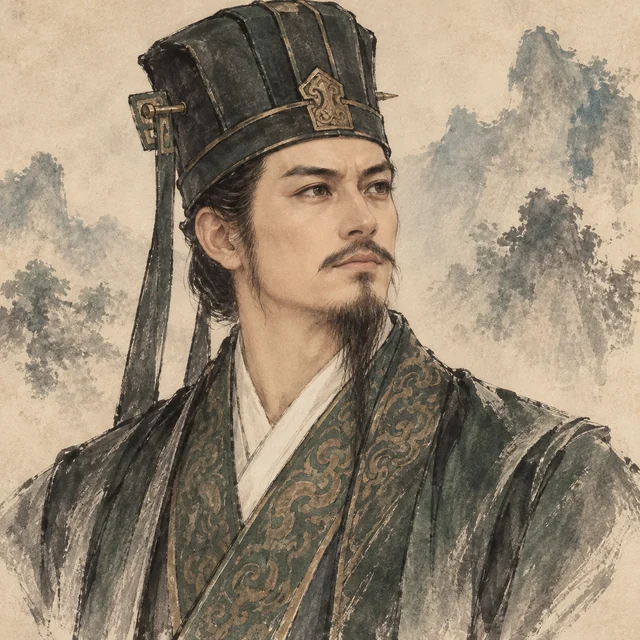
HISTORICAL PERSON
Zhuge Ke
诸葛恪
The son of Zhuge Jin, Zhuge Ke became regent after Sun Quan’s death and defeated Wei at Dongxing; he was later killed after an unsuccessful siege of Hefei New City.
This entry is supported by historical references, but does not yet have a conversation profile.
PRIMARY BIOGRAPHY
Biography
Zhuge Ke (203–253), courtesy name Yuanxun, was Zhuge Jin’s son and Zhuge Liang’s nephew, famed from youth for quick wit. When Sun Quan labeled a long-faced donkey “Zhuge Ziyu” at a banquet to mock his father’s long face, the boy knelt, asked for the brush, and added two characters — “’s donkey” — and the hall erupted; Sun Quan gave him the donkey.
He volunteered to pacify the Shanyue of Danyang and raised forty thousand soldiers where skeptics said none could be found. When Sun Quan died in 252, Zhuge Ke became regent for the boy emperor Sun Liang. That winter he crushed Sima Zhao’s eastern column at Dongxing — Ding Feng’s vanguard charging half-armored through the snow — and reached the height of his fame.
Made overconfident, he launched a grand invasion in 253 and bogged down before Hefei’s New City; disease and dead soldiers forced a humiliating retreat. Back home he grew more imperious, purging the palace guard. The palace official Sun Jun and the emperor set an ambush at a banquet and cut him down, with his three kin groups exterminated. Chen Shou praised his talent but asked: “boastful and overbearing — how could he not fall?”
Life and role
- Primary role
- Grand Tutor and Senior General
- Active period
- Documented coverage: Eastern Wu (203–253)
- Primary group
- Jiangdong–Sun Wu
Affiliations across a lifetime
- 222–252
Sun Wu
Palace attendant to the heir; pacified the Shanyue of Danyang, raising 40,000 troops
- 252–253
Regent (Grand Tutor)
Regent for Sun Liang; victor of Dongxing, then defeated at New City and murdered by Sun Jun
HISTORICAL RECORD
Historical sources
- Records of the Three Kingdoms · Wu, Book 19 · 诸葛滕二孙濮阳传 ↗
Chen Shou’s base text contains the biographies of Zhuge Ke (with Nie You attached), Teng Yin, Sun Jun (with Liu Zan attached), Sun Chen, and Puyang Xing. The concluding evaluation is separate from the biographies.