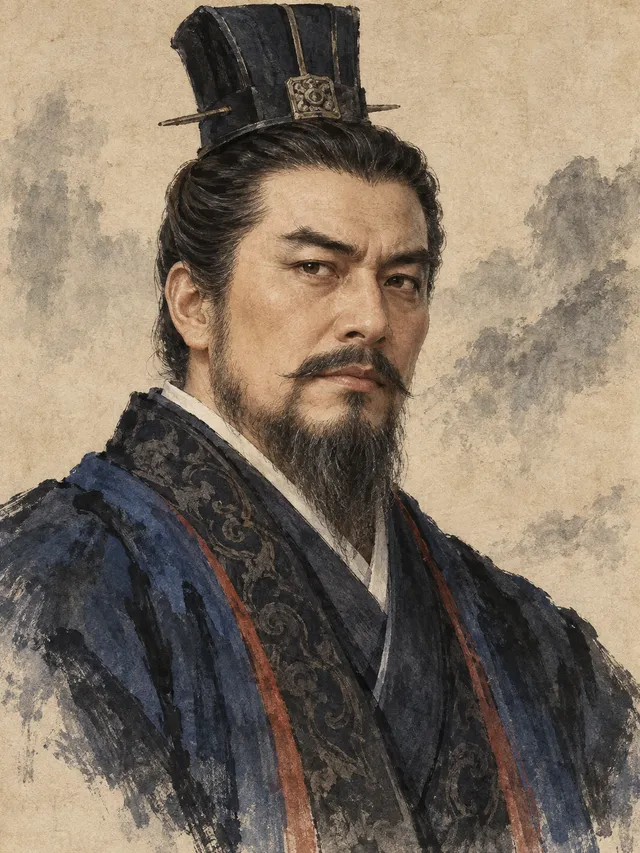
HISTORICAL PERSON
Cao Cao
曹操
A late Han commander and statesman who built the northern power base later inherited by Wei.
Start a conversation with Cao Cao →PRIMARY BIOGRAPHY
Biography
Cao Cao, courtesy name Mengde, was from Qiao in Pei, a descendant of the Han chancellor Cao Shen. His adoptive grandfather Cao Teng had been a regular palace attendant; his father Cao Song reached grand commandant, and the records cannot settle Cao Song’s birth. As a youth Cao Cao was alert and full of shifts, but a knight-errant who did not tend his estate, so the age did not mark him — only Qiao Xuan and He Yong did. Qiao Xuan told him the realm would fall into disorder, and that only a man of the age could steady it. At twenty he was recommended as filial and incorrupt, made commandant of the northern part of Luoyang, then magistrate of Dunqiu, then a gentleman consultant.
At the Yellow Turban rising he became a cavalry commandant, then chancellor of Jinan, where he dismissed eight corrupt magistrates and banned excessive cults. He was later colonel of the army of the centre. After Emperor Ling’s death He Jin called Dong Zhuo against the eunuchs and died before Dong Zhuo arrived. Dong Zhuo deposed the young emperor. Cao Cao raised troops from his own fortune in Chenliu. In 190 the eastern lords rose and named Yuan Shao their leader; Cao Cao served as general of manifest might.
At Xingyang on the Bian he met Xu Rong, was wounded by a stray arrow, and escaped on Cao Hong’s horse. As governor of Yan he later received Emperor Xian at Xu. In 200 at Guandu he held Yuan Shao, then by night, with five thousand men under Yuan banners and faggots in their arms, burned Chunyu Qiong’s depot at Wuchao; Yuan Shao’s host collapsed.
In 204 he took Ye from Yuan Shang. In 207 Zhang Liao led the van against the Wuhuan and Tadun was killed. In 208 the southern campaign ended in defeat at Red Cliffs against Liu Bei and Sun Quan. In 211 he broke Ma Chao and Han Sui at Tong Pass. In 213 the Han court made him Duke of Wei with the Nine Bestowments; in 216, King of Wei. He died at Luoyang in the first month of 220, aged sixty-six, and was first given the posthumous title King Wu. After Cao Pi established Wei, Cao Cao was honored as Emperor Wu. Cao Cao did not live to see the Han replaced.
Life and role
- Primary role
- Chancellor of Han
- Active period
- Documented coverage: 155–184 to 220
- Primary group
- Cao-Wei
Affiliations across a lifetime
- 175–196
From Luoyang commandant to Yan
Entered Han office by recommendation; after Xingyang, made Yan his base
- 196–220
Chancellor of Han, King of Wei
Received the court at Xu; won Guandu, lost Red Cliffs; died King of Wei at Luoyang
HISTORICAL RECORD
Historical sources
- Records of the Three Kingdoms · Wei, Book 1 · Annals of Emperor Wu ↗
Chen Shou’s base text in the Annals of Emperor Wu (Wei, Book 1) follows Cao Cao from his origins through his death. Pei Songzhi’s inserted citations are annotations and should be distinguished from the base text.