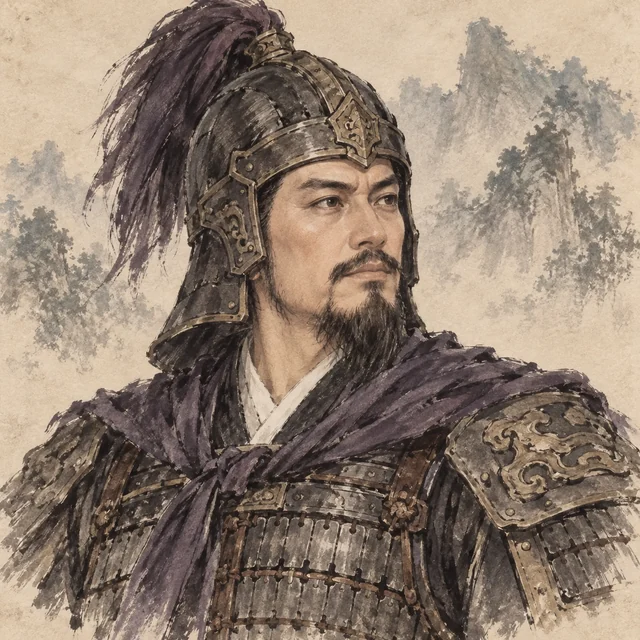
HISTORICAL PERSON
Zhang He
张郃
Zhang He first served Han Fu and Yuan Shao, then joined Cao Cao and became a leading commander in campaigns in the north, Hanzhong, and against Shu; he was killed during the campaign at Mumen.
This entry is supported by historical references, but does not yet have a conversation profile.
PRIMARY BIOGRAPHY
Biography
Zhang He (d. 231), courtesy name Junyi, came from Mao county in Hejian. He answered the levy when the Yellow Turbans rose, serving as a major under the Ji province governor Han Fu. When Han Fu fell in 191, Zhang He brought the provincial army over to Yuan Shao, who made him a colonel against Gongsun Zan; his victories over Gongsun Zan carried him up to General of the Household Who Brings Peace to the State, one of Yuan Shao’s famous commanders.
At Guandu in 200, Yuan Shao sent Chunyu Qiong with the grain train to Wuchao, and Cao Cao struck it in person. Zhang He urged Yuan Shao to relieve Wuchao at once — Cao Cao’s troops were picked men, Chunyu Qiong would break, and with him the whole cause; Guo Tu argued instead for attacking Cao Cao’s camp to force his return. Yuan Shao took Guo Tu’s advice, Wuchao fell, and Guo Tu covered himself by slandering Zhang He. Fearing for his life, Zhang He burned his siege engines with Gao Lan and surrendered to Cao Cao, who welcomed him in person as a Wei Zi leaving doomed Yin or a Han Xin coming over to Han, and made him Lieutenant General with the fief of a precinct marquis.
Thereafter Zhang He fought in nearly every campaign: the storming of Ye, the defeat of Yuan Tan at Bohai, the storming of Yongnu; the Liucheng campaign against the Wuhuan, where he and Zhang Liao led the van; Weinan against Ma Chao and Han Sui; the siege of Anding that won Yang Qiu’s surrender; and under Xiahou Yuan against Liang Xing, the Di of Wudu, and Song Jian of Fuhan. In 215 he opened the road to Hanzhong at the head of five thousand infantry against Zhang Lu. Left in Hanzhong after the conquest, he marched into Badong and Baxi to move their populations north; at Dangqu Zhang Fei held him fifty days, then took a side path through the narrow gorges, cut the column in two, and routed it — Zhang He escaped over the mountains on foot with a dozen men.
At Mount Dingjun in 219, when Xiahou Yuan was killed and the army reeled leaderless, the supervisor Du Xi and the major Guo Huai rallied the broken units and put Zhang He forward as acting commander: "General Zhang is a famous captain of the state," Guo Huai told the troops, "the one man Liu Bei fears." Zhang He dressed the ranks and re-set the camps, the other generals accepted his orders, and the army steadied. Under Cao Pi he rose to General of the Left and Marquis of Mao.
In 228 Zhuge Liang came out at Qishan and three commanderies rose for him, shaking the west. Emperor Ming came to Chang’an in person and sent Zhang He west with overall command. At Jieting he met Shu’s vanguard under Ma Su, who had abandoned the walled town to camp on the southern heights and left his water unguarded; Zhang He cut the water line and attacked, smashing Ma Su, then retook the three revolted commanderies. Zhuge Liang’s first northern expedition was over, and Zhang He was promoted General of Chariots and Cavalry who Conquers the West.
In 231 Zhuge Liang besieged Qishan again, and Zhang He opposed him at Lueyang. When Zhuge Liang retreated for want of grain, Sima Yi ordered Zhang He to pursue. Zhang He protested: by the laws of war you do not pursue a retreating army. Sima Yi insisted. At Mumen pass the Shu crossbows fired from the heights, a bolt struck Zhang He in the right knee, and he died of the wound, receiving the posthumous title Robust Marquis. A warrior who loved classical learning — he once recommended a scholarly townsman to the throne and was compared by imperial edict to the Han general Zhai Zun — Zhang He was above all a master of terrain and surprise, the Wei general Zhuge Liang feared most.
Life and role
- Primary role
- Wei commander
- Active period
- Late Han and Cao Wei (190s–240s)
- Primary group
- Cao-Wei
Affiliations across a lifetime
- Before 200
Han Fu, then Yuan Shao
Rose from a Yellow Turban levy to a named general of Yuan Shao through victories over Gongsun Zan.
- 200–215
Cao Cao’s campaigning general
Welcomed at Guandu as a second Han Xin; fought at Ye, Liucheng, Weinan, and in Longyou.
- 215–220
Hanzhong corps · defeat at Dangqu, rally after Dingjun
Beaten by Zhang Fei at Dangqu; after Xiahou Yuan’s death he steadied the army as acting commander.
- 220–231
Western front against Zhuge Liang
Broke Ma Su at Jieting and retook three commanderies; killed by a crossbow bolt at Mumen in 231 while pursuing on Sima Yi’s order.
HISTORICAL RECORD
Historical sources
- Records of the Three Kingdoms · Wei, Book 17 · Biographies of Zhang Liao, Le Jin, Yu Jin, Zhang He, and Xu Huang ↗
Chen Shou’s base text: biographies of Zhang Liao, Le Jin, Yu Jin, Zhang He, and Xu Huang, plus the attached account of Zhu Ling. Pei Songzhi’s annotations are registered separately.
- Records of the Three Kingdoms, with Pei Songzhi annotations · Pei Songzhi annotations to Wei, Book 17 ↗
Annotations to Wei Book 17, including extracts from Fu Zi, Sun Sheng, Wei Shu, Han Jin Chunqiu, Wei Lue, and Jiuzhou Chunqiu. These accounts and Pei’s judgments are kept distinct from Chen Shou’s base text.
- Records of the Three Kingdoms · Shu, Book 5 · Biography of Zhuge Liang (with Zhuge Qiao and Zhuge Zhan appended) ↗
Zhuge Zhan’s career and death at Mianzhu are appended to his father’s biography.