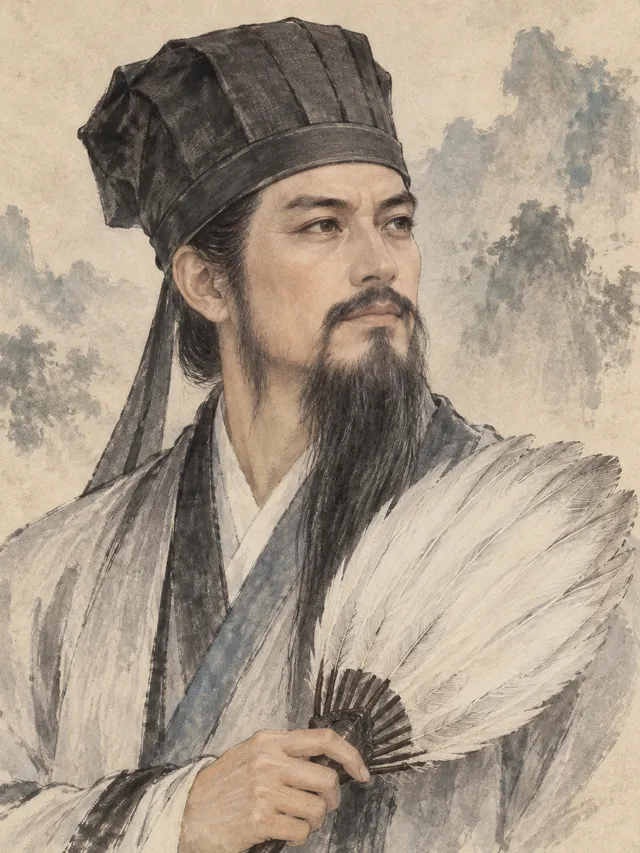
HISTORICAL PERSON
Zhuge Liang
诸葛亮
Shu Han’s chancellor, remembered for statecraft and repeated northern campaigns.
Start a conversation with Zhuge Liang →PRIMARY BIOGRAPHY
Biography
Zhuge Liang (181–234), courtesy name Kongming, was from Yangdu in Langye, a descendant of the Han colonel Zhuge Feng. Orphaned young, he followed his uncle Zhuge Xuan to Jing province and, after Xuan’s death, farmed in the countryside and recited the Liangfu ballad. Eight chi tall, he compared himself to Guan Zhong and Yue Yi; only Cui Zhouping and Xu Shu treated the claim as true.
When Liu Bei was at Xinye, Xu Shu told him: “Zhuge Kongming is the Sleeping Dragon — will you see him?” Liu Bei asked that Xu Shu bring him; Xu Shu answered that this man could be visited, not summoned. Liu Bei therefore went to Zhuge Liang, and only on the third visit was he received. Behind closed doors Zhuge Liang set out the plan later called the Longzhong counsel: hold Jing and Yi, settle the western Rong and southern Yue, ally with Sun Quan, and put the government in order. Liu Bei said, “Good,” and grew close to him. Guan Yu and Zhang Fei were displeased until Liu Bei told them: “Having Kongming, I am as a fish with water.” A Wei Lüe passage quoted by Pei Songzhi has Zhuge Liang calling on Liu Bei first; Pei, citing the Chu Shi Biao’s “you thrice visited me in my thatched hut,” follows the main biography, and the contradiction is kept in view.
In 208 he was sent to Wu and argued Sun Quan into a joint stand, which became the Red Cliffs campaign. After Liu Bei took the Jiangnan commanderies, Zhuge Liang as army adviser-colonel levied their taxes. When Chengdu fell in 214 he became army adviser-general; when Liu Bei was in the field he held Chengdu and kept it fed and armed. In 221 Liu Bei, now emperor, made him chancellor. At Yong’an in 223 the dying Liu Bei charged him with the heir, saying his talent was ten times Cao Pi’s, and that if the son proved unfit he might take the state himself. Zhuge Liang wept and pledged his life. Liu Bei also told Liu Shan to serve the chancellor as a father.
In 223 he was enfeoffed Marquis of Wuxiang, opened a secretariat, and took the governorship of Yi. After the mourning he made peace with Wu, then in 225 pacified Nanzhong, whose resources enriched the state. In 227 he moved north to Hanzhong and submitted the memorial known as the Chu Shi Biao. In 228 he feinted through the Xie valley while he himself struck Qishan; Nan’an, Tianshui, and Anding answered him. Ma Su disobeyed orders and was broken by Zhang He at Jieting; Zhuge Liang withdrew, executed Ma Su, and asked to be demoted. He campaigned again from the Scattered Pass, Chencang, Jianwei, and Qishan. In 234 he came out through the Xie valley, took Wuzhangyuan on the Wei, and faced Sima Yi. That eighth month he died in camp, aged fifty-four. When the army had gone, Sima Yi walked the empty earthworks and said, “A rare talent under heaven.”
Life and role
- Primary role
- Chancellor of Shu Han
- Active period
- Documented coverage: 181–early adulthood to 228–234
- Primary group
- Shu-Han
Affiliations across a lifetime
- 207–221
Army adviser to Liu Bei
Longzhong counsel; the Wu embassy; held Chengdu while Liu Bei campaigned
- 221–234
Chancellor of Shu Han
Received the Yong’an charge; southern and northern campaigns; died at Wuzhangyuan
HISTORICAL RECORD
Historical sources
- Records of the Three Kingdoms · Shu, Book 5 · Biography of Zhuge Liang ↗
The biography of Zhuge Liang (Shu, Book 5) records the Longzhong counsel, service under Liu Bei, regency, southern campaign, northern expeditions, and death in 234. A Pei Songzhi note preserves a conflicting account of who first visited Liu Bei and should be cited separately.